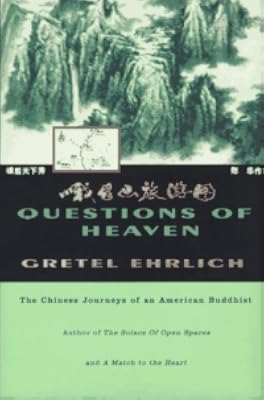
Questions of Heaven: The Chinese Journeys of an American Buddhist (Concord Library)
by Gretel Ehrlich
On This Page
Description
Gretel Ehrlich's path leads her to Sichuan and Yunnan Provinces in western China to climb Emei Shan, one of China's four sacred Buddhist mountains. For Ehrlich, a practicing Buddhist, the climb is both a spiritual pilgrimage and a troubling encounter with a culture reeling from recent political history. Ehrlich visits Buddhist lamas who, until recently, were in hiding from the purges of the Cultural Revolution, and she travels to a panda refuge in the mountains northwest of Chengdu - in both show more cases trying to unravel the ultimate fate of these once-revered symbols. "All roads to paradise first pass through purgatory." In perhaps the most hair-raising car-trip narrative in recent travel literature, Ehrlich writes of her journey from the southwestern city of Kunming over the Burma Road and on to Lijiang - an isolated mountain town which does in the end fulfill Ehrlich's hopes for cultural and spiritual revival, and where she learns from an unlikely group of Naxi sacred musicians that "music is medicine" and that profound healing requires profound faith. show lessTags
Recommendations






























Member Reviews
Judging by the subtitle The Chinese Journeys of an American Buddhist, Ehrlich's book purports to be a Buddhist adherent's travelogue to the nation's sacred mountains and monasteries. Unfortunately, Buddhism, and indeed, China are in short supply in this particular book.
Ehrlich makes a few vague references to studying with Tibetan monks, although these are so vague one wonders whether she is a serious student of any particular school of Buddhism or the prototypical "American Buddhist" who's read a few introductory books and thinks she has the philosophy down without needing to actively practice it. Her prose certainly doesn't leave one with the impression that she realizes there are distinctions between Chan and Tibetan Buddhism.
Also show more judging by her prose, she doesn't realize quite a few other things as well. It's clear by the book's indiscriminate mishmash of transliterations that Ehrlich doesn't speak Chinese, and from her accounts of her experiences and translator-facilitated conversations, that this has seriously impeded her ability to grasp what is occurring around her. Worse still, she spends a great deal of time complaining about the hardships of travel and lack of modern amenities, but then spends the rest of the time complaining that China's modernization has ruined it. Indeed, this is one of the book's main flaws, as Ehrlich throws repeated low-level tantrums every time she (re)discovers that the country has not obliged her by freezing itself in time during its golden age in the Tang Dynasty. Or perhaps Ehrlich's thinking of the Song, or Ming, or Qing Dynasty; in fact, it feels as though she was expecting the China of Crouching Tiger, Hidden Dragon instead of the historical China of any age. To get an idea of how ridiculous this is, imagine how you'd react to a Chinese tourist in Boston complaining that America is ruined--ruined!--because he has yet to see anyone wearing a tri-cornered hat, spinning wool or traveling somewhere by covered wagon.
The book's most worthy passages come towards the end, when Ehrlich travels to Greater Tibet and falls with a group of some traditional musicians, although once again, she doesn't seem to realize that there's a difference between the traditional Confucian music the musicians play and the area's traditional non-Han folk music (think of this as listening to a symphony in Belfast and thus assuming it's "the music of the ancient Celts"). Nevertheless, her accounts of the musicians' experiences during the Great Leap Forward and Cultural Revolution make for compelling reading; it's too bad the rest of the book is such a muck-up. This one is definitely worth skipping unless it's in your public library's collection and you've nothing better waiting to be read. show less
Ehrlich makes a few vague references to studying with Tibetan monks, although these are so vague one wonders whether she is a serious student of any particular school of Buddhism or the prototypical "American Buddhist" who's read a few introductory books and thinks she has the philosophy down without needing to actively practice it. Her prose certainly doesn't leave one with the impression that she realizes there are distinctions between Chan and Tibetan Buddhism.
Also show more judging by her prose, she doesn't realize quite a few other things as well. It's clear by the book's indiscriminate mishmash of transliterations that Ehrlich doesn't speak Chinese, and from her accounts of her experiences and translator-facilitated conversations, that this has seriously impeded her ability to grasp what is occurring around her. Worse still, she spends a great deal of time complaining about the hardships of travel and lack of modern amenities, but then spends the rest of the time complaining that China's modernization has ruined it. Indeed, this is one of the book's main flaws, as Ehrlich throws repeated low-level tantrums every time she (re)discovers that the country has not obliged her by freezing itself in time during its golden age in the Tang Dynasty. Or perhaps Ehrlich's thinking of the Song, or Ming, or Qing Dynasty; in fact, it feels as though she was expecting the China of Crouching Tiger, Hidden Dragon instead of the historical China of any age. To get an idea of how ridiculous this is, imagine how you'd react to a Chinese tourist in Boston complaining that America is ruined--ruined!--because he has yet to see anyone wearing a tri-cornered hat, spinning wool or traveling somewhere by covered wagon.
The book's most worthy passages come towards the end, when Ehrlich travels to Greater Tibet and falls with a group of some traditional musicians, although once again, she doesn't seem to realize that there's a difference between the traditional Confucian music the musicians play and the area's traditional non-Han folk music (think of this as listening to a symphony in Belfast and thus assuming it's "the music of the ancient Celts"). Nevertheless, her accounts of the musicians' experiences during the Great Leap Forward and Cultural Revolution make for compelling reading; it's too bad the rest of the book is such a muck-up. This one is definitely worth skipping unless it's in your public library's collection and you've nothing better waiting to be read. show less
Although this book was originally recommended when I took a masters-level "Literature of Travel" course, this unique piece of literature has been calling out to me for quite some time. I'm glad I finally took time out to read it.
On one level, this is a book about the spiritual journey of an American Buddhist as she climbs the metaphorically important mountains of China. On another level, this book painted an important sociological and historical portrait of China in the aftermath of Mao's Cultural Revolution/Great Leap Forward. The stories relayed by Xuan Ke, about how the intellectuals were tricked into critiquing the government and subsequently tortured and/or killed is truly the stuff of nightmares. Yet, Xuan Ke understood the show more importance of honestly understanding the past and he uses his rotten teeth as a symbol for such remembrance. "My wife keeps asking me to get my teeth fixed. They are all bad since being in prison. But they are like the Great Wall; the history of my life and therefore the history of the Chinese people shows in them, so they will stay like this" The book ends with Xuan Ke wiggling his darkened teeth and saying "Remember these." (Ehrlich, 121)
I feel that Ms. Ehrlich is an American sincerely trying to understand a totally foreign culture while demonstrating a true empathy for the suffering, both in the past and in the present, experienced by the Chinese people. Her prose is both poetic and informative at the same time and I am looking forward to reading her other work. show less
On one level, this is a book about the spiritual journey of an American Buddhist as she climbs the metaphorically important mountains of China. On another level, this book painted an important sociological and historical portrait of China in the aftermath of Mao's Cultural Revolution/Great Leap Forward. The stories relayed by Xuan Ke, about how the intellectuals were tricked into critiquing the government and subsequently tortured and/or killed is truly the stuff of nightmares. Yet, Xuan Ke understood the show more importance of honestly understanding the past and he uses his rotten teeth as a symbol for such remembrance. "My wife keeps asking me to get my teeth fixed. They are all bad since being in prison. But they are like the Great Wall; the history of my life and therefore the history of the Chinese people shows in them, so they will stay like this" The book ends with Xuan Ke wiggling his darkened teeth and saying "Remember these." (Ehrlich, 121)
I feel that Ms. Ehrlich is an American sincerely trying to understand a totally foreign culture while demonstrating a true empathy for the suffering, both in the past and in the present, experienced by the Chinese people. Her prose is both poetic and informative at the same time and I am looking forward to reading her other work. show less
Small collection of essays about a mountain climbing pilgrimage to China in the mid-90s. Ehrlich finds it a depressing place - until she gets to Lijiang and meets musicians who are trying to preserve some of the heritage that has been shattered by the Cultural Revolution.
Ratings
Members
- Recently Added By
Author Information

35+ Works 2,822 Members
Gretel Ehrlich is the author of "A Match to the Heart" among other works of nonfiction, fiction & poetry. She divides her time between California & Wyoming. (Bowker Author Biography)
Common Knowledge
- Important places
- Sichuan, China; Yunnan, China
Classifications
- Genres
- Fiction and Literature, Travel, Biography & Memoir
- DDC/MDS
- 818.5403 — Literature & rhetoric American literature in English American miscellaneous writings in English 20th Century 1945-1999 Diaries
- LCC
- PS3555 .H72 .A3 — Language and Literature American literature American literature Individual authors 1961-
- BISAC
Statistics
- Members
- 90
- Popularity
- 357,582
- Reviews
- 3
- Rating
- (3.75)
- Languages
- English
- Media
- Paper, Ebook
- ISBNs
- 3
- UPCs
- 1