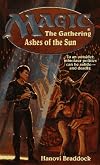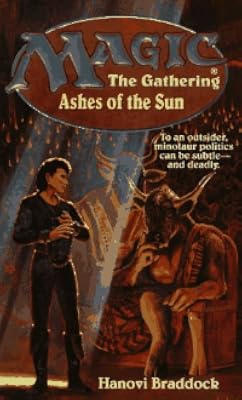
Ashes of the Sun
by Hanovi Braddock
Magic: The Gathering (1.07), Magic: The Gathering Original Series (7)
On This Page
Description
Hanovi Braddock Ayesh knows that danger lurks in the Miritiin Mountains, and danger is just what she wants. With her beloved cities of Neah turned to dust and rubble in the goblin wars, with even their memory fading to legend, what reason does she have to go on living? She's ready to die--as long as she goes down killing goblins. But the Miritiin minotaurs have plans for Ayesh, plans that don't include her death--yet. And as Ayesh becomes entangled in the inticate web of Miritiin poitics, show more she realizes that allies can be even deadlier than enemies. show lessTags
Recommendations


Member Reviews
I always hesitate to re-read a book I loved as a kid, out of fear that it won't stand up to an adult's consumption and retroactively diminish my childhood enjoyment. But I remembered a few odd things about the book and wanted to re-visit it.
I still love it. This is, hands down, the best Magic novel. It isn't as blatantly Magic as, say, Arena is. (Not that Arena is bad, it is also the best Magic novel in its own way.) There's maybe one paragraph that references specific cards explicitly (aside from Hurloon minotaur).
A bit of the plot:Ayesh is the last survivor of a country/culture that was destroyed by goblin hordes. Upon realizing that despite her best efforts, time will distort the knowledge of her people, she goes from depressed to show more suicidal, and goes off into the countryside to die fighting goblins. Instead, she is captured by minotaurs to be used in a scientific and political battle. Conservative minotaurs wish to follow a strict literal interpretation of their scripture and continue warring with the goblins. Liberal minotaurs wish to try to essentially Uplift the goblins to the point where war is no longer inevitable (and thus, violate scripture that pronounces goblins as vermin and infidels). Ayesh's part in this is to help the uplift process by training the goblins in the ways of her people, a mix of meditation and martial arts.
The characterization is solid. There's very few characters I'd peg as having little depth - of the 10 goblins, only 2-4 are really fleshed out, and one minotaur,Betalem is decidedly one-note. Ayesh is fantastic, beginning the novel as a self-hating, nationalistic, obsessed individual with a (at least understandable) hatred of goblins. Her arc is realistic and satisfying, without being some cheesy and unbelievable 180 change in all things. The goblins that are developed have satisfying arcs as well, though not all are necessarily happy. There's a special type of horror to some of them, like Kler's execution, which takes place when she is rational, for a crime that she committed while irrational and essentially a different person.
The action in the novel is well-written, easy to follow, with emotional impact. The temptation with fantasy action, especially fantasy action with martial arts, is to name every single move as if giving it a name like Break Lion or Thousand Leaves makes it understandable, cool, or believable. Instead, we are given actual movements. Its refreshing.
The minotaur culture is well-done, though I would have liked to see it a bit more fleshed out. There's plenty of thoughtful details that emphasize the author actually thought about the physiology of the creatures in a way few fantasy writers seem to do- no, they wouldn't use traditional human-style chairs with that sort of knee articulation. The cast/country does seem a bit sparse - we are given that this is an entire country living in the mountains, but rarely see more than a dozen named characters. This is explained away as the labyrinth is dark (minotaurs require much less light to see than humans) and minotaurs are largely secretive, tucking themselves away in the tunnel equivalent of alleys and backways and peering through secret peepholes.
I can't review the book without noting the mindfulness theme within it. Ayesh could have been a great ACT therapist. The lessons she gives the goblins could have been ripped right from the ACT textbook I'm reading. Goblin mind, diamond mind? Sounds like self-as-content and self-as-context, and the mind labeling exercises. She alludes to the leaves on the stream exercise for clearing thoughts, of the exercise in which a pain or other aversive experience is imagined as a separate physical object, at mindfulness of one's present moment, starting with the sensations from sitting in the chair, at breathing, at acting appropriately towards one's values despite feeling 'negative' emotions. It was so neat to discover this new connection from a childhood love to an adult love.
If you are only going to read one Magic novel, let this be the one. show less
I still love it. This is, hands down, the best Magic novel. It isn't as blatantly Magic as, say, Arena is. (Not that Arena is bad, it is also the best Magic novel in its own way.) There's maybe one paragraph that references specific cards explicitly (aside from Hurloon minotaur).
A bit of the plot:
The characterization is solid. There's very few characters I'd peg as having little depth - of the 10 goblins, only 2-4 are really fleshed out, and one minotaur,
The action in the novel is well-written, easy to follow, with emotional impact. The temptation with fantasy action, especially fantasy action with martial arts, is to name every single move as if giving it a name like Break Lion or Thousand Leaves makes it understandable, cool, or believable. Instead, we are given actual movements. Its refreshing.
The minotaur culture is well-done, though I would have liked to see it a bit more fleshed out. There's plenty of thoughtful details that emphasize the author actually thought about the physiology of the creatures in a way few fantasy writers seem to do- no, they wouldn't use traditional human-style chairs with that sort of knee articulation. The cast/country does seem a bit sparse - we are given that this is an entire country living in the mountains, but rarely see more than a dozen named characters. This is explained away as the labyrinth is dark (minotaurs require much less light to see than humans) and minotaurs are largely secretive, tucking themselves away in the tunnel equivalent of alleys and backways and peering through secret peepholes.
I can't review the book without noting the mindfulness theme within it. Ayesh could have been a great ACT therapist. The lessons she gives the goblins could have been ripped right from the ACT textbook I'm reading. Goblin mind, diamond mind? Sounds like self-as-content and self-as-context, and the mind labeling exercises. She alludes to the leaves on the stream exercise for clearing thoughts, of the exercise in which a pain or other aversive experience is imagined as a separate physical object, at mindfulness of one's present moment, starting with the sensations from sitting in the chair, at breathing, at acting appropriately towards one's values despite feeling 'negative' emotions. It was so neat to discover this new connection from a childhood love to an adult love.
If you are only going to read one Magic novel, let this be the one. show less
This was an interesting tale, but not what I expected from the book. The characters felt decent enough but still stiff. With the way the story is written, it's difficult to even give a synopsis without revealing too many details of the story. Had I not played the game the book is based on, I'd have been lost.
Ratings
Members
- Recently Added By
Lists

Religion in Fantasy and Horror
38 works; 9 members
1990s
309 works; 17 members

Books Read in 2003
257 works; 7 members

Slice of life speculative fiction
18 works; 2 members
Author Information

48+ Works 341 Members
Series


Common Knowledge
Classifications
Statistics
- Members
- 112
- Popularity
- 292,905
- Reviews
- 3
- Rating
- (3.72)
- Languages
- English, German
- Media
- Paper
- ISBNs
- 2