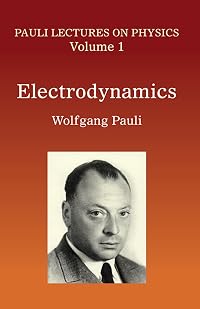
Electrodynamics: Volume 1 of Pauli Lectures on Physics (Dover Books on Physics)
by Wolfgang Pauli
Pauli Lectures on Physics (1)
On This Page
Description
These lectures covering topics basic to classical and modern physics were given by Pauli at the Zurich Federal Institute, where they were transcribed by his collaborators. They have now been translated and edited for English publication, and are introduced by Victor Weisskopf, who writes as follows: "It is often said that scientific texts quickly become obsolete. Why are the Pauli lectures brought to the public today, when some of them were given as long as twenty years ago? The reason is show more simple: Pauli's way of presenting physics is never out of date. His famous article on the foundations of quantum mechanics appeared in 1933 in the German encyclopedia Handbuch der Physik.Twenty-five years later it reappeared practically unchanged in a new edition, whereas most other contributions to this encyclopedia had to be completely rewritten. The reason for this remarkable fact lies in Pauli's style, which is commensurate to the greatness of its subject in its clarity and impact. Style in scientific writing is a quality that today is on the point of vanishing. The pressure of fast publication is so great that people rush into print with hurriedly written papers and books that show little concern for careful formulation of ideas. Mathematical and instrumental techniques have become complicated and difficult today; they demand so much skill and training that most of the effort of writing and learning is devoted to the acquisition of this skill instead of insight into important concepts. Essential ideas of physics are often lost in the dense forest of mathematical reasoning. This situation need not be so. Pauli's lectures show how physical ideas can be presented clearly and in good mathematical form, without being hidden in formalistic expertise." show lessTags
Recommendations




Members
- Recently Added By
Author Information

41 Works 545 Members
Born in Switzerland, Wolfgang Pauli was the son of a professor of physical chemistry at the University of Vienna and godson of Ernst Mach. He was a child prodigy, writing an outstanding paper on the theory of relativity at age 19, and receiving his Ph.D. from the University of Munich in 1922. After further study with Niels Bohr and Max Born, Pauli show more taught at the Federal Institute of Technology in Zurich, where he remained until his death in 1958. His discovery of the exclusion principle enabled Pauli to explain the structure of the periodic table of elements, formulate fundamental theories of electrical conductivity in metal, and investigate magnetic properties of matter. For this discovery, Pauli received the Nobel Prize in 1945. Pauli's second great accomplishment was resolving the "problem" of beta decay. In 1930 he addressed this question of the "missing energy" of electrons by suggesting that an emitted electron was accompanied by a neutral particle carrying an excess of energy. Pauli's intellectual ability was not matched by his manual dexterity; his colleagues laughed at the so-called Pauli effect, whereby accidents seemed to happen whenever he worked in the laboratory. (Bowker Author Biography) show less
Some Editions
Series

Belongs to Publisher Series
Common Knowledge
- Canonical title*
- Electrodynamics
*Some information comes from Common Knowledge in other languages. Click "Edit" for more information.
Classifications
- Genres
- Science & Nature, Nonfiction
- DDC/MDS
- 530 — Natural sciences & mathematics Physics Physics
- LCC
- QC3 — Science Physics Physics General
- BISAC
Statistics
- Members
- 50
- Popularity
- 605,354
- Languages
- English, German, Italian, Spanish
- Media
- Paper
- ISBNs
- 3
- UPCs
- 1