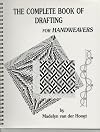
The Complete Book of Drafting for Handweavers
by Madelyn Van der Hoogt
On This Page
Description
This is a book on drafting that is also a handbook of weaves. You'll not only learn to use drafting tools--warp and weft draw-downs, warp and weft cross sections, and block profile drafts, you'll also learn to design with pattern weaves. Under one cover find the steps for drafting and weaving any profile design in any unit weave as well as extras like color-and-weave, blended drafts, turned drafts, network drafting, and fabric analysis. Beginner and advanced weavers will refer to it as a show more constant resource, from the first to the last day you weave! Considered a classic for its clear and concise explanations as well as its excellent diagrams and illustrations! Black & white photographs and diagrams. show lessTags
Recommendations




















Member Recommendations

Member Reviews
This book is a bit hard to review because it is so specific to handweavers but, the following quote may give you some idea about the contents. “The Complete Book of Drafting includes all of the ways in which weave structures can be illustrated on paper”
For centuries, handweavers have had their own methods of putting down on paper, all of the details that are needed to weave different woven structures and patterns. Most modern weavers learn to read weaving drafts, but more knowledge is needed in order to create your own and to go beyond the basics. Madelyn van der Hoogt is one of the most weaving literate weavers today and this book has become a handbook for all weavers interested in designing their own cloth and recording it for show more other weavers.
The book could certainly be classified as a textbook and is divided into four sections.
Part one covers basic weave structures and the principles of drafting. There is a page that identifies the different types of structures and underneath each of those headings are examples of specific structures related to the type. A list of basic drafting words is handy, especially for new weavers. Chapter one gets you into reading weaving drafts, the parts of these drafts and variations in how other cultures may have drafted..
Part two covers “Blocks” and what they mean to the handweaver. A chapter is devoted to “Reading Profile Drafts” and how this shorthand can be used for many different structures.
Part three is about “Unit Weaves” and how to understand and draft them. This includes lace, damask, tied weaves, and more.
The last part of the book gives explanations about how to turn a draft and why you might want to learn this skill. Also, understanding blended and network drafting. Finally, understanding and using fabric analysis.
Throughout the book there are practice pages for you to try your new drafting skills, graph paper to copy and design sheets. There is also an answer section to help you verify that you have done the practice sections correctly.
Working through this book would make an excellent study group project. It is also an invaluable reference and should probably be on every serious weaver's bookshelf. show less
For centuries, handweavers have had their own methods of putting down on paper, all of the details that are needed to weave different woven structures and patterns. Most modern weavers learn to read weaving drafts, but more knowledge is needed in order to create your own and to go beyond the basics. Madelyn van der Hoogt is one of the most weaving literate weavers today and this book has become a handbook for all weavers interested in designing their own cloth and recording it for show more other weavers.
The book could certainly be classified as a textbook and is divided into four sections.
Part one covers basic weave structures and the principles of drafting. There is a page that identifies the different types of structures and underneath each of those headings are examples of specific structures related to the type. A list of basic drafting words is handy, especially for new weavers. Chapter one gets you into reading weaving drafts, the parts of these drafts and variations in how other cultures may have drafted..
Part two covers “Blocks” and what they mean to the handweaver. A chapter is devoted to “Reading Profile Drafts” and how this shorthand can be used for many different structures.
Part three is about “Unit Weaves” and how to understand and draft them. This includes lace, damask, tied weaves, and more.
The last part of the book gives explanations about how to turn a draft and why you might want to learn this skill. Also, understanding blended and network drafting. Finally, understanding and using fabric analysis.
Throughout the book there are practice pages for you to try your new drafting skills, graph paper to copy and design sheets. There is also an answer section to help you verify that you have done the practice sections correctly.
Working through this book would make an excellent study group project. It is also an invaluable reference and should probably be on every serious weaver's bookshelf. show less
With The Complete Book of Drafting, you'll not only learn to use drafting tools-warp and weft drawdowns, warp and weft corss sections, and block profile drafts-you'll also learn how to design with pattern weaves. Under one cover find the steps for drafting and weaving any profile design in any unit weave. Divided into four sections, there are two chapters on basic weaves for the novice, three chapters on blocks and six on unit weaves for the intermediate weaver, and finally a chapter on extras for those weavers ready to forge ahead
The absolute, must own book for anyone who weaves. Working through this workbook, will give any weaver the tools necessary for doing their own design work.
Laine Escola
Ratings
Members
- Recently Added By
Lists

Handweavers Classics
50 works; 2 members
Author Information

187+ Works 4,096 Members
Classifications
Statistics
- Members
- 447
- Popularity
- 68,619
- Reviews
- 4
- Rating
- (4.57)
- Languages
- English
- Media
- Paper
- ISBNs
- 1
- ASINs
- 2