The Ogre
by Michel Tournier
On This Page
Description
An international bestseller and winner of the Prix Goncourt, France's most prestigious literary award, "The Ogre" is a masterful tale of innocence, perversion, and obsession. It follows the passage of strange, gentle Abel Tiffauges from submissive schoolboy to "ogre" of the Nazi school at the castle of Kaltenborn, taking us deeper into the dark heart of fascism than any novel since "The Tin Drum." Until the very last page, when Abel meets his mystic fate in the collapsing ruins of the Third show more Reich, it shocks us, dazzles us, and above all holds us spellbound. show lessTags
Recommendations

























Member Recommendations

Member Reviews
Cet avertissement s'adresse à toutes les mères habitant les régions de Gehlenburg, Sensburg, Lötzen et Lyck ! Prenez garde à l'ogre de Kaltenborn ! Il convoite vos enfants. Il parcourt nos régions et vole les enfants. Si vous avez des enfants, pensez toujours à l'Ogre, car lui pense toujours à eux ! Ne les laissez pas s'éloigner seuls. Apprenez-leur à fuir et à se cacher s'ils voient un géant monté sur un cheval bleu, accompagné d'une meute noire. S'il vient à vous, résistez à ses menaces, soyez sourdes à ses promesses. Une seule certitude doit guider votre conduite de mères : si l'Ogre emporte votre enfant, vous ne le reverrez Jamais !
Une enfance frustrée de tendresse, une adolescence humiliée, un métier qu'il show more juge au-dessous de lui même ont contribué à faire d'Abel Tiffauges l'ennemi de la société et des hommes qui l'incarnent. Mais un épisode de sa vie d'écolier lui a donné la conviction qu'il existe une secrète complicité entre le cours des choses et son destin personnel : parce qu'il devait ce matin là comparaître devant le conseil de discipline, il a fait des vœux pour que le collège soit détruit par un incendie. Or, tandis que dans les cas ordinaires ce genre de prière demeure sans effet, cette fois l'incendie libérateur a lieu...
Deux passions éclairent et réchauffent sa solitude : la détection des symboles dont il devine la présence autour de lui, et le goût de la chair fraîche. Il hante les étals des bouchers, puis il rôde autour des écoles communales. Il y a en lui du mage de de l'Ogre, le premier guidant et secourant le second. C'est ainsi qu'une histoire de viol menaçant de l'envoyer au bagne, la mobilisation de 1939 lui vaut un non-lieu : l'école a encore brûlé!
Fait prisonnier en 1940, il est acheminé vers la Prusse-Orientale. Mais alors que ses compagnons sont accablés par cette plaine infinie et désolée, Tiffauges y voit la terre magique qu'il attendait, et il trouve une étrange libération dans sa captivité. show less
Une enfance frustrée de tendresse, une adolescence humiliée, un métier qu'il show more juge au-dessous de lui même ont contribué à faire d'Abel Tiffauges l'ennemi de la société et des hommes qui l'incarnent. Mais un épisode de sa vie d'écolier lui a donné la conviction qu'il existe une secrète complicité entre le cours des choses et son destin personnel : parce qu'il devait ce matin là comparaître devant le conseil de discipline, il a fait des vœux pour que le collège soit détruit par un incendie. Or, tandis que dans les cas ordinaires ce genre de prière demeure sans effet, cette fois l'incendie libérateur a lieu...
Deux passions éclairent et réchauffent sa solitude : la détection des symboles dont il devine la présence autour de lui, et le goût de la chair fraîche. Il hante les étals des bouchers, puis il rôde autour des écoles communales. Il y a en lui du mage de de l'Ogre, le premier guidant et secourant le second. C'est ainsi qu'une histoire de viol menaçant de l'envoyer au bagne, la mobilisation de 1939 lui vaut un non-lieu : l'école a encore brûlé!
Fait prisonnier en 1940, il est acheminé vers la Prusse-Orientale. Mais alors que ses compagnons sont accablés par cette plaine infinie et désolée, Tiffauges y voit la terre magique qu'il attendait, et il trouve une étrange libération dans sa captivité. show less
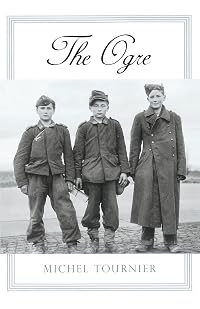
I read this book haunted by the photo on the front cover. The cover design is by Rebecca S Neimark from Twenty-Six Letters and the photo is titled 'Fourteen year-old prisoners, members of Hitler's 'Air Guard', from Archive Photos. Their faces show bewilderment, truculence and naïve amusement at the predicament they find themselves in. They are so young yet they represent both evil and innocence. I wonder what became of them.
Reminding me that books were chosen for 1001 Books for their place in the history of the novel, The Ogre by Michel Tournier (1924-2016) is included because it marks a departure in style for French Literature.
The novel won the Prix Goncourt in 1970, and Wikipedia also tells me that Tournier was a contender for the Nobel Prize. (See here).
The central character, Abel Tiffauges, is warped by his own experiences and by the evil regime. He narrates the first third of the novel, (130 pages) in the chapter titled 'Sinister Writings of Abel Tiffauges' so that the reader is on alert from the outset. Tiffauges grows up lonely and alienated because he is bullied for his stupidity and his appearance, and he drifts into employment as a garage mechanic. He has an unhealthy attraction to young children, and thinks he has had an existential experience when he holds an injured youth in his arms... he relates this to the legend of St Christopher and thenceforth looks for supernatural signs that he is a child-bearer.
It is his girlfriend who recognises that there is something odd about this deceptively gentle giant: she christens him The Ogre. He evades trial for rape by the outbreak of WW2 and his removal to Germany as a POW. On the Rhine he is trained to manage the pigeons used for communication, and his obsessive tenderness in caring for them and his pragmatism about eating them is a portent of what is to come, caring for children destined to become soldiers while indifferent to their fate and the fate of other children under the Nazis.
To read the rest of my review please visit https://anzlitlovers.com/2021/01/23/the-ogre-by-michel-tournier-translated-by-ba... show less
Reminding me that books were chosen for 1001 Books for their place in the history of the novel, The Ogre by Michel Tournier (1924-2016) is included because it marks a departure in style for French Literature.
The flamboyant baroque novels of Michel Tournier came as a breath of fresh air to a French literary sceneshow more
dominated by the austere nouveau roman. The Ogre, a heady mix of war story, reworked myth and sexual perversion, was Tournier's second novel. (1001 Books You Must Read Before You Die, ABC Books, 2006, p.620)
The novel won the Prix Goncourt in 1970, and Wikipedia also tells me that Tournier was a contender for the Nobel Prize. (See here).
The central character, Abel Tiffauges, is warped by his own experiences and by the evil regime. He narrates the first third of the novel, (130 pages) in the chapter titled 'Sinister Writings of Abel Tiffauges' so that the reader is on alert from the outset. Tiffauges grows up lonely and alienated because he is bullied for his stupidity and his appearance, and he drifts into employment as a garage mechanic. He has an unhealthy attraction to young children, and thinks he has had an existential experience when he holds an injured youth in his arms... he relates this to the legend of St Christopher and thenceforth looks for supernatural signs that he is a child-bearer.
It is his girlfriend who recognises that there is something odd about this deceptively gentle giant: she christens him The Ogre. He evades trial for rape by the outbreak of WW2 and his removal to Germany as a POW. On the Rhine he is trained to manage the pigeons used for communication, and his obsessive tenderness in caring for them and his pragmatism about eating them is a portent of what is to come, caring for children destined to become soldiers while indifferent to their fate and the fate of other children under the Nazis.
To read the rest of my review please visit https://anzlitlovers.com/2021/01/23/the-ogre-by-michel-tournier-translated-by-ba... show less
A mincing, hulking French pedophile gets caught in the winds of World War 2 and ends up in charge of a Hitler Youth prep school! Hijinx Ensue!
Ohlala. Voila un livre qui est difficile à expliquer. Beaucoup d'éléments provocatives, une histoire influencée par la mythologie et la Christianité. Si vous êtes préparés pour un boulversement éthique, lisez 'Le Roi Des Aulnes'!
El rey de los alisos
Michel Tournier
Publicado: 1970 | 322 páginas
Novela Drama Histórico
«El rey de los alisos», la novela con la que Michel Tournier obtuvo el Premio Goncourt, narra la historia de Abel Tiffauges, un extraño prisionero francés en la Alemania del III Reich, mezcla de ogro depredador y adolescente perverso, que se siente predestinado para llevar a cabo una misión en Prusia, cuna legendaria de la nación alemana. El celebrado autor de «Medianoche de amor» nos muestra aquí lo más oculto, tierno y enfermizo del ser humano, siempre en busca de significados, ritos y señales que le guíen y rediman de su condición de ser para la muerte. Fantasía insólita sobre los tiempos tenebrosos de la última guerra mundial, show more este libro constituye un extraordinario viaje hacia la infancia y un inquietante ensayo sobre el amor. show less
Michel Tournier
Publicado: 1970 | 322 páginas
Novela Drama Histórico
«El rey de los alisos», la novela con la que Michel Tournier obtuvo el Premio Goncourt, narra la historia de Abel Tiffauges, un extraño prisionero francés en la Alemania del III Reich, mezcla de ogro depredador y adolescente perverso, que se siente predestinado para llevar a cabo una misión en Prusia, cuna legendaria de la nación alemana. El celebrado autor de «Medianoche de amor» nos muestra aquí lo más oculto, tierno y enfermizo del ser humano, siempre en busca de significados, ritos y señales que le guíen y rediman de su condición de ser para la muerte. Fantasía insólita sobre los tiempos tenebrosos de la última guerra mundial, show more este libro constituye un extraordinario viaje hacia la infancia y un inquietante ensayo sobre el amor. show less
A mincing, hulking French pedophile gets caught in the winds of World War 2 and ends up in charge of a Hitler Youth prep school! Hijinx Ensue!
Strange and beautiful story set in nazi Europe.
Members
- Recently Added By
Lists

1001 Books You Must Read Before You Die
1,448 works; 1,134 members

Top Five Books of 2013
1,562 works; 721 members

Harold Bloom - The Western Canon: D. The Chaotic Age
833 works; 24 members

A Good Read (Radio 4)
221 works; 1 member
Canon de la narrativa universal del s. XX (cicutadry)
499 works; 3 members
Author Information

79+ Works 4,840 Members
Michel Édouard Tournier was born in Paris, France on December 19, 1924. He received a degree in philosophy and law from the Sorbonne and studied German philosophy at the University of Tübingen for four years. After failing the philosophy exam that would have certified him as a university teacher, he started producing radio and television show more programs and writing literary journalism. He was the press agent for a new radio station Europe 1 for four years. He then became the literary director of the publishing house Editions Plon. His first novel, Friday, was published in 1967 and won the Grand Prix du Roman by the Académie Française. His second novel, Le Roi des Aulnes, which was also published as The Ogre and The Erl-King, won the Prix Goncourt, France's top literary prize, in 1970. His other works included Friday and Robinson: Life on Speranza Island, Gemini, The Woodcock, The Fetishist, The Motionless Wanderer, The Four Wise Men, Gilles and Jeanne, The Golden Droplet, Keys and Locks, The Flight of the Vampire, and Mount Tabor and Mount Sinai. He died on January 18, 2016 at the age of 91. (Bowker Author Biography) show less
Some Editions
Awards and Honors
Series
Belongs to Publisher Series
Work Relationships
Common Knowledge
- Canonical title*
- De elzenkoning
- Original title
- Le roi des aulnes
- Alternate titles
- The Erl-King
- Original publication date
- 1970
- People/Characters
- Abel Tiffauges
- Important places*
- Pruisen, Duitsland
- Important events*
- Tweede Wereldoorlog
- Related movies
- Der Unhold (1996 | IMDb)
- Epigraph*
- Om iets interessant te maken is het genoeg er lang naar te kijken. Gustave Flaubert
- Dedication*
- Aan de belasterde nagedachtenis van de Starets Grigorij Jefimovitsj Raspoetin, genezer van de tsarevitsj Alexis, vermoord omdat hij zich had verzet tegen de ontketening van de oorlog in 1914.
- First words
- You're an ogre, Rachel used to say to me sometimes.
- Last words
- (Click to show. Warning: May contain spoilers.)When he turned to look up for the last time at Ephraim, all he saw was a six-pointed star turning slowly against the black sky.
- Original language
- French
*Some information comes from Common Knowledge in other languages. Click "Edit" for more information.
Classifications
Statistics
- Members
- 1,084
- Popularity
- 23,545
- Reviews
- 20
- Rating
- (3.98)
- Languages
- 18 — Catalan, Czech, Dutch, English, Estonian, Finnish, French, German, Hungarian, Italian, Lithuanian, Polish, Portuguese, Romanian, Russian, Spanish, Swedish, Turkish
- Media
- Paper, Ebook
- ISBNs
- 56
- ASINs
- 18