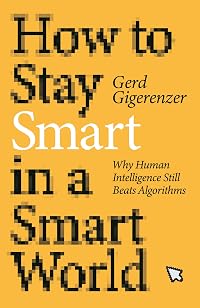
How to Stay Smart in a Smart World: Why Human Intelligence Still Beats Algorithms
by Gerd Gigerenzer
On This Page
Description
Doomsday prophets of technology predict that robots will take over the world, leaving humans behind in the dust. Tech industry boosters think replacing people with software might make the world a better place-while tech industry critics warn darkly about surveillance capitalism. Despite their differing views of the future, they all agree: machines will soon do everything better than humans. How to Stay Smart in a Smart World shows why that's not true, and tells us how we can stay in charge show more in a world populated by algorithms. Machines powered by artificial intelligence are good at some things (playing chess), but not others (life-and-death decisions, or anything involving uncertainty). Gerd Gigerenzer explains why algorithms often fail at finding us romantic partners (love is not chess), why self-driving cars fall prey to the Russian Tank Fallacy, and how judges and police rely increasingly on nontransparent "black box" algorithms to predict whether a criminal defendant will reoffend or show up in court. He invokes Black Mirror, considers the privacy paradox (people want privacy, but give their data away), and explains that social media get us hooked by programming intermittent reinforcement in the form of the "like" button. We shouldn't trust smart technology unconditionally, Gigerenzer tells us, but we shouldn't fear it unthinkingly, either show lessTags
Recommendations














Member Reviews
Great book about eh upside and down side of the artificial intelligence revolution and why a lot of current thinking is wrong. EG about autonomous vehicles.
Ci sono vari motivi per cui l'intelligenza umana batte ancora gli algoritmi. Per prima cosa, gli algoritmi spesso non possono affrontare problemi che richiedono una certa creatività. Mentre un algoritmo può eseguire un compito in modo efficiente e accurato, non è dotato della capacità di pensare in modo creativo o di vedere le cose da una nuova prospettiva. Inoltre, gli algoritmi sono generalmente limitati ai dati che gli vengono forniti, mentre l'intelligenza umana può usare i dati e le informazioni per formulare nuove ipotesi o idee. Infine, l'intelligenza umana può effettuare calcoli complessi che sarebbero troppo complicati per un algoritmo. L'intelligenza umana possiede l'intuizione che è una forma di conoscenza o di show more consapevolezza che non viene appresa attraverso il ragionamento o l'esperienza, ma deriva da una sorta di istinto o di "sentimento" sottile. È una forma di pensiero che è più veloce e più accurata della logica e della razionalità. show less
Feb 19, 2023Italian
Ratings
Members
- Recently Added By
Author Information

25 Works 2,214 Members
Gerd Gigerenzer is director of the Center for Adaptive Behavior and Cognition at the Max Planck Institute for Human Development in Berlin, Germany. He has taught at several universities, including the University of Chicago and the University of Virginia, and has been a Fellow at the Center of Advanced Study in the Behavioral Sciences at Stanford show more University show less
Awards and Honors
Awards
Classifications
- Genres
- Technology, Nonfiction, Science & Nature, General Nonfiction
- DDC/MDS
- 303.4834 — Society, government, & culture Social sciences, sociology & anthropology Social processes Social change Causes of change Development of science and technology Computers, automation, microelectronics, robots
- LCC
- Q334.7 .G54 — Science Science (General) Cybernetics
- BISAC
Statistics
- Members
- 72
- Popularity
- 430,922
- Reviews
- 3
- Rating
- (3.92)
- Languages
- English, German, Italian
- Media
- Paper, Audiobook, Ebook
- ISBNs
- 11
- ASINs
- 2