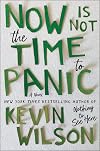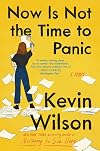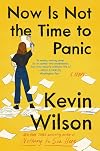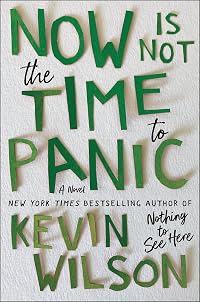
Now Is Not the Time to Panic
by Kevin Wilson
On This Page
Description
A novel about two teenage misfits who spectacularly collide one fateful summer, and the art they make that changes their lives forever. Sixteen-year-old Frankie Budge, aspiring writer, indifferent student, offbeat loner, is determined to make it through yet another sad summer in Coalfield, Tennessee, when she meets Zeke, a talented artist who has just moved into his grandmother's unhappy house and who is as lonely and awkward as Frankie is. Romantic and creative sparks begin to fly, and when show more the two jointly make an unsigned poster, shot through with an enigmatic phrase, it becomes unforgettable to anyone who sees it. The edge is a shantytown filled with gold seekers. We are fugitives, and the law is skinny with hunger for us. The posters begin appearing everywhere, and people wonder who is behind them. Satanists, kidnappers, the rumors won't stop, and soon the mystery has dangerous repercussions that spread far beyond the town. The art that brought Frankie and Zeke together now threatens to tear them apart. Twenty years later, Frances Eleanor Budge, famous author, mom to a wonderful daughter, wife to a loving husband, gets a call that threatens to upend everything: a journalist named Mazzy Brower is writing a story about the Coalfield Panic of 1996. Might Frances know something about that? And will what she knows destroy the life she's so carefully built? show lessTags
Recommendations





Member Reviews
I couldn’t believe how deeply personal this novel felt when I heard the author describe his reasons behind writing it. It was such a great exploration of the meaning of art, its impact, an artist’s control over it, and its ripple effect on culture. It was also very much the story of awkward teenagers trying to figure out who they are.
“The chaos of our daughter, so lovely and beautiful, I would always be grateful for it. How she required us to keep living, to keep moving forward just so she didn’t leave us in her dust.”
“We made the poster so we can still control it I think.
That’s not how art works.”
“The chaos of our daughter, so lovely and beautiful, I would always be grateful for it. How she required us to keep living, to keep moving forward just so she didn’t leave us in her dust.”
“We made the poster so we can still control it I think.
That’s not how art works.”
Real Rating: 4.75* of five, rounded up
The Publisher Says: From the New York Times bestselling author of Nothing to See Here comes an exuberant, bighearted novel about two teenage misfits who spectacularly collide one fateful summer, and the art they make that changes their lives forever.
Sixteen-year-old Frankie Budge—aspiring writer, indifferent student, offbeat loner—is determined to make it through yet another sad summer in Coalfield, Tennessee, when she meets Zeke, a talented artist who has just moved into his grandmother’s unhappy house and who is as lonely and awkward as Frankie is. Romantic and creative sparks begin to fly, and when the two jointly make an unsigned poster, shot through with an enigmatic phrase, it becomes show more unforgettable to anyone who sees it. The edge is a shantytown filled with gold seekers. We are fugitives, and the law is skinny with hunger for us.
The posters begin appearing everywhere, and people wonder who is behind them. Satanists, kidnappers—the rumors won’t stop, and soon the mystery has dangerous repercussions that spread far beyond the town. The art that brought Frankie and Zeke together now threatens to tear them apart.
Twenty years later, Frances Eleanor Budge—famous author, mom to a wonderful daughter, wife to a loving husband—gets a call that threatens to upend everything: a journalist named Mazzy Brower is writing a story about the Coalfield Panic of 1996. Might Frances know something about that? And will what she knows destroy the life she’s so carefully built?
A bold coming-of-age story, written with Kevin Wilson’s trademark wit and blazing prose, Now Is Not The Time to Panic is a nuanced exploration of young love, identity, and the power of art. It’s also about the secrets that haunt us—and, ultimately, what the truth will set free.
I RECEIVED A DRC FROM THE PUBLISHER VIA EDELWEISS+. THANK YOU.
My Review: Nothing to See Here was a solid 3.5-star read for me. It was entertaining and I got a few moments of real emotional involvement. I didn't think I'd go looking for more of Author Wilson's work but the Universe had other ideas...Ecco offered me the DRC and, being game as well as greedy, I hopped on it like a hen on a junebug.
Frankie Budge is a teenaged girl with a serious boredom problem. She's a Coalfield, Tennessee, girl who's smart enough to be a novelist in training and bored enough to do anything to stave off the screaming meemees. She's got triplet brothers whose lives will clearly end in tears, prison sentences, and severe emotional damage. Her father's left his family for another woman, and her mother...cruises...she lets Frankie be her own weird self because, well, triplet boys on the way to prison require more than a single working mother actually has to give. Yay for Frankie! Then she meets Zeke, a new kid with no friends.
Zeke's dad was a horndog, too. (Is this something Author Wilson knows about from personal experience, one must ask oneself.) Zeke apparently decompensated all over the guy in the middle of his office. Well, that's what his mom says...he can't remember any of it. Oh, and this is important: He's so freaked about the whole nightmare that he's decided to rename himself "Zeke" short for his middle name, Ezekiel. He and his mom are staying in Coalfield, where she was from. And that's how the match met the gas....
Y'all remember the 1980s Satanic Panic era? All that horror, all those lives ruined...well, in her gawky attempt to connect with this boy she likes, Frankie made the error to end all errors...she showed him a Xerox machine her brothers had stolen from the high school's shed. With toner and paper and everything...and she lets Zeke fix it, using the loveliest phrase for a paper jam I've ever heard: "like the machine had done origami"...so thus begins one of the major Satanic panics moved all the way up in time to 1996.
Their use for the photocopier is to make an art project (after Frankie uses it as an excuse to cop her first-ever kiss from a boy who's never kissed a girl either) of a poster—a drawing Zeke does after she writes “The edge is a shantytown filled with gold seekers. We are fugitives, and the law is skinny with hunger for us” on a piece of paper. Then the Xerox comes into play...she comments in her narrative about them being kids from Nowheresville and never having heard of Andy Warhol so they were inventing this new thing together...and, after making a bunch of them, Frankie puts them up all over Coalfield.
Hijinks quite horribly ensue.
The inspiration of some older teens to play off this mysterious and compelling artwork, using it for their own ends, and the horrors that any powerful thing can call forth when it's anonymous and unclaimed, break the entire town. Frankie and Zeke are kids. They're way too scared to face up to the consequences (some truly terrifying) of their innocent actions. And that is where I realized I was a lot more involved with this story than I ever was with the first book of his I read. I circled back and read "On Writing Now Is Not The Time to Panic", Author Wilson's introductory story of how this book has been moving inside him for a long time. He spoke directly from his heart, revealed his genuine grief that finally summoned this book into the world after the decades of growing, and I was utterly changed. A story I'd thought was pretty good became a moving, honest act of love for a past and a life he was no longer living. And that made my pleasure multiply many-fold.
What it means to my old-man self to see someone as young as Author Wilson contend with the doomed promise of nostalgia, to confront the power of a past one can never reach but must always reach for...well, that spoke to me. That made me feel I was heard and understood by a complete stranger who couldn't pick me out in a line-up of Boomers. I am validated by this evidence of my sad, wistful knowledge of the ghost-hand of the past clutching with steel talons in someone young enough to be my child.
Then what the hell happened to that fifth star, it's fair to ask. Welllll...I'm really not sure it's fair to say, he said, glancing at the ever-present truncheons of the Spoiler Stasi. I'm not a big fan of the way the pressure to dredge up her past with Zeke, now going by his first name again, entered Frankie's life, and the things it led her to do were understandable but frankly disturbing to me. I felt she was violating boundaries for selfish reasons. It's not like she needed to do something she did the way she did it...the knowledge could've been gained less invasively...but here we are. I've only docked a quarter-star and I'm pretty sure the sales won't suffer because one no-name blogger was squicked out at some stuff that most of y'all (who never had your boundaries utterly disregarded by a woman) won't notice.
I'm still glad I read the book, you can see. I'm especially delighted by a piece of mother-daughter healing that spoke loudly to me. And you know, that is more than enough of a gift to take the slight sting of imperfection off my eyes. show less
The Publisher Says: From the New York Times bestselling author of Nothing to See Here comes an exuberant, bighearted novel about two teenage misfits who spectacularly collide one fateful summer, and the art they make that changes their lives forever.
Sixteen-year-old Frankie Budge—aspiring writer, indifferent student, offbeat loner—is determined to make it through yet another sad summer in Coalfield, Tennessee, when she meets Zeke, a talented artist who has just moved into his grandmother’s unhappy house and who is as lonely and awkward as Frankie is. Romantic and creative sparks begin to fly, and when the two jointly make an unsigned poster, shot through with an enigmatic phrase, it becomes show more unforgettable to anyone who sees it. The edge is a shantytown filled with gold seekers. We are fugitives, and the law is skinny with hunger for us.
The posters begin appearing everywhere, and people wonder who is behind them. Satanists, kidnappers—the rumors won’t stop, and soon the mystery has dangerous repercussions that spread far beyond the town. The art that brought Frankie and Zeke together now threatens to tear them apart.
Twenty years later, Frances Eleanor Budge—famous author, mom to a wonderful daughter, wife to a loving husband—gets a call that threatens to upend everything: a journalist named Mazzy Brower is writing a story about the Coalfield Panic of 1996. Might Frances know something about that? And will what she knows destroy the life she’s so carefully built?
A bold coming-of-age story, written with Kevin Wilson’s trademark wit and blazing prose, Now Is Not The Time to Panic is a nuanced exploration of young love, identity, and the power of art. It’s also about the secrets that haunt us—and, ultimately, what the truth will set free.
I RECEIVED A DRC FROM THE PUBLISHER VIA EDELWEISS+. THANK YOU.
My Review: Nothing to See Here was a solid 3.5-star read for me. It was entertaining and I got a few moments of real emotional involvement. I didn't think I'd go looking for more of Author Wilson's work but the Universe had other ideas...Ecco offered me the DRC and, being game as well as greedy, I hopped on it like a hen on a junebug.
Frankie Budge is a teenaged girl with a serious boredom problem. She's a Coalfield, Tennessee, girl who's smart enough to be a novelist in training and bored enough to do anything to stave off the screaming meemees. She's got triplet brothers whose lives will clearly end in tears, prison sentences, and severe emotional damage. Her father's left his family for another woman, and her mother...cruises...she lets Frankie be her own weird self because, well, triplet boys on the way to prison require more than a single working mother actually has to give. Yay for Frankie! Then she meets Zeke, a new kid with no friends.
Zeke's dad was a horndog, too. (Is this something Author Wilson knows about from personal experience, one must ask oneself.) Zeke apparently decompensated all over the guy in the middle of his office. Well, that's what his mom says...he can't remember any of it. Oh, and this is important: He's so freaked about the whole nightmare that he's decided to rename himself "Zeke" short for his middle name, Ezekiel. He and his mom are staying in Coalfield, where she was from. And that's how the match met the gas....
Y'all remember the 1980s Satanic Panic era? All that horror, all those lives ruined...well, in her gawky attempt to connect with this boy she likes, Frankie made the error to end all errors...she showed him a Xerox machine her brothers had stolen from the high school's shed. With toner and paper and everything...and she lets Zeke fix it, using the loveliest phrase for a paper jam I've ever heard: "like the machine had done origami"...so thus begins one of the major Satanic panics moved all the way up in time to 1996.
Their use for the photocopier is to make an art project (after Frankie uses it as an excuse to cop her first-ever kiss from a boy who's never kissed a girl either) of a poster—a drawing Zeke does after she writes “The edge is a shantytown filled with gold seekers. We are fugitives, and the law is skinny with hunger for us” on a piece of paper. Then the Xerox comes into play...she comments in her narrative about them being kids from Nowheresville and never having heard of Andy Warhol so they were inventing this new thing together...and, after making a bunch of them, Frankie puts them up all over Coalfield.
Hijinks quite horribly ensue.
The inspiration of some older teens to play off this mysterious and compelling artwork, using it for their own ends, and the horrors that any powerful thing can call forth when it's anonymous and unclaimed, break the entire town. Frankie and Zeke are kids. They're way too scared to face up to the consequences (some truly terrifying) of their innocent actions. And that is where I realized I was a lot more involved with this story than I ever was with the first book of his I read. I circled back and read "On Writing Now Is Not The Time to Panic", Author Wilson's introductory story of how this book has been moving inside him for a long time. He spoke directly from his heart, revealed his genuine grief that finally summoned this book into the world after the decades of growing, and I was utterly changed. A story I'd thought was pretty good became a moving, honest act of love for a past and a life he was no longer living. And that made my pleasure multiply many-fold.
What it means to my old-man self to see someone as young as Author Wilson contend with the doomed promise of nostalgia, to confront the power of a past one can never reach but must always reach for...well, that spoke to me. That made me feel I was heard and understood by a complete stranger who couldn't pick me out in a line-up of Boomers. I am validated by this evidence of my sad, wistful knowledge of the ghost-hand of the past clutching with steel talons in someone young enough to be my child.
Then what the hell happened to that fifth star, it's fair to ask. Welllll...I'm really not sure it's fair to say, he said, glancing at the ever-present truncheons of the Spoiler Stasi. I'm not a big fan of the way the pressure to dredge up her past with Zeke, now going by his first name again, entered Frankie's life, and the things it led her to do were understandable but frankly disturbing to me. I felt she was violating boundaries for selfish reasons. It's not like she needed to do something she did the way she did it...the knowledge could've been gained less invasively...but here we are. I've only docked a quarter-star and I'm pretty sure the sales won't suffer because one no-name blogger was squicked out at some stuff that most of y'all (who never had your boundaries utterly disregarded by a woman) won't notice.
I'm still glad I read the book, you can see. I'm especially delighted by a piece of mother-daughter healing that spoke loudly to me. And you know, that is more than enough of a gift to take the slight sting of imperfection off my eyes. show less
“The edge is a shantytown filled with gold seekers, we are the new fugitives, and the law is skinny with hunger for us.” Sixteen-year-old Frankie, future writer of successful YA books, thought up that line. It was part of a teenage prank cooked up by her and her summer bestie Zeke, two bored teenagers trapped in a small, boring town. Frankie wrote the line down on paper, and budding artist Zeke drew around the words, creating their own personal ‘tag.’ Piercing their fingers, they spotted the paper with their blood, imagined stars. Using the copier Frankie’s older brothers had stolen and hidden in the garage, the pair made thousands of copies which they posted throughout the town.
Small towns. I lived in a few back in the 90s. I show more grew up in the ‘burbs, so I had little understanding of how small towns worked. I was told that the bank was the hub of the rumor network where gossip was a commodity. A woman warned a man who had returned to his hometown should not to carry his purse on the street or he would get beat up. The Klan left posters in rural driveways. I would be told not to take our son to the preschool filled with ‘those people,’ i.e., the rural poor. Adults were sure that role playing games were causing physic harm to teenagers unable to keep their roles and reality separate, or that the games were leading them to worship the devil.
So when Frankie and Zeke obsessed over getting their art across the town, I was not surprised that the townspeople reacted in fear, imagining it a sinister message. That other teens made an icon of the poster, and used adult’s fear to claim they were victims of imagined, evil, deviants. That they patrolled the streets with guns, looking for trouble where there was none. That things went crazy, and people died.
Ten years later, Frankie is a successful writer, happily married with a child. Happy. But haunted by that summer, those words still echoing in her head constantly. A phone call from a stranger threatens to upend everything. But first, it was time to tell her story to her family, and to find Zeke and warn him of what is to come.
The characters feel out of sync with the world, turning to art for expression and to make an impact. Art is their obsession, but what they create is misunderstood and feared by their isolated community. What they create is misappropriated and copied. Once out in the world, they can’t control what happens. They struggle with pride of what they created and the guilt of how it was misused. As an adult, Zeke struggles with mental health issues and Frankie can’t shake off those few months of combustive creativity and excitement.
The characters learn the nature of art and it’s impact, the rush of expression, the joy of putting it out there. Then watching what happens to it in the world, out of your ability to control it.
I read the novel in a day.
I received a free egalley from the publisher through NetGalley. My review is fair and unbiased. show less
Small towns. I lived in a few back in the 90s. I show more grew up in the ‘burbs, so I had little understanding of how small towns worked. I was told that the bank was the hub of the rumor network where gossip was a commodity. A woman warned a man who had returned to his hometown should not to carry his purse on the street or he would get beat up. The Klan left posters in rural driveways. I would be told not to take our son to the preschool filled with ‘those people,’ i.e., the rural poor. Adults were sure that role playing games were causing physic harm to teenagers unable to keep their roles and reality separate, or that the games were leading them to worship the devil.
So when Frankie and Zeke obsessed over getting their art across the town, I was not surprised that the townspeople reacted in fear, imagining it a sinister message. That other teens made an icon of the poster, and used adult’s fear to claim they were victims of imagined, evil, deviants. That they patrolled the streets with guns, looking for trouble where there was none. That things went crazy, and people died.
Ten years later, Frankie is a successful writer, happily married with a child. Happy. But haunted by that summer, those words still echoing in her head constantly. A phone call from a stranger threatens to upend everything. But first, it was time to tell her story to her family, and to find Zeke and warn him of what is to come.
The characters feel out of sync with the world, turning to art for expression and to make an impact. Art is their obsession, but what they create is misunderstood and feared by their isolated community. What they create is misappropriated and copied. Once out in the world, they can’t control what happens. They struggle with pride of what they created and the guilt of how it was misused. As an adult, Zeke struggles with mental health issues and Frankie can’t shake off those few months of combustive creativity and excitement.
The characters learn the nature of art and it’s impact, the rush of expression, the joy of putting it out there. Then watching what happens to it in the world, out of your ability to control it.
I read the novel in a day.
I received a free egalley from the publisher through NetGalley. My review is fair and unbiased. show less
From the publisher’s summary, ‘Now Is Not The Time To Panic’ sounds like a coming-of-age Young Adult novel with a quirky romantic subplot. It isn’t. It is a very grown-up book about art, identity, the power of obsession, and the corrosive effect of keeping secret, for more than twenty years, events that you believe defined you.
The novel starts with present-day Frankie having the life she’s made as a wife. a mother and a successful author, put at risk because the secret she’s kept for twenty years, about the things she did in the summer of her sixteenth year, is about to be exposed. The story then moves between the present-day and the summer of 1996, revealing what Frankie has kept secret and what it means to her.
The 1996 show more timeline vividly captured what it was like to be sixteen and strange in a small town that had nothing to offer you, at a time before there was an Internet to show you other worlds and connect you to other people like yourself.
I loved that the present-day Frankie still so closely resembled her sixteen-year-old self in terms of her passions and her fears. She loves the normalcy of the life she’s built as an adult, but knows it sits on a foundation of strangeness that she’s kept secret even from the people she loves.
I loved that 1996 Frankie, even at sixteen, understood that who she was and what she wanted was different from the people around her, felt no need to apologise for it and had no ability to explain it except through art.
One of the strongest themes in the book is an exploration of what art is. This isn’t done through abstract conversations about art theory, but by describing what it feels like to create art that expresses something you know to be true and important, but that you can’t explain except through showing people the art. It showed the power of ambiguously truthful art to stir emotions in others, ranging from rapture to rage, and how art, once shared, no longer belongs to or is completely defined by the people who created it.
All of this is wrapped in a propulsive plot that had me turning the digital pages to find out what Frankie did in 1996 and what was going to happen to her in the present day.
I liked that the people in the present-day timeline often surprised me. Present-day Zeke was entirely credible, and yet very different from the boy who spent the summer of 1996 in a strange town. I knew how Frankie expected those she loves to react to the revelation of her secret, so the unexpected elements of their reactions helped me and Frankie to reassess what her secret really meant.
I admire Kevin Wilson’s ability to tell this story in a way that kept it accessible and hopeful without letting it become either clichéd or cosy. The book left me with a lot to ponder about how the story we tell ourselves about our lives shapes our behaviour and our expectations, even when, or perhaps especially when, the story is not the whole truth. show less
The novel starts with present-day Frankie having the life she’s made as a wife. a mother and a successful author, put at risk because the secret she’s kept for twenty years, about the things she did in the summer of her sixteenth year, is about to be exposed. The story then moves between the present-day and the summer of 1996, revealing what Frankie has kept secret and what it means to her.
The 1996 show more timeline vividly captured what it was like to be sixteen and strange in a small town that had nothing to offer you, at a time before there was an Internet to show you other worlds and connect you to other people like yourself.
I loved that the present-day Frankie still so closely resembled her sixteen-year-old self in terms of her passions and her fears. She loves the normalcy of the life she’s built as an adult, but knows it sits on a foundation of strangeness that she’s kept secret even from the people she loves.
I loved that 1996 Frankie, even at sixteen, understood that who she was and what she wanted was different from the people around her, felt no need to apologise for it and had no ability to explain it except through art.
One of the strongest themes in the book is an exploration of what art is. This isn’t done through abstract conversations about art theory, but by describing what it feels like to create art that expresses something you know to be true and important, but that you can’t explain except through showing people the art. It showed the power of ambiguously truthful art to stir emotions in others, ranging from rapture to rage, and how art, once shared, no longer belongs to or is completely defined by the people who created it.
All of this is wrapped in a propulsive plot that had me turning the digital pages to find out what Frankie did in 1996 and what was going to happen to her in the present day.
I liked that the people in the present-day timeline often surprised me. Present-day Zeke was entirely credible, and yet very different from the boy who spent the summer of 1996 in a strange town. I knew how Frankie expected those she loves to react to the revelation of her secret, so the unexpected elements of their reactions helped me and Frankie to reassess what her secret really meant.
I admire Kevin Wilson’s ability to tell this story in a way that kept it accessible and hopeful without letting it become either clichéd or cosy. The book left me with a lot to ponder about how the story we tell ourselves about our lives shapes our behaviour and our expectations, even when, or perhaps especially when, the story is not the whole truth. show less
Everyone thinks the South is, like, Flannery O'Connor. They think it's haunted. And maybe it is, deep down, in the soil, but I never saw it that way. We had a McDonald's. I don't know how else to say it. There were no bookstores, okay, fine. The museums we had were of the Old Jail Museum or Military Vehicle Museum or Railroad Museum variety. We had a Wal-Mart. I wore normal clothes.
Frankie is a teenager in a small Tennessee town in the nineties. She has three older brothers, triplets, who run wild, and an exhausted, hard-working mother. Her father left and now has a new wife and a new daughter who he has given Frankie's name. And she doesn't have any friends. Then she meets Zeke, in Coalfield for the summer. He's her age and just as show more artistic and dissatisfied. They quickly become friends and together make art together, she writing and he drawing. They make art together, combining her words and his sketches, and a little blood for effect, into a piece they then photocopy and post around the town as something to do in a quiet town during the summer. They expect some consternation, maybe annoyance on the part of some, but when there art project explodes in ways they never intended or dreamed of, they both have to grapple with the consequences.
This is, at heart, a book longing for those teenage years, after one learned to drive and gained some independence, but before the end of high school heralded in adult responsibilities. Frankie is an engaging narrator, sarcastic and incisive, as she looks back on those years as the ones that formed her, the ones she still thinks about every day. Her relationship with Zeke is lovely; two lonely young artists finding each other and finding in each other a way to belong that they hadn't found before. And that friendship is viewed through a veil of nostalgia, a combination of adult assessment and rose-colored glasses, so that she hesitates to recount that time to anyone else. Wilson has a talent at finding the weird in ordinary places and this novel is both wild and utterly believable, or at least, Wilson makes us believe it. show less
"The edge is a shantytown filled with gold seekers. We are fugitives, and the law is skinny with hunger for us."
In the 1990s, Frankie Budge is a bored 16-year-old in Coalfield, Tennessee. When Zeke comes to town for the summer from Memphis, the two form a friendship, and decide - as a writer and artist, respectively - to make something together. The thing they make is a poster, with a phrase by Frankie and a line drawing by Zeke, which they copy and hang all over town, inadvertently inspiring the "Coalfield Panic."
Now a published author with a dentist husband and young daughter, Frankie is caught off guard when a reporter from The New Yorker calls her to talk about the poster and the Panic. She has never told anyone - not her mother, show more not her husband - and is worried her past will overwhelm her present.
Quotes
I cared so much, but I put a lot of effort into not caring. (10)
But I was sixteen. I lived inside of myself way more than I lived inside of this town. (15)
You had to choose sides. And you always chose the person who didn't fuck everything up. You chose the person who was stuck with you. (18)
It made me sad. I wondered if that was kind of the purpose of art, maybe, to make you see things that you knew but couldn't say out loud. (35)
It was the high of doing something weird, not knowing the outcome. (55)
But I had always been curious about how you could live a life where you never worried about repercussions, never considered that the thing you did rippled out into the world. (61)
He had this faraway look in his eyes, like he was running simulations of how his life was going to turn out. (92)
...I had no idea what other people thought was good or what was important. And so I almost never told anyone what I liked because I was terrified that they would tell me how stupid it was. (108)
I had wanted people to care, to notice, but I hadn't wanted them to put their own hands all over it, to try to claim it. But how do you stop something like that? (123)
"It was beautiful, and then somebody else, the rest of the world, made it not beautiful." (Frankie's mom, 206)
I don't know exactly what I had hoped. You hold on to something for twenty years, the expectations and possibilities bend and twist alongside your actual life. (231) show less
In the 1990s, Frankie Budge is a bored 16-year-old in Coalfield, Tennessee. When Zeke comes to town for the summer from Memphis, the two form a friendship, and decide - as a writer and artist, respectively - to make something together. The thing they make is a poster, with a phrase by Frankie and a line drawing by Zeke, which they copy and hang all over town, inadvertently inspiring the "Coalfield Panic."
Now a published author with a dentist husband and young daughter, Frankie is caught off guard when a reporter from The New Yorker calls her to talk about the poster and the Panic. She has never told anyone - not her mother, show more not her husband - and is worried her past will overwhelm her present.
Quotes
I cared so much, but I put a lot of effort into not caring. (10)
But I was sixteen. I lived inside of myself way more than I lived inside of this town. (15)
You had to choose sides. And you always chose the person who didn't fuck everything up. You chose the person who was stuck with you. (18)
It made me sad. I wondered if that was kind of the purpose of art, maybe, to make you see things that you knew but couldn't say out loud. (35)
It was the high of doing something weird, not knowing the outcome. (55)
But I had always been curious about how you could live a life where you never worried about repercussions, never considered that the thing you did rippled out into the world. (61)
He had this faraway look in his eyes, like he was running simulations of how his life was going to turn out. (92)
...I had no idea what other people thought was good or what was important. And so I almost never told anyone what I liked because I was terrified that they would tell me how stupid it was. (108)
I had wanted people to care, to notice, but I hadn't wanted them to put their own hands all over it, to try to claim it. But how do you stop something like that? (123)
"It was beautiful, and then somebody else, the rest of the world, made it not beautiful." (Frankie's mom, 206)
I don't know exactly what I had hoped. You hold on to something for twenty years, the expectations and possibilities bend and twist alongside your actual life. (231) show less
"Now is not the time to panic, but, also, there seem to be dark forces at play, and I will do everything in my power as an upholder of justice to root them out and send them as far from Coalfield as is humanly possible."
This little book about feeling like an outsider and being obsessed with something and making art and then watching what you made leave your control and become entirely its own entity got me obsessed as I reading it. I really loved Frankie and felt like I understood her, as I was also a small-town Southern girl growing up in almost the same time period with not a lot of friends who read too many books and wanted to be a writer. The fact that Frankienever stopped putting the poster up killed me.
This little book about feeling like an outsider and being obsessed with something and making art and then watching what you made leave your control and become entirely its own entity got me obsessed as I reading it. I really loved Frankie and felt like I understood her, as I was also a small-town Southern girl growing up in almost the same time period with not a lot of friends who read too many books and wanted to be a writer. The fact that Frankie
Members
- Recently Added By
Lists

Books published and read in 2022
82 works; 5 members

Writers as Characters in Fiction
120 works; 18 members

Bitter Southerner Summer Reading Roundup
198 works; 8 members

Books Read in 2022
5,168 works; 114 members

Books Set in Tennessee
5 works; 1 member

2022 GoodReads Choice Fiction Awards
20 works; 1 member

Books With the Most Memorable Titles
478 works; 158 members

Top Five Books of 2023
767 works; 317 members

Best Audiobooks
240 works; 114 members

Fiction Published in 2022
21 works; 1 member

Books Read in 2025
4,091 works; 97 members
Author Information

7+ Works 6,969 Members
Some Editions
Awards and Honors
Awards
Distinctions
Common Knowledge
- Canonical title
- Now Is Not the Time to Panic
- Original publication date
- 2022
- People/Characters
- Frances "Frankie" Eleanor Budge; Ezekiel "Zeke" Brown
- Important places
- Coalfield, Tennessee, USA
- Dedication
- In memory of Eric Matthew Hailey
(1973-2020) - First words
- I ANSWERED THE PHONE, AND THERE WAS A WOMAN'S VOICE on the other end, a voice that I didn't recognize.
- Quotations
- "I think maybe art is supposed to make your family uncomfortable," he offered.
"Are you guys boyfriend and girlfriend?" Andrew interrupted, pointing the tip of his slice of pizza at Zeke in a way that only my brothers could make look threatening.
"We're friends," I finally said. "We're FRIENDS."
"Good friends," Zeke offered, and I nodded to him like, Yeah, duh, but also like, Shut up, my brothers will try to ruin me.
"Well, I for one think i... (show all)t's great that Frankie has found such a good friend for the summer."
"Frankie has no friends," Brian told Zeke, like maybe he was stupid and didn't understand how weird I was.
The edge is a shantytown filled with gold seekers. We are fugitives, and the law is skinny with hunger for us.
He took the map out of his backpack and searched until he found the geographic location of this abandoned house and made a star with his pen. He held it open and we looked at the stars on the map. Even though Coalfield seemed... (show all) like the dinkiest place on earth, when we counted the stars, all the open space that was still unmarked, I felt a little overwhelmed. I felt like maybe I wouldn't be able to sleep until the whole map was a single constellation.
At that moment, I could feel something opening up in me and I realize how hard it was to walk through the day when you had an obsession and you couldn't say a word about it.
This was the beauty of obsession, I realized. It never waned.
"Are you okay?" I asked him. He had this faraway look in his eyes, like he was running simulations of how his life was going to turn out.
"Yeah, I mean, of course," he finally replied. "It's just . . . well, I don't like t... (show all)he fact that the police are involved."
"Okay, you're from Memphis, so I get it, but this is Coalfield and the cops are idiots, okay?"
And that hour in the room, the two of us almost touching, the thing we made beginning to fully assemble itself, to spread out into the world, was the happiest I have maybe ever been in my entire life.
I knew he was doing this for himself, that he wanted to know that he wasn't a bad person. And it made me love him, even as it made me feel a little bit worse about myself. Because I didn't care if I was a bad person anymore. ... (show all)I just . . . I just didn't.
it takes very little to think that someone else might actually know who you are, even as you spend all your time thinking that no one understands you. It's such a lovely feeling.
Why did everyone want things to move forward, and why did I want to be frozen in a block of ice?
I knew the world was going on outside, that things were happening, that large forces were now having to contend with this thing that I had started, but it felt so disconnected from reality.
When I was done making copies, I put my hand on the glass and made a single copy of my palm. I looked at the lines, wished I knew how to read them. I wanted to know what my future was, because in that moment, I could not imag... (show all)ine a future at all. I could not imagine how in the world I would keep this secret for the rest of my life. But I knew I would. And even then, sixteen years old, I knew that I would hate every person in my life who loved me, who took care of me, who helped me find a way to whatever life I would have, because I could never tell them who I was, what I'd done.
I CAME HOME AND MY ARM HEALED. MY BROTHERS WERE TENTATIVE around me, kind even. I think they were a little shocked that I had survived something worse than anything they'd lived through. They had not realized that I was also ... (show all)invincible, I guess, and it made them wary of my power, of what I could do to them.
"I hated being a teenager."
"I don't hate it," I said, feeling a little affronted.
"Well, I did," he told me, looking a sad. "Not because I thought something better was coming. I just never felt right inside my own body... (show all)."
"I feel that sometimes," I admitted.
"And then I got older, and, guess what? I still never felt right inside my body. I don't think I ever will. I kind of flamed out everywhere I went, always got a little less than what I thought I'd get. But I guess that's okay. I think maybe it's necessary to feel like you're not quite settled, or maybe for some people it's necessary."
"But I also think it's not so bad if you never quite feel right in this world. It's still worth hanging around. You just have to look harder to find the things you love."
She showed it to Hobart, who also loved it, and it made me feel, for the first time, that maybe it was dumb to be embarrassed about weird things if you were really good at them. Or not good. If they made you happy.
"I wish you hadn't gone away," I told him. "I wish that summer had never ended." When I said it out loud, I realized how childish it sounded, how self-absorbed.
In the final paragraph, the reporter quoted Teddie Cowan, the county sheriff, saying, "Now is not the time to panic, but, also, there seem to be dark forces at play, and I will do everything in my power as an upholder of just... (show all)ice to root them out and send them as far from Coalfield as is humanly possible."
A woman in Hillsborough, North Carolina, said the lines came from an unpublished novel by her late husband, who had written hundreds of erotic novels under the pen name Dick Paine. - Last words
- (Click to show. Warning: May contain spoilers.)I said the line. Nothing had changed. I said it, and every single word was exactly the same, just as I had made it that summer. It would never change. So I said it again. And again. And again.
- Canonical DDC/MDS
- 813.6
Classifications
Statistics
- Members
- 916
- Popularity
- 29,245
- Reviews
- 56
- Rating
- (3.88)
- Languages
- English
- Media
- Paper, Audiobook, Ebook
- ISBNs
- 14
- ASINs
- 5