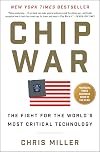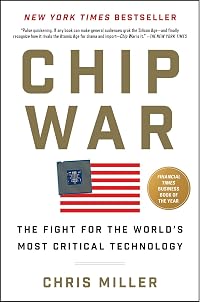
Chip War: The Fight for the World's Most Critical Technology
by Chris Miller
On This Page
Description
"An epic account of the decades-long battle to control what has emerged as the world's most critical resource--microchip technology--with the United States and China increasingly in conflict. You may be surprised to learn that microchips are the new oil--the scarce resource on which the modern world depends. Today, military, economic, and geopolitical power are built on a foundation of computer chips. Virtually everything--from missiles to microwaves, smartphones to the stock market--runs on show more chips. Until recently, America designed and built the fastest chips and maintained its lead as the #1 superpower. Now, America's edge is slipping, undermined by competitors in Taiwan, Korea, Europe, and, above all, China. Today, as Chip War reveals, China, which spends more money each year importing chips than it spends importing oil, is pouring billions into a chip-building initiative to catch up to the US. At stake is America's military superiority and economic prosperity. Economic historian Chris Miller explains how the semiconductor came to play a critical role in modern life and how the U.S. become dominant in chip design and manufacturing and applied this technology to military systems. America's victory in the Cold War and its global military dominance stems from its ability to harness computing power more effectively than any other power. But here, too, China is catching up, with its chip-building ambitions and military modernization going hand in hand. America has let key components of the chip-building process slip out of its grasp, contributing not only to a worldwide chip shortage but also a new Cold War with a superpower adversary that is desperate to bridge the gap. Illuminating, timely, and fascinating, Chip War shows that, to make sense of the current state of politics, economics, and technology, we must first understand the vital role played by chips"--Amazon. show lessTags
Recommendations
















Member Reviews
I tackled this as an audiobook, and it’s an extensive, well-structured account of the history of semiconductor chips and their central role in shaping modern technology, economics, and geopolitical power. Miller situates the development of chips firmly within the global political landscape, showing how something physically tiny has become foundational to military strength, economic resilience, and the way we all live day to day.
One of the book’s biggest strengths is its accessibility. Despite dealing with cutting-edge, highly complex technology, the narrative never feels exclusionary. Miller consistently strikes the right balance between technical accuracy and clarity, allowing non-technologists to follow not just how chips work, show more but why supply chains, fabrication capacity, and national policy decisions matter so profoundly. The historical grounding, tied to recognisable world events and current tensions, makes the stakes feel concrete rather than abstract.
The tone of the writing is excellent: calm, confident, and quietly urgent. However, the audiobook narration didn’t always support that strength. The delivery is quite monotone, to the point that it occasionally undercut the tension and fascination of the subject matter. As a result, it took me far longer to get through the book than I expected, despite being genuinely absorbed by the content. It’s a clear example of how much narration can shape the experience of an audiobook.
Overall, this is a fascinating and important book, particularly for anyone interested in the intersection of technology, power, and global politics. It made me far more aware of how exposed modern societies are to disruptions in chip production and supply - and how central these invisible components have become to almost everything else. show less
One of the book’s biggest strengths is its accessibility. Despite dealing with cutting-edge, highly complex technology, the narrative never feels exclusionary. Miller consistently strikes the right balance between technical accuracy and clarity, allowing non-technologists to follow not just how chips work, show more but why supply chains, fabrication capacity, and national policy decisions matter so profoundly. The historical grounding, tied to recognisable world events and current tensions, makes the stakes feel concrete rather than abstract.
The tone of the writing is excellent: calm, confident, and quietly urgent. However, the audiobook narration didn’t always support that strength. The delivery is quite monotone, to the point that it occasionally undercut the tension and fascination of the subject matter. As a result, it took me far longer to get through the book than I expected, despite being genuinely absorbed by the content. It’s a clear example of how much narration can shape the experience of an audiobook.
Overall, this is a fascinating and important book, particularly for anyone interested in the intersection of technology, power, and global politics. It made me far more aware of how exposed modern societies are to disruptions in chip production and supply - and how central these invisible components have become to almost everything else. show less
Fascinating, well-timed and expertly researched story about the entire history of semiconductors, from the invention of the transistor up to the geopolitical situation faced by the U.S. and China in Taiwan today. While the pandemic chip shortages woke us up to the centrality of chips, “the new oil,” to our everyday lives, I now have to admit I was not as informed as I thought before reading this. I was aware of the importance of Dutch EUV lithography company ASML and Taiwanese company TSMC’s central role in our supply chains, but this book was so informative and goes into such details (about for example Intel’s latest fumbles, Huawei’s rise and downfall, and Nvidia’s forays into artificial intelligence) that I felt I was show more starting to learn about Silicon Valley from scratch. If anyone has a passing interest in this topic I would recommend you prioritize it higher in your reading list as it’s the most up to date survey of the chip landscape. A good story about our fragility in the face of such a bottlenecked industry. show less
A detailed account of the history of chip-making and the embedded perils ahead. Chris Miller brilliantly balances technical, business, and geopolitical drivers to give the reader a comprehensive picture of our dependency on microprocessors and chips, and the risks that a major disruption in Taiwan would pose on the global economy. COVID will look like a picnic compared to that. A must-read.
Computer chips are the foundational commodity of the cultures and lifestyles of the 21st century. In this book, Chris Miller outlines the way in which we've come further than ever thought possible by the inventors of the computer chip, and, how the computer chip supply chain is precariously centralized.
Similar to the way that Yasha Levine, in "Surveillance Valley," establishes that a history of the internet is a military history, the history of computer chips is a military history. During the first twenty years of their development, 95% of revenues of computer chip companies came from (US) defense contracts.
Ever wonder where the term "debugging" comes from? Back when computers were composed of tubes, sometimes the tubes would attract show more moths, and sometimes the moths would damage the tubes (likely losing their lives in the process). "Debugging," was the process of removing the moths, cleaning up the circuitry, and replacing any blown tubes.
The first quarter of the 21st century has thus far also been the story of a growing cold war between China and the United States. This book describes these fronts from the perspectives of chips. Did you know that maintaining cutting-edge chip technology requires hundreds of billions of dollars of investment on an annual basis? Miller points out that, not even the US military budget (currently running at about three quarters of a trillion dollars a year) or Apple (with $360 billion in revenues in 2021) would be able to single-handedly maintain cutting edge chip infrastructure. It is necessarily a global, or at least multinational, project.
The technology required to make chips sounds like science fiction. Extreme ultra-violet light (closer in wavelength to x-ray than visible light) is produced by vaporizing droplets of tin with a massively powerful laser 50,000 times per second. This is then reflected on a mirror whose surface, if blow up to the size of Germany, would have tenth-of-a-millimeter variances in flatness, and would be able to aim well enough to hit a golf ball at the range of the moon. Chips have gotten so small that conventional electrical engineering becomes a poor map of reality and quantum tunneling is a challenge (where electrons show up in the "wrong" place).
Moore's law predicted the doubling in chip capacity, but only for one decades time. It has continued, unrelenting, for the past half century. That said, this is no reason to believe this breakneck pace of progress will be sustainable.
Are you curious about the provenance and history of the building blocks of modern life, and curious about the geopolitical tensions that result from the power that comes along with such technology? If so, then this is the book for you! show less
Similar to the way that Yasha Levine, in "Surveillance Valley," establishes that a history of the internet is a military history, the history of computer chips is a military history. During the first twenty years of their development, 95% of revenues of computer chip companies came from (US) defense contracts.
Ever wonder where the term "debugging" comes from? Back when computers were composed of tubes, sometimes the tubes would attract show more moths, and sometimes the moths would damage the tubes (likely losing their lives in the process). "Debugging," was the process of removing the moths, cleaning up the circuitry, and replacing any blown tubes.
The first quarter of the 21st century has thus far also been the story of a growing cold war between China and the United States. This book describes these fronts from the perspectives of chips. Did you know that maintaining cutting-edge chip technology requires hundreds of billions of dollars of investment on an annual basis? Miller points out that, not even the US military budget (currently running at about three quarters of a trillion dollars a year) or Apple (with $360 billion in revenues in 2021) would be able to single-handedly maintain cutting edge chip infrastructure. It is necessarily a global, or at least multinational, project.
The technology required to make chips sounds like science fiction. Extreme ultra-violet light (closer in wavelength to x-ray than visible light) is produced by vaporizing droplets of tin with a massively powerful laser 50,000 times per second. This is then reflected on a mirror whose surface, if blow up to the size of Germany, would have tenth-of-a-millimeter variances in flatness, and would be able to aim well enough to hit a golf ball at the range of the moon. Chips have gotten so small that conventional electrical engineering becomes a poor map of reality and quantum tunneling is a challenge (where electrons show up in the "wrong" place).
Moore's law predicted the doubling in chip capacity, but only for one decades time. It has continued, unrelenting, for the past half century. That said, this is no reason to believe this breakneck pace of progress will be sustainable.
Are you curious about the provenance and history of the building blocks of modern life, and curious about the geopolitical tensions that result from the power that comes along with such technology? If so, then this is the book for you! show less
I found [b:Chip War: The Fight for the World's Most Critical Technology|60321447|Chip War The Fight for the World's Most Critical Technology|Chris Miller|https://i.gr-assets.com/images/S/compressed.photo.goodreads.com/books/1662566820l/60321447._SY75_.jpg|95096793], a history of the semiconductor industry, unexpectedly fascinating. Although written in a journalistic style it is dense with information, which reminded me of Daniel Yergin's [b:The Prize: The Epic Quest for Oil, Money, and Power|169354|The Prize The Epic Quest for Oil, Money, and Power|Daniel Yergin|https://i.gr-assets.com/images/S/compressed.photo.goodreads.com/books/1403025725l/169354._SY75_.jpg|163531]. I think it's an important book for understanding how technology has show more shifted the loci of economic power across the world in the past sixty years. Although written from an American perspective, it offers a lot of insight into how chip manufacture became concentrated in a handful of East Asian companies.
The early history of how semiconductors were invented really emphasises how deeply entwined computing was with wars and the military-industrial complex. It was interesting to learn about the USSR's attempts to keep up with American chip technology during the Cold War, always struggling with quality control when using the requisite advanced manufacturing techniques. Also notable in the historical chapters is the fact that, 'It was mostly men who designed the earliest semiconductors, and mostly women who assembled them'. There is a depressing theme of searching the globe for the cheapest skilled labour and consistently resisting attempts to unionise:
I did not previously realise the importance of chips in weapons and found the chapters on this topic quite chilling. The automation of weaponry continues to increase, yet the concentration of the chip industry also creates military vulnerabilities. Apparently Russia is currently suffering a severe shortage due to Ukraine War sanctions, so is reduced to using chips from domestic appliances in weapons.
Part VIII of the book concerns China's recent rise as a chip manufacturer. An infographic notes that China produces 15% of all chips, mostly low-tech, but the industry is expanding rapidly with heavy government support. The detailed discussion of Huawei begs the question posed in [b:Red Capitalism: The Fragile Financial Foundation of China's Extraordinary Rise|8806625|Red Capitalism The Fragile Financial Foundation of China's Extraordinary Rise|Carl E. Walter|https://i.gr-assets.com/images/S/compressed.photo.goodreads.com/books/1348416675l/8806625._SY75_.jpg|13680809]: what in China isn't a sovereign wealth fund? Can any large Chinese company be considered otherwise? I found Miller's explanation of the conflict between the US and China over chip intellectual property and security during the Obama and Trump presidencies useful. It was covered in the media quite superficially, so I hadn't really grasped what was going on:
Miller projects the disastrous impact on the entire global economy if Taiwan's TSMC chip factories were put out of action in a war with China. This would not be in the interests of China, or anyone else really, but is a real risk if armed conflict were to break out between China and the US. The structure of the chip industry almost looks like a globally-distributed series of natural monopolies for different chip types, which means interdependence and limited competition awkwardly coexist:
Over the decades chips have become more and more expensive and complex to manufacture as, 'each generation of technological improvement made fabs more expensive'. The equipment now used to make advanced semiconductors is mindblowingly complicated, costs two hundred million dollars to build, and requires tens of thousands of components sourced from around the world: 'ASML's EUV lithography tool is the most expensive mass-produced machine tool in history'. Intel alone invested $4 BILLION in developing this machine. The only way to get a passable return on such outlandish sums is to manufacture and sell humungous quantities of chips.
These economies of scale based on vast investments in equipment have led to an extraordinary concentration of the market, with profound geopolitical implications. What a fascinating unintended consequence of globalised capitalism these monopolies are! Despite lack of immediate competition, the industry is trapped in an endless race to cram more transistors on each chip using more and more expensive machines, and for what? So that surveillance capitalism can gather yet more personal data and generative so-called AI can fill the internet with sludge? It was useful to gain understanding of the hardware side of Silicon Valley, which gets much less attention than software and online platforms in the technology books I've read to date.
I found [b:Chip War: The Fight for the World's Most Critical Technology|60321447|Chip War The Fight for the World's Most Critical Technology|Chris Miller|https://i.gr-assets.com/images/S/compressed.photo.goodreads.com/books/1662566820l/60321447._SY75_.jpg|95096793] a very thought-provoking reminder that daily life in 2023 depends upon a myriad of miniscule semiconductors that I had not previously considered the provenance of. Miller conveys an impressive quantity of information in an accessible style, providing considerable insight into the peculiarities of these lynchpins in the global economy. show less
The early history of how semiconductors were invented really emphasises how deeply entwined computing was with wars and the military-industrial complex. It was interesting to learn about the USSR's attempts to keep up with American chip technology during the Cold War, always struggling with quality control when using the requisite advanced manufacturing techniques. Also notable in the historical chapters is the fact that, 'It was mostly men who designed the earliest semiconductors, and mostly women who assembled them'. There is a depressing theme of searching the globe for the cheapest skilled labour and consistently resisting attempts to unionise:
Semiconductors recast the economies and politics of America's friends in the region. Cities that had been breeding grounds for political radicalism were transformed by diligent assembly line workers, happy to trade unemployment or subsistence farming for better paying jobs in factories. By the early 1980s, the electronics industry accounted for 7 percent of Singapore's GNP and a quarter of its manufacturing jobs. Of electronics production, 60 percent was semiconductor devices, and much of the rest was goods that couldn't work without semiconductors. In Hong Kong, electronic manufacturing created more jobs than any industry except textiles.
I did not previously realise the importance of chips in weapons and found the chapters on this topic quite chilling. The automation of weaponry continues to increase, yet the concentration of the chip industry also creates military vulnerabilities. Apparently Russia is currently suffering a severe shortage due to Ukraine War sanctions, so is reduced to using chips from domestic appliances in weapons.
Part VIII of the book concerns China's recent rise as a chip manufacturer. An infographic notes that China produces 15% of all chips, mostly low-tech, but the industry is expanding rapidly with heavy government support. The detailed discussion of Huawei begs the question posed in [b:Red Capitalism: The Fragile Financial Foundation of China's Extraordinary Rise|8806625|Red Capitalism The Fragile Financial Foundation of China's Extraordinary Rise|Carl E. Walter|https://i.gr-assets.com/images/S/compressed.photo.goodreads.com/books/1348416675l/8806625._SY75_.jpg|13680809]: what in China isn't a sovereign wealth fund? Can any large Chinese company be considered otherwise? I found Miller's explanation of the conflict between the US and China over chip intellectual property and security during the Obama and Trump presidencies useful. It was covered in the media quite superficially, so I hadn't really grasped what was going on:
In Washington and in the chip industry, almost everyone had drunk their own kool-aid about globalisation. Newspapers and academics alike reported that globalisation was in fact 'global', that technological diffusion was unstoppable, that other countries' advancing technological capabilities were in the US interest, and that even if they weren't, nothing could halt technological progress. [...] However, 'globalisation' of chip fabrication hadn't occurred; 'Taiwanisation' had. Technology hadn't diffused. It was monopolised by a handful of irreplaceable companies.
Miller projects the disastrous impact on the entire global economy if Taiwan's TSMC chip factories were put out of action in a war with China. This would not be in the interests of China, or anyone else really, but is a real risk if armed conflict were to break out between China and the US. The structure of the chip industry almost looks like a globally-distributed series of natural monopolies for different chip types, which means interdependence and limited competition awkwardly coexist:
However, the messages coming from the chip industry weren't any more coherent than the contradictory leaks from the Trump White House. Publicly, semiconductor CEOs and their lobbyists urged the new administration to work with China and encourage it to comply with trade agreements. Privately, they admitted this strategy was hopeless and feared that state-supported Chinese competitors would grab market share at their expense. The entire chip industry depended on sales to China - be it chipmakers like Intel, fabless designers like Qualcomm, or equipment manufacturers like Applied Materials. One US semiconductor executive wryly summed things up to a White House official: "Our fundamental problem is that our number one customer is our number one competitor".
Over the decades chips have become more and more expensive and complex to manufacture as, 'each generation of technological improvement made fabs more expensive'. The equipment now used to make advanced semiconductors is mindblowingly complicated, costs two hundred million dollars to build, and requires tens of thousands of components sourced from around the world: 'ASML's EUV lithography tool is the most expensive mass-produced machine tool in history'. Intel alone invested $4 BILLION in developing this machine. The only way to get a passable return on such outlandish sums is to manufacture and sell humungous quantities of chips.
These economies of scale based on vast investments in equipment have led to an extraordinary concentration of the market, with profound geopolitical implications. What a fascinating unintended consequence of globalised capitalism these monopolies are! Despite lack of immediate competition, the industry is trapped in an endless race to cram more transistors on each chip using more and more expensive machines, and for what? So that surveillance capitalism can gather yet more personal data and generative so-called AI can fill the internet with sludge? It was useful to gain understanding of the hardware side of Silicon Valley, which gets much less attention than software and online platforms in the technology books I've read to date.
I found [b:Chip War: The Fight for the World's Most Critical Technology|60321447|Chip War The Fight for the World's Most Critical Technology|Chris Miller|https://i.gr-assets.com/images/S/compressed.photo.goodreads.com/books/1662566820l/60321447._SY75_.jpg|95096793] a very thought-provoking reminder that daily life in 2023 depends upon a myriad of miniscule semiconductors that I had not previously considered the provenance of. Miller conveys an impressive quantity of information in an accessible style, providing considerable insight into the peculiarities of these lynchpins in the global economy. show less
This is a clearly written, deeply researched entirely fascinating history of the semiconductor silicon industry, telling of our complete dependence on it for many electrical devices without which modern life would be unimaginable and indeed impossible. That dependence is made worse by the fact that the key manufacturer for the vast majority of semiconductor chips is TSMC in Taiwan, perilously placed in relation to China. And the desire of the US to prevent China from gaining the ascendancy in terms of chip development is one of the most compelling aspects of the book - not just its desire to ensure TSMC remains accessible but to increase domestic manufacture (not at all a straightforward process) but also to prevent access to China of show more the incredibly complicated and expensive equipment used to design and fabricate chips which is solely made by a Dutch company, ASML (and which is a very significant contributor to the Dutch economy). Anyway - hugely informative and topical. show less
I can’t think of a more relevant book to charting the future of Sino-US relations for the coming 20-30 years.
Also, if you ever doubted government’s subservience to multi-national tech firms before, after reading this book you will understand that tech really rules the roost. The firms that make our computer chips have more money to invest and bigger markets than you could dream of.
How they got this way us the subject of this book.
Defense, communications, health, commerce today are now wedded to these extraordinary inventions.
We owe their success in a large part to scientific breakthroughs, but also to engineering, logistics, and savvy marketing innovations as well. And one of the industries biggest innovators was a quality control show more guy with a laser focus on process. show less
Also, if you ever doubted government’s subservience to multi-national tech firms before, after reading this book you will understand that tech really rules the roost. The firms that make our computer chips have more money to invest and bigger markets than you could dream of.
How they got this way us the subject of this book.
Defense, communications, health, commerce today are now wedded to these extraordinary inventions.
We owe their success in a large part to scientific breakthroughs, but also to engineering, logistics, and savvy marketing innovations as well. And one of the industries biggest innovators was a quality control show more guy with a laser focus on process. show less
Members
- Recently Added By
Lists

Books recommended by Barack Obama
295 works; 28 members

Obama Reads
181 works; 3 members

Books Read in 2024
4,623 works; 126 members

My wishlist
85 works; 1 member
Author Information

4 Works 953 Members
Awards and Honors
Awards
Distinctions
Common Knowledge
- Canonical title
- Chip War: The Fight for the World's Most Critical Technology
- Original title
- Chip War: The Fight for the World's Most Critical Technology
- Dedication
- To Liya
- First words
- The destroyer USS Mustin slipped into the northern end of the Taiwan Strait on August 18, 2020, its five-inch gun pointed southward as it began a solo mission to sail through the Strait and reaffirm that these internat... (show all)ional waters were not controlled by China - at least not yet. (Introduction)
Japanese soldiers described Worl War II as a "typhoon of steel."
It was only five days after People's Liberation Army forces began shelling the Taiwanese-held Quemoy Island in 1958 that, amid the sweltering Dallas summer, Jack Kilby demonstrated to his colleagues that all the components of... (show all) a circuit - transistors, resistors, and capacitors - could be made from semiconductor materials. (Conclusion) - Last words
- (Click to show. Warning: May contain spoilers.)To understand how our world came to be defined by quintillions of transistors and a tiny number of irreplaceable companies, we must begin by looking back to the origins of the silicon age. (Introduction).
(Click to show. Warning: May contain spoilers.)This time, Beijing might wager that it could well win.
(Click to show. Warning: May contain spoilers.)The chips they invented and the industry they built provide the hidden circuitry that's structured our history and will shape our future. (Conclusion) - Blurbers
- Ferguson, Niall; Yergin, Daniel; Kennedy, Paul; McAfee, Andrew; Kaplan, Robert D.; O'Mara, Margaret (show all 9); Wang, Dan; Stavridis, Admiral James; Summers, Lawrence H.
Classifications
- Genres
- Technology, Business, General Nonfiction, Nonfiction, Economics, History, Science & Nature
- DDC/MDS
- 338.476213815 — Society, government, & culture Economics Production Secondary industries and services Services and specific products Technology Engineering and allied operations
- LCC
- HD9696 .I582 .M55 — Social sciences Industries. Land use. Labor Industries. Land use. Labor Special industries and trades Mechanical industries
- BISAC
Statistics
- Members
- 872
- Popularity
- 31,042
- Reviews
- 26
- Rating
- (4.22)
- Languages
- 8 — Chinese, English, French, German, Italian, Portuguese, Spanish, Swedish
- Media
- Paper, Audiobook, Ebook
- ISBNs
- 24
- ASINs
- 7