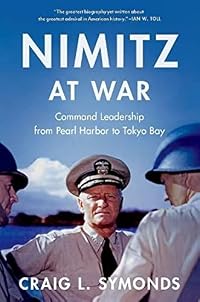
Nimitz at War: Command Leadership from Pearl Harbor to Tokyo Bay
by Craig L. Symonds
On This Page
Description
From America's preeminent naval historian, the first full-length portrait in over fifty years of the man who won the war in the Pacific in World War Two. Only days after the Japanese attacked Pearl Harbor, President Franklin D. Roosevelt tapped Chester W. Nimitz to assume command of the Pacific Fleet. Nimitz transformed the devastated and dispirited Pacific fleet into the most powerful and commanding naval force in history. Facing demands from Washington to mount an early offensive, he had show more first to revive the depressed morale of the thousands of sailors, soldiers, and Marines who served under him. And of course, he also confronted a formidable and implacable enemy in the Imperial Japanese Navy, which, until the Battle of Midway, had the run of the Pacific. Craig Symonds's Nimitz at War captures Nimitz's composure, discipline, homespun wisdom, and most of all his uncanny sense of when to assert authority and when to pull back. As Symonds's absorbing, dynamic, and authoritative portrait reveals, it required qualities of leadership exhibited by few other commanders in history, qualities that are enduringly and even poignantly relevant to our own moment. show lessTags
Recommendations













Member Reviews
Read this book on Audible for my GCMH project and for War at Sea in the Age of Sail fall/winter elective at the NWC. Sent the below review to the Mariner's Mirror:
Craig L. Symonds, Craig L. Nimitz at War: Command Leadership from Pearl Harbor to Tokyo Bay. New York: Oxford University Press, 2022. ISBN 978-0-19-006236-1. List of Maps. Notes. Bibliography. Index. Pp. xvi, 474.
Aptly titled, Nimitz at War is a thorough account of the War in the Pacific from the perspective of the victorious commander, Fleet Admiral Chester W. Nimitz. Exhaustively researched and perspicuously written, this wartime portrait promptly places the reader in Nimitz’s black leather shoes, from taking command of the Pacific Fleet aboard the USS Grayling in December show more 1941 to signing the Instrument of Surrender on the USS Missouri in September 1945. Throughout the book, the reader engages with the array of challenges facing the fleet admiral, contrasting the nuances of his daily routine with the magnitude of his strategic decisions. Ignore the quote affixed somewhat ironically to the front cover; this book is not a biography of Nimitz, it is a case study of his leadership during war.
Symonds offers this leadership portrayal as a refreshing contrast to the other popular, and polarizing World War II commanders. Consistent with the author’s goals, this leadership textbook reconstructs Nimitz’s experiences in order to carefully assess his performance throughout the war. Symonds routinely showcases Nimitz’s ability to remain calm despite relentless pressures from Admiral King in Washington, a never-ending parade of distinguished visitors to Oahu, a prickly adjacent commander in General Douglas MacArthur, and the burden of commanding the “largest naval force ever assembled in the largest naval war ever fought” (xii). He successfully reveals Nimitz’s unique ability to consistently command commanders, many of whom proved to be exceptionally difficult. The descriptive writing enables the reader to picture and nearly feel the piercing gaze of Nimitz’s cool blue eyes, his gravest reprimand. Symonds carefully and consistently reinforces Nimitz’s distinct leadership traits of patience, humility, and decisiveness. Symonds achieves his goal and by the end, readers will likely be convinced of their importance and compelled to adopt these characteristics into their own leadership behavior repertoire.
Woven throughout this book are humorous anecdotes, dangerous encounters, and moments of intense sorrow that enable Symonds to capture a wide audience and captivate his readers. Often written on the same page as monumental decisions, these helpful interruptions remind the reader of Chester Nimitz the person in addition to his responsibility as fleet commander. Using personal letters from his wife and the mothers of slain marines, Symonds successfully recreates the human dimension and enables the reader to better understand the enormity of his own personal struggles as a wartime commander. Nimitz’s exhaustive routine, which included strenuous daily walks, ocean swims, and firing on a pistol range coupled with Hawaiian recreation, socializing, and the companionship of his dog Mak (named after Makalapa Hill in Hawaii – not MacArthur) enabled him to cope with his struggles and balance the enormous pressure he felt on a daily basis for four years.
The book is neatly broken up into four main sections, each comprised of multiple, easy to read chapters that effectively tell Nimitz’s World War II story in chronological order. The book begins with Nimitz taking command in Hawaii, detailing the leadership challenges he faced resurrecting the ships and the morale of the Pacific Fleet following the tragedy of Pearl Harbor. The second section recounts his trials during the Navy’s days of famine where his instincts for aggressive action were always tempered by the risks associated to their sparse resources in the South Pacific. Subsequently, the third section highlights his decisions geared towards Japan’s destruction during the years where American industrial might overwhelmed his adversaries on a drive through the Central Pacific to Japan’s doorstep. The final section, suitably titled Dénouement, brings the story to its successful conclusion with Nimitz at the helm. While the epilogue provides closure by summarizing his life after the war, the book remains true to its title and focuses entirely on his command of the Pacific Fleet during World War II.
A prominent naval historian, Symonds adds this account to his portfolio of 17 other books. The back cover highlights the praise this book deservedly receives from well-known naval historians and military professionals around the country. His inspiration to write this book originated from his first mentor and colleague at the Naval Academy, someone who knew Nimitz personally. Despite the challenges of the global pandemic in 2020-21, Symonds conducted exceptional research from personal and public papers, newspapers, official histories, oral histories, personal accounts, and memoirs. Symonds end notes, organized by chapter, connect the reader to his detailed research from 9 archives and over 100 secondary sources. The Nimitz Graybook served as the “principal primary source for this narrative” and is “referenced literally hundreds of times” (411). The detailed and well organized 14-page index further enhances this book’s standing as a textbook on command excellence.
One need not be a military professional or historian to enjoy Nimitz at War. Symonds’s writing enables current and aspiring leaders to respect and admire Nimitz’s leadership qualities during excruciating circumstances. By its end, one may cautiously wonder how the nation may have fared had FDR not insisted on Nimitz’s selection to command the Pacific Fleet or if he had been killed in one of his multiple near-death experiences during the war. On the other hand, some may feel obligated to take this account with a grain of salt as Symonds makes claims about Nimitz’s leadership that he himself never would have. Students of other prominent leaders from this time may take exception to Symonds’s portrayal as it leaves little room to credit anyone more than Nimitz for Allied victory in the Pacific. The contrast from Nimitz to polarizing leaders such as MacArthur enable Symonds to secure the moral high ground in any historiographical debate. However, Symonds does not intend this to be a comparison against other leaders, nor does he use this to attack them. Instead, he offers a thorough examination of influential leadership designed to challenge those willing to study and reflect upon it. show less
Craig L. Symonds, Craig L. Nimitz at War: Command Leadership from Pearl Harbor to Tokyo Bay. New York: Oxford University Press, 2022. ISBN 978-0-19-006236-1. List of Maps. Notes. Bibliography. Index. Pp. xvi, 474.
Aptly titled, Nimitz at War is a thorough account of the War in the Pacific from the perspective of the victorious commander, Fleet Admiral Chester W. Nimitz. Exhaustively researched and perspicuously written, this wartime portrait promptly places the reader in Nimitz’s black leather shoes, from taking command of the Pacific Fleet aboard the USS Grayling in December show more 1941 to signing the Instrument of Surrender on the USS Missouri in September 1945. Throughout the book, the reader engages with the array of challenges facing the fleet admiral, contrasting the nuances of his daily routine with the magnitude of his strategic decisions. Ignore the quote affixed somewhat ironically to the front cover; this book is not a biography of Nimitz, it is a case study of his leadership during war.
Symonds offers this leadership portrayal as a refreshing contrast to the other popular, and polarizing World War II commanders. Consistent with the author’s goals, this leadership textbook reconstructs Nimitz’s experiences in order to carefully assess his performance throughout the war. Symonds routinely showcases Nimitz’s ability to remain calm despite relentless pressures from Admiral King in Washington, a never-ending parade of distinguished visitors to Oahu, a prickly adjacent commander in General Douglas MacArthur, and the burden of commanding the “largest naval force ever assembled in the largest naval war ever fought” (xii). He successfully reveals Nimitz’s unique ability to consistently command commanders, many of whom proved to be exceptionally difficult. The descriptive writing enables the reader to picture and nearly feel the piercing gaze of Nimitz’s cool blue eyes, his gravest reprimand. Symonds carefully and consistently reinforces Nimitz’s distinct leadership traits of patience, humility, and decisiveness. Symonds achieves his goal and by the end, readers will likely be convinced of their importance and compelled to adopt these characteristics into their own leadership behavior repertoire.
Woven throughout this book are humorous anecdotes, dangerous encounters, and moments of intense sorrow that enable Symonds to capture a wide audience and captivate his readers. Often written on the same page as monumental decisions, these helpful interruptions remind the reader of Chester Nimitz the person in addition to his responsibility as fleet commander. Using personal letters from his wife and the mothers of slain marines, Symonds successfully recreates the human dimension and enables the reader to better understand the enormity of his own personal struggles as a wartime commander. Nimitz’s exhaustive routine, which included strenuous daily walks, ocean swims, and firing on a pistol range coupled with Hawaiian recreation, socializing, and the companionship of his dog Mak (named after Makalapa Hill in Hawaii – not MacArthur) enabled him to cope with his struggles and balance the enormous pressure he felt on a daily basis for four years.
The book is neatly broken up into four main sections, each comprised of multiple, easy to read chapters that effectively tell Nimitz’s World War II story in chronological order. The book begins with Nimitz taking command in Hawaii, detailing the leadership challenges he faced resurrecting the ships and the morale of the Pacific Fleet following the tragedy of Pearl Harbor. The second section recounts his trials during the Navy’s days of famine where his instincts for aggressive action were always tempered by the risks associated to their sparse resources in the South Pacific. Subsequently, the third section highlights his decisions geared towards Japan’s destruction during the years where American industrial might overwhelmed his adversaries on a drive through the Central Pacific to Japan’s doorstep. The final section, suitably titled Dénouement, brings the story to its successful conclusion with Nimitz at the helm. While the epilogue provides closure by summarizing his life after the war, the book remains true to its title and focuses entirely on his command of the Pacific Fleet during World War II.
A prominent naval historian, Symonds adds this account to his portfolio of 17 other books. The back cover highlights the praise this book deservedly receives from well-known naval historians and military professionals around the country. His inspiration to write this book originated from his first mentor and colleague at the Naval Academy, someone who knew Nimitz personally. Despite the challenges of the global pandemic in 2020-21, Symonds conducted exceptional research from personal and public papers, newspapers, official histories, oral histories, personal accounts, and memoirs. Symonds end notes, organized by chapter, connect the reader to his detailed research from 9 archives and over 100 secondary sources. The Nimitz Graybook served as the “principal primary source for this narrative” and is “referenced literally hundreds of times” (411). The detailed and well organized 14-page index further enhances this book’s standing as a textbook on command excellence.
One need not be a military professional or historian to enjoy Nimitz at War. Symonds’s writing enables current and aspiring leaders to respect and admire Nimitz’s leadership qualities during excruciating circumstances. By its end, one may cautiously wonder how the nation may have fared had FDR not insisted on Nimitz’s selection to command the Pacific Fleet or if he had been killed in one of his multiple near-death experiences during the war. On the other hand, some may feel obligated to take this account with a grain of salt as Symonds makes claims about Nimitz’s leadership that he himself never would have. Students of other prominent leaders from this time may take exception to Symonds’s portrayal as it leaves little room to credit anyone more than Nimitz for Allied victory in the Pacific. The contrast from Nimitz to polarizing leaders such as MacArthur enable Symonds to secure the moral high ground in any historiographical debate. However, Symonds does not intend this to be a comparison against other leaders, nor does he use this to attack them. Instead, he offers a thorough examination of influential leadership designed to challenge those willing to study and reflect upon it. show less
II finished Craig Symonds, Nimitz At War: Command Leadership From Pearl Harbor To Tokyo Bay. A short but outstanding history which details the command and leadership style of Admiral Chester Nimitz.
Not a detailed military history of the either the naval or land war but a history of Nimitz leadership style. At first thought by CNO Ernest J. King to be to much of a conciliatory in his leadership style to make the tough and necessary decisions needed of a theater commander he won him over and after the war King endorsed Nimitz as the most qualified man to take over as CNO.
Largely a man who quietly led but was firm in conviction and after getting all available information and input from his gifted team of subordinates which included a wide show more variety of individuals including Ray Spruance, William “Bull” Halsey, Marine General Holland “Howlin Mad” Smith, Admiral Richmond Kelly Turner, Army General Robert C. Richardson, and Admiral Charles Lockwood in charge of the submarine forces under Nimitz, but in the end a man who was confident to make his own decision even when in conflict with his subordinates. Able to work with General Douglas MacArthur, a true testament to his leadership style.
A wonderful short history coming in at 396 pages. A definite must read. show less
Not a detailed military history of the either the naval or land war but a history of Nimitz leadership style. At first thought by CNO Ernest J. King to be to much of a conciliatory in his leadership style to make the tough and necessary decisions needed of a theater commander he won him over and after the war King endorsed Nimitz as the most qualified man to take over as CNO.
Largely a man who quietly led but was firm in conviction and after getting all available information and input from his gifted team of subordinates which included a wide show more variety of individuals including Ray Spruance, William “Bull” Halsey, Marine General Holland “Howlin Mad” Smith, Admiral Richmond Kelly Turner, Army General Robert C. Richardson, and Admiral Charles Lockwood in charge of the submarine forces under Nimitz, but in the end a man who was confident to make his own decision even when in conflict with his subordinates. Able to work with General Douglas MacArthur, a true testament to his leadership style.
A wonderful short history coming in at 396 pages. A definite must read. show less
Tremendous. I couldn't resist starting to read it the day the book was delivered, and kept right at it until complete.
It is a familiar overall story, but still seems fresh.
It is a familiar overall story, but still seems fresh.
Ratings
Members
- Recently Added By
Author Information

26+ Works 2,805 Members
Craig L. Symonds is Professor Emeritus at the United States Naval Academy, where he taught naval history and Civil War History for thirty years. He is the author of a host of award-winning titles, including most recently World War II at Sea (Oxford U. Press, 2018).
Awards and Honors
Classifications
Statistics
- Members
- 125
- Popularity
- 259,757
- Reviews
- 3
- Rating
- (4.66)
- Languages
- English
- Media
- Paper, Audiobook, Ebook
- ISBNs
- 8
- ASINs
- 2