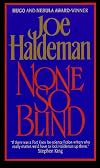
None So Blind: A Short Story Collection
by Joe Haldeman
On This Page
Description
An award-winning visionary and true master of worlds and wonders, the man whom author David Brin calls "one of the best prophetic writers of our times," once again demonstrates the breathtaking scope and startling power of his imagination, transporting listeners across space and time, into the heart of darkness and the soul of madness. From the spine-tingling account of an intergalactic poacher's rite of passage to an erotic and ultimately uplifting modern fable of inner scars and show more otherworldly transformation, here are fifteen remarkable tales, including the classic novella The Hemingway Hoax. These are stories that sing with a unique and haunting voice-stories of war's monsters, of brutal art and lost stars, and a brief, miraculous moment called childhood, when a young girl can actually fly. show lessTags
Recommendations





























Member Reviews
My reactions to reading this collection in 1997. Some spoilers may follow.
*”Introduction: What You Don’t Know Can’t Hurt You” -- Haldeman talks about the input of emotional and physical experience into fiction and cites it as a rationale for his notes on each of the collection’s stories.
*”Feedback” -- Haldeman invents a neat piece of technology in a “skinsuit”, a device that allows one to tap into the manual skill and aesthetic judgments of an artist. The story involves a “facilitator” painter, the process of facilitating, and a client with murderous impulses.
*”Passages” -- This seems to be a story set in the same Confederacíon universe as Haldeman’s All My Sins Remembered and There Is No Darkness, show more co-written with Jack C. Haldeman II. It is a tale of a hunting guide and one of those strange, seemingly barbaric alien rites that, as usual in sf, turns out to have quite a rational purpose. The aliens are the Obelobelians and the rite of passage – survived by the narrator but not his client – involves being attacked by a predator. If you don’t struggle when the balaseli lands on your head, if you practice rational fearlessness, the creature will die, poisoned by your sweat. However, if you struggle, its death struggles will flay you alive.
*”Job Security” -- A story about perspective – or rather the lack of it. The stars are going out one by one (depending on their distance from Earth, the farthest ones going out first) and all the janitor-narrator can think of his lax job and how the astronomers at the observatory where he works are concerned with their job security. He doesn’t realize the gravity of the situation.
*”The Hemingway Hoax” - This is the first time I’ve read the novella that the short novel is based on. I’m still not sure I understand fully what happens. Evidently, John Baird – a Hemingway fan, aficionado, and would-be forger across several timelines – is killed again and again by sinister agents from STAB – the Spatio-Temporal Adjustment Board. However, his eidetic memory preserves not only his life but memories of these encounters. He also keeps encountering Sylvester Castlemaine, his would-be partner in crime who gets more violent with each incarnation. At story’s end, Baird seems to become Hemingway. I’ll trust Haldeman’s integrity and the opinion of others to tell me Haldeman’s pastiches of Hemingway are well done. I appreciated the story more the second time around. First, the parts with the mysterious lifeforms that work for STAB – they exist on other levels and in both the past and future – were creepy and blackly funny – particularly when the STAB agent and Baird talk. I like the idea that the STAB agent – in a reversal of what time/dimensional policemen usually want to do in sf (with the somewhat exception of Poul Anderson’s frequently gloomy Time Patrol stories) – wants to make sure a nuclear war breaks out in 2006 – a war that will wipe life from Earth. Second, I like that Haldeman postulates the cultural influence of Hemingway and other American writers (including Robert Heinlein) as being even more important to the events of the future than a politician’s or scientist’s action.
*”Images” -- This is a rather contrived story about a scorned Vietnam veteran who is also a voyeur (Haldeman admits to lifting this detail from his own life) and afraid of sexual intimacy meeting and falling in love with a shy, scarred women who consumes male homosexual porn. The interesting part of the story is the science fictional conceit of one of the veteran-narrator’s actors (the narrator directs a political theater group) being a shape changing alien who uses sex to collect DNA of our species.
*”Beachhead” -- Story that postulates that after a disastrous war in the future an odd social order is constructed by the survivors. Tests are granted. The majority that show low anti-social tendencies leave an island to fight “the war”. Actually they live in a peaceful world while those left behind are told to become solid citizens. If they pass the test, they are allowed to leave the island too.
*”The Monster” -- This story reminded me of H. P. Lovecraft in that it’s a first person narration of a person who encounters an unearthly presence in a remote area (Vietnam) and who dies mysteriously at story’s end in a mental asylum. However, I don’t know if Lovecraft was the originator of this type of horror story. Haldeman gives no rationale for the creature the narrator encounters in the Vietnam war, who gets him court martialed and imprisoned, who he seemingly kills in San Francisco, and who may fatally possess him at story’s end. I thought it was interesting that one of Haldeman’s motives for writing this story was to set the record straight about the Vietnam War’s often glamorized Long Range Recon Patrols. Haldeman says they were often punishment details.
*”If I Had the Wings of an Angel” -- A simple story about a girl flying – and ruing the day she will weigh too much to do it – in the low-gravity of a hollowed out asteroid. She is the central character of Haldeman’s World trilogy.
*”The Cure” -- Another of those dream therapy (here called “drama therapy”) stories where someone controls the dream imagery of someone for therapeutic reasons. Here the therapy is on, as it usually is, a suicidal person. The story is interesting mainly for Haldeman’s biographical notes.
*”Graves” -- A finely atmospheric story about a Graves Registration Unit coming across the corpse of a strange creature in the Vietnam War and some strangely mutilated American corpses. The story seems utterly convincing though Haldeman says he made up all the details of its operation.
*”None So Blind” -- This is a good story though I’m not sure it deserved a Hugo. Haldeman frankly admits the tone is based on Frederik Pohl’s “Day Million”. Essentially this story asks “Why aren’t blind people geniuses?” given how much of the brain is used to receive, process, and interpret visual images. Genius Cletus Jefferson researches the question, turns his blind wife into a genius, and unleashes a world where people blind themselves to compete intellectually. show less
*”Introduction: What You Don’t Know Can’t Hurt You” -- Haldeman talks about the input of emotional and physical experience into fiction and cites it as a rationale for his notes on each of the collection’s stories.
*”Feedback” -- Haldeman invents a neat piece of technology in a “skinsuit”, a device that allows one to tap into the manual skill and aesthetic judgments of an artist. The story involves a “facilitator” painter, the process of facilitating, and a client with murderous impulses.
*”Passages” -- This seems to be a story set in the same Confederacíon universe as Haldeman’s All My Sins Remembered and There Is No Darkness, show more co-written with Jack C. Haldeman II. It is a tale of a hunting guide and one of those strange, seemingly barbaric alien rites that, as usual in sf, turns out to have quite a rational purpose. The aliens are the Obelobelians and the rite of passage – survived by the narrator but not his client – involves being attacked by a predator. If you don’t struggle when the balaseli lands on your head, if you practice rational fearlessness, the creature will die, poisoned by your sweat. However, if you struggle, its death struggles will flay you alive.
*”Job Security” -- A story about perspective – or rather the lack of it. The stars are going out one by one (depending on their distance from Earth, the farthest ones going out first) and all the janitor-narrator can think of his lax job and how the astronomers at the observatory where he works are concerned with their job security. He doesn’t realize the gravity of the situation.
*”The Hemingway Hoax” - This is the first time I’ve read the novella that the short novel is based on. I’m still not sure I understand fully what happens. Evidently, John Baird – a Hemingway fan, aficionado, and would-be forger across several timelines – is killed again and again by sinister agents from STAB – the Spatio-Temporal Adjustment Board. However, his eidetic memory preserves not only his life but memories of these encounters. He also keeps encountering Sylvester Castlemaine, his would-be partner in crime who gets more violent with each incarnation. At story’s end, Baird seems to become Hemingway. I’ll trust Haldeman’s integrity and the opinion of others to tell me Haldeman’s pastiches of Hemingway are well done. I appreciated the story more the second time around. First, the parts with the mysterious lifeforms that work for STAB – they exist on other levels and in both the past and future – were creepy and blackly funny – particularly when the STAB agent and Baird talk. I like the idea that the STAB agent – in a reversal of what time/dimensional policemen usually want to do in sf (with the somewhat exception of Poul Anderson’s frequently gloomy Time Patrol stories) – wants to make sure a nuclear war breaks out in 2006 – a war that will wipe life from Earth. Second, I like that Haldeman postulates the cultural influence of Hemingway and other American writers (including Robert Heinlein) as being even more important to the events of the future than a politician’s or scientist’s action.
*”Images” -- This is a rather contrived story about a scorned Vietnam veteran who is also a voyeur (Haldeman admits to lifting this detail from his own life) and afraid of sexual intimacy meeting and falling in love with a shy, scarred women who consumes male homosexual porn. The interesting part of the story is the science fictional conceit of one of the veteran-narrator’s actors (the narrator directs a political theater group) being a shape changing alien who uses sex to collect DNA of our species.
*”Beachhead” -- Story that postulates that after a disastrous war in the future an odd social order is constructed by the survivors. Tests are granted. The majority that show low anti-social tendencies leave an island to fight “the war”. Actually they live in a peaceful world while those left behind are told to become solid citizens. If they pass the test, they are allowed to leave the island too.
*”The Monster” -- This story reminded me of H. P. Lovecraft in that it’s a first person narration of a person who encounters an unearthly presence in a remote area (Vietnam) and who dies mysteriously at story’s end in a mental asylum. However, I don’t know if Lovecraft was the originator of this type of horror story. Haldeman gives no rationale for the creature the narrator encounters in the Vietnam war, who gets him court martialed and imprisoned, who he seemingly kills in San Francisco, and who may fatally possess him at story’s end. I thought it was interesting that one of Haldeman’s motives for writing this story was to set the record straight about the Vietnam War’s often glamorized Long Range Recon Patrols. Haldeman says they were often punishment details.
*”If I Had the Wings of an Angel” -- A simple story about a girl flying – and ruing the day she will weigh too much to do it – in the low-gravity of a hollowed out asteroid. She is the central character of Haldeman’s World trilogy.
*”The Cure” -- Another of those dream therapy (here called “drama therapy”) stories where someone controls the dream imagery of someone for therapeutic reasons. Here the therapy is on, as it usually is, a suicidal person. The story is interesting mainly for Haldeman’s biographical notes.
*”Graves” -- A finely atmospheric story about a Graves Registration Unit coming across the corpse of a strange creature in the Vietnam War and some strangely mutilated American corpses. The story seems utterly convincing though Haldeman says he made up all the details of its operation.
*”None So Blind” -- This is a good story though I’m not sure it deserved a Hugo. Haldeman frankly admits the tone is based on Frederik Pohl’s “Day Million”. Essentially this story asks “Why aren’t blind people geniuses?” given how much of the brain is used to receive, process, and interpret visual images. Genius Cletus Jefferson researches the question, turns his blind wife into a genius, and unleashes a world where people blind themselves to compete intellectually. show less
Great collection of short sci-fi.
Ratings
Members
- Recently Added By
Author Information

191+ Works 30,908 Members
Joe Haldeman has uniquely blended a strong interest in astronomy and with his love for writing to publish numerous novels, anthologies and short stories over three decades. He holds a B.S. in astronomy from the University of Maryland (1967), and an M.F.A. in English from the Iowa Writers Workshop (1975). An adjunct professor at Massachusetts show more Institute of Technology, Haldeman has also taught at Michigan State, Larion West Seattle, SUNY Buffalo, Princeton, University of North Dakota, Kent State and the University of North Florida Haldeman's works include War Year (1972), The Forever War (1975), Worlds (1981), Worlds Apart (1983), Tools of the Trade (1987), and The Hemingway Hoax (1990). He has also co-authored and edited numerous works of science fiction. Born in Oklahoma on June 9, 1943, Haldeman grew up in Puerto Rico, New Orleans, Washington D.C., and Alaska. He was drafted into the military in 1967, fighting in the Central Highlands of Vietnam as a combat engineer with the 4th Division (1/22nd Airmobile Battalion), for which he received the Purple Heart, among other medals. (Bowker Author Biography) show less
Awards and Honors
Awards
Work Relationships
Contains
Common Knowledge
- Original publication date
- 1996 (Collection) (Collection); 1986 (DX; The Monster) (DX | The Monster); 1989 (Time Lapse) (Time Lapse); 1990 (The Hemingway Hoax; Passages) (The Hemingway Hoax | Passages); 1991 (Homecoming; If I had the Wings of an Angel; Images) (Homecoming | If I had the Wings of an Angel | Images); 1992 (Beachhead; Graves; Job Security) (Beachhead | Graves | Job Security) (show all 8); 1993 (The Cure; Feedback) (The Cure | Feedback); 1994 (Fire, Ice; None so Blind) (Fire, Ice | None so Blind)
- Disambiguation notice
- This is the short story collection, not the short story from which it takes its name. Please do not combine them.
Unknown if the short story collection book also titled None So Blind OR if just the short story by itself.
Classifications
Statistics
- Members
- 211
- Popularity
- 155,561
- Reviews
- 2
- Rating
- (3.64)
- Languages
- English
- Media
- Paper, Audiobook, Ebook
- ISBNs
- 8
- ASINs
- 1