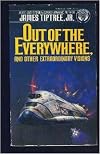
Out of the Everywhere
by James Tiptree Jr.
On This Page
Tags
Recommendations
























Member Reviews
I hadn't read any Tiptree before this; her stories are strong, and this anthology makes me want to read more. This is a very good collection, reflecting a strong, wry wit and a healthy discomfort with any bellicose and sexist society. Only one story here dragged for me; I found "Slow Music" both drawn out and trite, a long doggerel a bit too precious and without much final pay-off. On the other and more positive hand, the first story in the collection ("Angel Fix") is flat-out funny, the last two are brilliant, and "We Who Stole the 'Dream'" is ruefully memorable. This collection is definitely worth recommending.
A very dark set of stories, much more so than I was expecting. But these stories are among some of the more thoughtful stories about our troubled, human tendencies toward each other.
Tiptree is all in on examining gender troubles and the worlds portrayed in these stories have no shortage of men behaving terribly toward women. I could see some saying that the premise of some stories (e.g., a pathogen that causes men, collectively, to develop a desire to exterminate all women) is over the top, and I would agree. But it may be that I don't require as much boxing about the ears to see similar themes in more realistic and relatable narratives in 2024 than readers did in 1981. I don't know how well known it was at the time that James Tiptree show more was the nom de plume of Alice Sheldon. Nevertheless, these work for work for speculative science fiction pretty well.
In fact, the medium of science fiction seems well suited to this kind of intellectual and speculative work because it bridges the world we know with the world that could be. It bridges the here with the there, and the now with the future. On those grounds, Tiptree can fashion spaces and beings that bear a resemblance or connection to what we know but are just alien enough (in the general sense of the word) to be out of reach or unknowable. It is like a kind of latent frustration that it is possible to envisage a world that is not aggressively patriarchal and gender biased, but it remains out of reach. The last piece in this collection "With Delicate Mad Hands" is one of the best pieces in the collection and it illustrates this idea so nicely.
The other thing science fiction seems to do for Tiptree is to give an opportunity to set up aliens (in the more scifi-specific sense) as parallels to women. At the hands of men, aliens in this book are abused, enslaved, and generally mistreated in the worst possible ways. But in the absence of men, those relationships between aliens and women evolve in a different kind of way that allows insight into speculation about interpersonal relationship and politics. show less
Tiptree is all in on examining gender troubles and the worlds portrayed in these stories have no shortage of men behaving terribly toward women. I could see some saying that the premise of some stories (e.g., a pathogen that causes men, collectively, to develop a desire to exterminate all women) is over the top, and I would agree. But it may be that I don't require as much boxing about the ears to see similar themes in more realistic and relatable narratives in 2024 than readers did in 1981. I don't know how well known it was at the time that James Tiptree show more was the nom de plume of Alice Sheldon. Nevertheless, these work for work for speculative science fiction pretty well.
In fact, the medium of science fiction seems well suited to this kind of intellectual and speculative work because it bridges the world we know with the world that could be. It bridges the here with the there, and the now with the future. On those grounds, Tiptree can fashion spaces and beings that bear a resemblance or connection to what we know but are just alien enough (in the general sense of the word) to be out of reach or unknowable. It is like a kind of latent frustration that it is possible to envisage a world that is not aggressively patriarchal and gender biased, but it remains out of reach. The last piece in this collection "With Delicate Mad Hands" is one of the best pieces in the collection and it illustrates this idea so nicely.
The other thing science fiction seems to do for Tiptree is to give an opportunity to set up aliens (in the more scifi-specific sense) as parallels to women. At the hands of men, aliens in this book are abused, enslaved, and generally mistreated in the worst possible ways. But in the absence of men, those relationships between aliens and women evolve in a different kind of way that allows insight into speculation about interpersonal relationship and politics. show less
Actually, the only story I didn't finish was the last, the novellette 'With Delicate Mad Hands," because by that time I'd had enough Tiptree (this collection confirms that I'm not a fan) and I found a review online that described it well enough to me that I felt comfortable abandoning. And that's all I can say.
Oh, and I can add that the title of the collection is from a poem called "Baby" by the wonderful [a:George MacDonald|2413|George MacDonald|https://images.gr-assets.com/authors/1201019294p2/2413.jpg].
Oh, and I can add that the title of the collection is from a poem called "Baby" by the wonderful [a:George MacDonald|2413|George MacDonald|https://images.gr-assets.com/authors/1201019294p2/2413.jpg].
This contains "The Screwfly Solution" which was originally published as Racoona Sheldon, and it is also the winner of a Nebula. There are a couple that were written just for this collection. It's truly one of my favorite books.
Ratings
Members
- Recently Added By
Lists

Favorite Science Fiction by Women Authors
754 works; 203 members
Author Information

125+ Works 6,942 Members
James Tiptree, Jr., was the pseudonym that Alice Bradley Sheldon began to use for her writing in 1967. Born in Chicago, she grew up in Africa and India, worked for the CIA, and earned a Ph.D. in psychology. In 1987, when Tiptree and her husband became gravely ill, she killed him and herself
Some Editions
Series
Belongs to Publisher Series
Work Relationships
Common Knowledge
- Canonical title
- Out of the Everywhere
- Original title
- Out of the Everywhere and Other Extraordinary Visions
- Original publication date
- 1981
- Disambiguation notice*
- This is a collection. Do NOT combine with any short story.
*Some information comes from Common Knowledge in other languages. Click "Edit" for more information.
Classifications
Statistics
- Members
- 219
- Popularity
- 149,851
- Reviews
- 4
- Rating
- (4.23)
- Languages
- English, German
- Media
- Paper, Ebook
- ISBNs
- 3
- ASINs
- 3