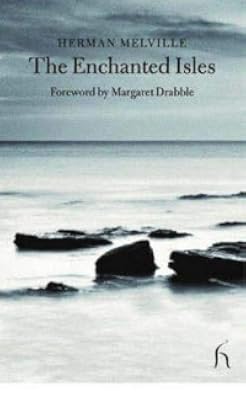
The Enchanted Isles
by Herman Melville 
On This Page
Description
One of Melville’s earliest writings, The Enchanted Isles is a hauntingly beautiful descriptive work inspired by a tour of the Galapagos Islands. Originally penned as a travelogue, Melville’s writings form a series of evocative sketches of each of the Galapagos Islands. Recounting their myths and legends, he conjures up the spirit of each in astonishing detail. Read together, they create a timeless classic, perfectly capturing the islands’ eternal charm and mystery.Tags
Recommendations





























Member Reviews
Sobre islas Galápagos
May 16, 2019Spanish
Ratings
Members
- Recently Added By
Author Information

661+ Works 78,658 Members
Herman Melville (August 1, 1819 - September 28, 1891) was born into a seemingly secure, prosperous world, a descendant of prominent Dutch and English families long established in New York State. That security vanished when first, the family business failed, and then, two years later, in young Melville's thirteenth year, his father died. Without show more enough money to gain the formal education that professions required, Melville was thrown on his own resources and in 1841 sailed off on a whaling ship bound for the South Seas. His experiences at sea during the next four years were to form in part the basis of his best fiction. Melville's first two books, Typee (1846) and Omoo (1847), were partly romance and partly autobiographical travel books set in the South Seas. Both were popular successes, particularly Typee, which included a stay among cannibals and a romance with a South Sea maiden. During the next several years, Melville published three more romances that drew upon his experiences at sea: Redburn (1849) and White-Jacket (1850), both fairly realistic accounts of the sailor's life and depicting the loss of innocence of central characters; and Mardi (1849), which, like the other two books, began as a romance of adventure but turned into an allegorical critique of contemporary American civilization. Moby Dick (1851) also began as an adventure story, based on Melville's experiences aboard the whaling ship. However, in the writing of it inspired in part by conversations with his friend and neighbor Hawthorne and partly by his own irrepressible imagination and reading of Shakespeare and other Renaissance dramatists Melville turned the book into something so strange that, when it appeared in print, many of his readers and critics were dumbfounded, even outraged. By the mid-1850s, Melville's literary reputation was all but destroyed, and he was obliged to live the rest of his life taking whatever jobs he could find and borrowing money from relatives, who fortunately were always in a position to help him. He continued to write, however, and published some marvelous short fiction pieces Benito Cereno" (1855) and "Bartleby, the Scrivener" (1853) are the best. He also published several volumes of poetry, the most important of which was Battle Pieces and Aspects of the War (1866), poems of occasionally great power that were written in response to the moral challenge of the Civil War. His posthumously published work, Billy Budd (1924), on which he worked up until the time of his death, became Melville's last significant literary work, a brilliant short novel that movingly describes a young sailor's imprisonment and death. Melville's reputation, however, rests most solidly on his great epic romance, Moby Dick. It is a difficult as well as a brilliant book, and many critics have offered interpretations of its complicated ambiguous symbolism. Darrel Abel briefly summed up Moby Dick as "the story of an attempt to search the unsearchable ways of God," although the book has historical, political, and moral implications as well. Melville died at his home in New York City early on the morning of September 28, 1891, at age 72. The doctor listed "cardiac dilation" on the death certificate. He was interred in the Woodlawn Cemetery in The Bronx, New York, along with his wife, Elizabeth Shaw Melville. (Bowker Author Biography) show less
Herman Melville has a Legacy Library. Legacy libraries are the personal libraries of famous readers, entered by LibraryThing members from the Legacy Libraries group.
Series
Belongs to Publisher Series
Work Relationships
Is contained in
Is abridged in
Common Knowledge
- Canonical title
- The Enchanted Isles
- Original title
- The Encantadas or Enchanted isles
- Original publication date
- 1854; 1856
- Important places
- Galápagos Islands; Rock Rodondo, Galápagos Islands; Narborough Island, Galápagos Islands; Albemarle Island, Galápagos Islands; Barrington Island, Galápagos Islands; Charles' Island, Galápagos Islands (show all 8); Norfolk Island, Galápagos Islands; Hood's Island, Galápagos Islands
- First words
- Take five-and-twenty heaps of cinders dumped here and there in an outside city lot, imagine some of them magnified into mountains, and the vacant lot the sea, and you will have a fit idea of the general aspect of the Encantad... (show all)as or Enchanted Isles.
Classifications
Statistics
- Members
- 126
- Popularity
- 259,551
- Reviews
- 1
- Rating
- (3.55)
- Languages
- 8 — Catalan, English, French, German, Italian, Portuguese, Russian, Spanish
- Media
- Paper, Audiobook
- ISBNs
- 17
- ASINs
- 5