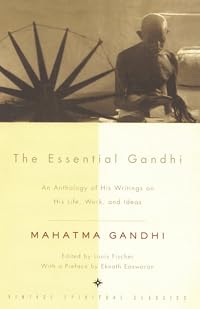
The Essential Gandhi: An Anthology of His Writings on His Life, Work, and Ideas
by Mahatma Gandhi
On This Page
Description
Mohandas K. Gandhi, called Mahatma ("great soul"), was the father of modern India, but his influence has spread well beyond the subcontinent and is as important today as it was in the first part of the twentieth century and during this nation's own civil rights movement. Taken from Gandhi's writings throughout his life, this text introduces the reader to Gandhi's thoughts on politics, spirituality, poverty, suffering, love, non-violence, civil disobedience, and his own life. The pieces show more collected here, with explanatory head notes by Gandhi biographer Louis Fischer, offer a clearest, thorough portrait of a great spiritual leader. show lessTags
Recommendations












Member Reviews
This is an awesome resource for primary material (Gandhi's own writings). The book presents excerpts from multiple sources, both from his time in South Africa and in India, in what seems to be a mostly chronological order. The way it's written makes it easy to read, almost like a first person novel.
In terms of the content itself, Gandhi was brilliant and way ahead of his time.
In terms of the content itself, Gandhi was brilliant and way ahead of his time.
The Essential Gandhi: An Anthology of His Life, Work and Ideas by Mahatma Gandhi, edited by Louis Fischer. Section 7 C: The Church in the World: Society/Human Rights/Justice. This is a compilation of the writings of Mohandas K. Gandhi, called Mahatma (“Great Soul”). It begins with his life, education in England as a lawyer, and his early work in South Africa on behalf of the oppressed Indian population there. Later he returned to India where he developed the idea that Indian could only become independent of English rule through satyagraha, “the force borne of truth, love and non-violence,” Based on American existentialist Henry Thoreau’s concept of civil disobedience, it took Gandhi much work and time to educate the Indians to show more this concept. Even if Indians were tortured, imprisoned, or mown down with gunfire, he said their response must be nonviolent. When riots erupted, Gandhi would fast to make his point. Satyagraha was based on Jesus’ teachings, and later used to great effect by Dr. King and his compatriots in the American civil rights movement.
Later chapters discuss Gandhi’s ideas. He advocated that Indians discard western clothing and wear only locally handspun cotton as a silent protest against British imperialism. Gandhi wore only a cotton loin cloth, cotton shawl and sandals. Indians had once spun their own cotton in their homes, only to be supplanted by English woven cloth made from Indian cotton. Gandhi advocated that every Indian household to have at least one spinning wheel, to spin their own cotton thread and take it to collective local weavers to be woven, cutting out the English completely. He also advocated gathering salt from the seashore to destroy the English monopoly on salt manufacture and sales. He wanted to abolish the heinous Hindu caste system in which a large percentage of Hindus were oppressed as “untouchables.”
Gandhi wanted all Indians – Hindus, Muslims, Parsis and Christians – to live in peace. He advocated world peace, and rather than feeding the hungry with handouts, he wanted all people to have the means to grow their own food. He believed in the value of manual labor and advised nobody to go to England to be educated, but to create Indian schools where children would be taught subject matter including chemistry and physics but also manual skills.
Gandhi was a very powerful force for freedom, peace, truth and love. He proved that nonviolent civil resistance was more powerful than any army or regime. He is probably the most influential, important person of the 20th century. His words still ring true today much like Jesus Christ’s words also ring true.
To make this book come alive, it is helpful and entertaining to watch the film classic Gandhi, starring Sir Ben Kingsley. Much like Daniel Day-Lewis’s recent portrayal of Abraham Lincoln is the closest we can probably get to Lincoln’s essence without having the real Lincoln’s image on film, Kingsley’s portrayal is probably the closest we can get to the essential Gandhi other than newsreels which often had prejudiced voice-overs. Kingsley said that the funeral procession scenes were shot in the same place they originally occurred, along with crowd members who had witnessed the actual funeral. He said as he lay on a large moving catafalque bedecked with thousands of marigold blossoms, the crowd was absolutely silent, filled with respect and awe. That must have been quite a thrill for Kingsley! show less
Later chapters discuss Gandhi’s ideas. He advocated that Indians discard western clothing and wear only locally handspun cotton as a silent protest against British imperialism. Gandhi wore only a cotton loin cloth, cotton shawl and sandals. Indians had once spun their own cotton in their homes, only to be supplanted by English woven cloth made from Indian cotton. Gandhi advocated that every Indian household to have at least one spinning wheel, to spin their own cotton thread and take it to collective local weavers to be woven, cutting out the English completely. He also advocated gathering salt from the seashore to destroy the English monopoly on salt manufacture and sales. He wanted to abolish the heinous Hindu caste system in which a large percentage of Hindus were oppressed as “untouchables.”
Gandhi wanted all Indians – Hindus, Muslims, Parsis and Christians – to live in peace. He advocated world peace, and rather than feeding the hungry with handouts, he wanted all people to have the means to grow their own food. He believed in the value of manual labor and advised nobody to go to England to be educated, but to create Indian schools where children would be taught subject matter including chemistry and physics but also manual skills.
Gandhi was a very powerful force for freedom, peace, truth and love. He proved that nonviolent civil resistance was more powerful than any army or regime. He is probably the most influential, important person of the 20th century. His words still ring true today much like Jesus Christ’s words also ring true.
To make this book come alive, it is helpful and entertaining to watch the film classic Gandhi, starring Sir Ben Kingsley. Much like Daniel Day-Lewis’s recent portrayal of Abraham Lincoln is the closest we can probably get to Lincoln’s essence without having the real Lincoln’s image on film, Kingsley’s portrayal is probably the closest we can get to the essential Gandhi other than newsreels which often had prejudiced voice-overs. Kingsley said that the funeral procession scenes were shot in the same place they originally occurred, along with crowd members who had witnessed the actual funeral. He said as he lay on a large moving catafalque bedecked with thousands of marigold blossoms, the crowd was absolutely silent, filled with respect and awe. That must have been quite a thrill for Kingsley! show less
Ratings
Members
- Recently Added By
Author Information

624+ Works 9,680 Members
Mohandas Gandhi is well known as a political activist and pacifist who played a key role in achieving India's independence from Great Britain. Although born in Porbandar, India, to parents of the Vaisya (merchant) caste, he was given a modern education and eventually studied law in London. After returning briefly to India, Gandhi went to South show more Africa in 1893, where he spent the next 20 years working to secure Indian rights. It was during this time that he experimented with and developed his basic philosophy of life. Philosophically, Gandhi is best known for his ideas of satyagraha (truth-force) and ahimsa (nonharming). Intrinsic to the idea of truth-force is the correlation between truth and being; truth is not merely a mental correspondence with reality but a mode of existence. Hence, the power of the truth is not what one argues for but what one is. He developed this idea in conjunction with the principle of nonviolence, showing in his nationalist activities that the force of truth, expressed nonviolently, can be an irresistible political weapon against intolerance, racism, and social violence. Although his basic terminology and conceptual context were Hindu, Gandhi was impressed by the universal religious emphasis on the self-transformative power of love, drawing his inspiration from Christianity, Western philosophy, and Islam as well. (Bowker Author Biography) show less
All Editions
Series
Belongs to Publisher Series
Work Relationships
Common Knowledge
- Original publication date
- 1962
- People/Characters
- Mohandas Gandhi
- Important places
- India
- Original language
- English
Classifications
- Genres
- Nonfiction, Biography & Memoir, General Nonfiction, Religion & Spirituality, History, Philosophy
- DDC/MDS
- 954.035092 — History & geography History of Asia India 1785–1947 British rule 1858–1947 Control by Crown History, geographic treatment, biography Biography
- LCC
- DS481 .G3 .A28 — History of Europe, Asia, Africa and Oceania Asia History of Asia India (Bharat) History
- BISAC
Statistics
- Members
- 628
- Popularity
- 46,500
- Reviews
- 2
- Rating
- (4.04)
- Languages
- English
- Media
- Paper, Ebook
- ISBNs
- 6
- ASINs
- 6