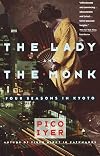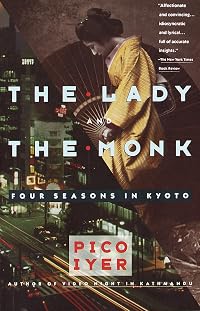
The Lady and the Monk: Four Seasons in Kyoto
by Pico Iyer
On This Page
Description
When Pico Iyer decided to go to Kyoto and live in a monastery, he did so to learn about Zen Buddhism from the inside, to get to know Kyoto, one of the loveliest old cities in the world, and to find out something about Japanese culture today-not the world of businessmen and production lines, but the traditional world of changing seasons and the silence of temples, of the images woven through literature, of the lunar Japan that still lives on behind the rising sun of geopolitical power. All show more this he did. And then he met Sachiko. Vivacious, attractive, thoroughly educated, speaking English enthusiastically if eccentrically, the wife of a Japanese "salaryman" who seldom left the office before Sachiko was as conversant with tea ceremony and classical Japanese literature as with rock music, Goethe, and Vivaldi. With the lightness of touch that made Video Night in Kathmandu so captivating, Pico Iyer fashions from their relationship a marvelously ironic yet heartfelt book that is at once a portrait of cross-cultural infatuation-and misunderstanding-and a delightfully fresh way of seeing both the old Japan and the very new. show lessTags
Recommendations







































Member Reviews
Much of what passes as travel writing is an exercise in ego, the world experienced and conveyed through the author's eye and pen. But here, and if it is deceit it is an almost perfect one, the author is off-centre. Saying more is less, a delicate tale of love, zen and passing time.
A delicate and profound tale of an unexpected friendship of an Indian traveler-writer and a house-bound mother of two in Kyoto. Redolent of the misty and green countryside, the well-loved gardens and shrines of this Japanese heartland, the story ends not in bitter-sweet parting, but in a union in partnership that has lasted these many decades (it is the actual life-story of the author). It occurs to me that this sort of story of the meeting of two souls, totally without any context or shared history, could probably happen only to an Indian. A great book for learners of Japanese, as it delves into the Japanese soul and into the vagaries of communication across cultures with not-so-strong language skills.
Nothing much happens in this exploration of cultural distinctions. We're not even sure how far the author "gets" with 'the lady,' though it does not really matter. Inasmuch as I have always been fascinated by Kyoto and Zen, I found it fascinating nevertheless. Also explores the world of the expat and how reverse culture shock strikes once one leaves the country one has been visiting.
http://pixxiefishbooks.blogspot.com/2...
In the late 1980s, Pico Iyer came to Kyoto for a year, to try his hand at learning more about the Japanese culture. What he learns, and what any person who has spent a significant chunk of time in the country will likely corroborate, is that Japan is a country of contradictions, a country pushing relentlessly into the future while still holding particular ties to many of its traditional cultural and religious roots.
Iyer doesn't learn this by contemplating in front of a Zen rock garden, however. His guide turns out to be the most unlikely person, a petite, 20-something mother of two called Sachiko. She is small and superbly naive, but she dreams big, sharing her thoughts and ideas in her show more devil-may-care English.
This was quite a lovely book, though I sometimes found it strange and jarring to be reading it while in Japan. I'm not sure why that was. Perhaps it was that the Japan that I was reading about was all too much like the Japan in which I was actually living. While perhaps that seems strange, it isn't. Iyer's Japan is magical and mundane, steeped in culture and completely removed from the outside world at the same time. This is entirely too much like the Japan I know. If you've never been to Japan, Sachiko's character might seem overly precocious and naive, a cute character sketch from the late 1980s, but not possibly a real person...but once you come here, you realize that not much has changed, and people are really like this.
That aside, it was a great read and I recommend it to anyone who has the slightest interest in Japan. It's a nice, little romance, but can also be taken as much more. show less
In the late 1980s, Pico Iyer came to Kyoto for a year, to try his hand at learning more about the Japanese culture. What he learns, and what any person who has spent a significant chunk of time in the country will likely corroborate, is that Japan is a country of contradictions, a country pushing relentlessly into the future while still holding particular ties to many of its traditional cultural and religious roots.
Iyer doesn't learn this by contemplating in front of a Zen rock garden, however. His guide turns out to be the most unlikely person, a petite, 20-something mother of two called Sachiko. She is small and superbly naive, but she dreams big, sharing her thoughts and ideas in her show more devil-may-care English.
This was quite a lovely book, though I sometimes found it strange and jarring to be reading it while in Japan. I'm not sure why that was. Perhaps it was that the Japan that I was reading about was all too much like the Japan in which I was actually living. While perhaps that seems strange, it isn't. Iyer's Japan is magical and mundane, steeped in culture and completely removed from the outside world at the same time. This is entirely too much like the Japan I know. If you've never been to Japan, Sachiko's character might seem overly precocious and naive, a cute character sketch from the late 1980s, but not possibly a real person...but once you come here, you realize that not much has changed, and people are really like this.
That aside, it was a great read and I recommend it to anyone who has the slightest interest in Japan. It's a nice, little romance, but can also be taken as much more. show less
Iyer is a sharp-eyed and thoughtful observer, and he is successful in evoking the life of Tokyo's malls, temples, and back streets, moonlit nights on the water, and the vulgarity of the Westernized nightclub and amusement quarter - New Yorker
The allure and ultimately futile pursuit to obtain the core understanding of OTHER, on the part of a a travel writer and a married japanese woman
Iyer moves to Kyoto, Japan to write. While there, he meets a young Japanese wife and mother, as anxious to practice her English as he was to practice his Japanese. Thus a relationship was born, between the two cultures. Fascinating book.
Members
- Recently Added By
Lists

Travelogues in Japan
22 works; 3 members
Author Information

35+ Works 5,318 Members
Pico Iyer was born in Oxford, England to Indian parents, who immigrated to California in 1957. He received a B.A. and M.A. from Oxford University and a second masters degree from Harvard University. From 1982 to 1985, he was a writer for Time magazine. Following a leave of absence to visit Asia, Iyer wrote Video Nights in Katmandu: And Other show more Reports from the Not-So-Far East. In 1986 he returned to Time as a contributor. He also contributes regularly to Conde Nast Traveler magazine. Pico Iyer has written several other travel books including The Lady and the Monk: Four Seasons in Kyoto; Falling Off the Map: Some Lonely Places in the World; and Tropical Classical: Essays from Several Directions. (Bowker Author Biography) show less
Awards and Honors
Awards
Series
Belongs to Publisher Series
Common Knowledge
- Original publication date
- 1991
- Important places
- Kyoto, Japan; Japan; Honshū, Japan
Classifications
Statistics
- Members
- 611
- Popularity
- 47,797
- Reviews
- 12
- Rating
- (3.73)
- Languages
- Dutch, English, Italian
- Media
- Paper, Audiobook, Ebook
- ISBNs
- 16
- ASINs
- 3