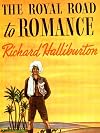
The Royal Road to Romance
by Richard Halliburton
On This Page
Description
"The Royal Road to Romance is the travel classic in which a happy, young romanticist goes laughing and beating and fighting his vagabond way into the glamorous corners of the world. When Richard Halliburton graduated from Princeton, he chose adventure over a career, traveling to far away places. This vivid book tells what happened, from a break-through Matterhorn mountain ascent in the Alps to being jailed for taking forbidden pictures on Gibraltar. "One of the most fascinating books of its show more kind ever written." In 1939 the swashbuckling author was lost at sea in the Pacific."-- show lessTags
Recommendations
























Member Reviews
The Royal Road to Romance opens with Halliburton's Princeton days when the mere scent of apple blossoms could distract him from his studies. Indeed, he had an adventurous spirit from a very young age and was a self-proclaimed "horizon chaser." Later he calls himself the "devil's pet protégé", unable to resist the call of the road.
Halliburton was a reckless adventurer. He yielded to illegal temptations all the time. He told a stranger he was "in quest of the pot of gold at the foot of the rainbow" (p 102). For some reason he and his roommate wanted to climb the Matterhorn so badly that they were willing to lie about their mountaineering experience and hide their lack of equipment. They traveled without an itinerary; going where the show more fancy took them. Halliburton made impetuous decisions - jumping off a train somewhere in Switzerland because he couldn't get a sense of the countryside by rail, breaking into the gardens of the Generalife by scaling a wall protected by thorny rose bushes, or using lies to get where he anywhere needed to go. He told one farmer he was a horse doctor so that he could acquire a donkey. After he was arrested he told a guard he was a train robber and bigamist and then stole a copy of the Short History of Gibraltar as a souvenir of his penal adventure.
Other adventures include climbing the pyramids at night, swimming naked in the Nile, trekking to the city of Ladakh where only twelve white visitors are allowed each year (because he wants to see a town that practices polyandry) and climbing Mount Fuji in the offseason, just to say he did. show less
Halliburton was a reckless adventurer. He yielded to illegal temptations all the time. He told a stranger he was "in quest of the pot of gold at the foot of the rainbow" (p 102). For some reason he and his roommate wanted to climb the Matterhorn so badly that they were willing to lie about their mountaineering experience and hide their lack of equipment. They traveled without an itinerary; going where the show more fancy took them. Halliburton made impetuous decisions - jumping off a train somewhere in Switzerland because he couldn't get a sense of the countryside by rail, breaking into the gardens of the Generalife by scaling a wall protected by thorny rose bushes, or using lies to get where he anywhere needed to go. He told one farmer he was a horse doctor so that he could acquire a donkey. After he was arrested he told a guard he was a train robber and bigamist and then stole a copy of the Short History of Gibraltar as a souvenir of his penal adventure.
Other adventures include climbing the pyramids at night, swimming naked in the Nile, trekking to the city of Ladakh where only twelve white visitors are allowed each year (because he wants to see a town that practices polyandry) and climbing Mount Fuji in the offseason, just to say he did. show less
What a great read! Full of dash and swag and daring-do and, yes, romance – the romance of travel, the romance of nostalgia, the romance of an age in which an ambitious, fearless young man could decide to temporarily abandon his Princeton education and spend a couple of years wandering the world in search of outrageous adventure, sustained merely by bravado, an iron constitution, and 1000s of years of white privilege. If you enjoy travel tales well told; if you long for the world the way it was before globalization began its soulless, homogenizing work; if destinations with glamorous names like Siam and Kashmir, Algiers and Srinagar make something in your soul thrill, then this is the book for you!
Just to be clear, this is (more or show more less) a work of non-fiction. Richard Halliburton really did undertake, in the course of less than two years, an extraordinary series of adventures, some of which are summarized below. To fund his adventures, however, he relied on payments from the newspapers that ran the stories he submitted to them of his adventures, so the tales he tells here are heavy on adventure, danger, comedy and romance while simultaneously light on details. And if some of Halliburton’s prose comes off as occasionally patronizing, intolerant, or judgmental (especially in the case of the Japanese), at least some of that needs to be put to the credit of the times that Halliburton lived in, and the racial prejudices of the privileged white class to which he belonged.
Whatever his drawbacks as a reliable narrator, you have to love the guy’s utter lack of humility! In a chapter humbly titled “Humiliating the Matterhorn,” he recounts his adventures attaining the peak of this storied mountain; later, he also ascends Mt. Fuji in the middle of winter. He recounts magical nights spent sleeping the gardens of the Taj Majal, overlooking desert vistas from atop the pyramids of Egypt, and wandering the wonders of Alhambra. He spends one Christmas in balmy Seville, the next in a blizzard-assailed wooden church in the tundras of Russia. He participates in a tiger hunt in India, swims with crocodiles in the Nile River, and barely survives a mule-transit of the Pyrenees. He witnesses an imperial wedding in Japan, the installation of a child Shushok (a living incarnation of Bakola, a saintly contemporary of Buddha) at a Tibetan monastery, and then a memorial funeral ceremony in Bali, where the corpse is nearly torn asunder by rioting natives representing the “Forces of Earth” vs. the “Forces of Heaven.” Among other perils, he is assailed by leeches while endeavoring a 40mile transit of unassailable rainforest, attacked by pirates on a Macau gambling boat, and thrown into a Gibralter jail on suspicion of spying. And lest we forget that romance isn’t just about travel, our resolute hero manages to gets locked into the Trocadero Palais at night with a French damsel, picnics with a fiery Spanish dancer while in Barcelona, fraternizes with a New York debutante in the gambling dens of Monte Carlo, and even manages to exhort a bashful Hindu maiden into accompanying him on a boatride across a romantic Udaipur lake. And so very many castles, temples, and estates …! Chillon Castle in Paris, famous for inspiring Lord Byron’s The Prisoner of Chillon. Fontevrautl, where abbey where Richard the Lionhert “breathed his last.” Carcassonne, full of the ghosts of Crusaders and Saracens and Visigoths. Ankgor Wat, the abandoned city of the Khmers.
To be clear, Halliburton’s extraordinary feats are consistently abetted by the intercession of endlessly hospitable strangers. This is where the whole “white privilege” thing becomes relevant, for whenever he finds himself destitute or homeless along the way, there always seems to be a train conductor willing to let him ride first-class on a third-class fare, a European colonial delighted to invite him spend time recouping at their villa, or a Y.M.C.A. with rooms to let. (I had no idea YMCAs were the hostels of the their day, located in exotic cities all over the world!) Other affable strangers who help him along the include a host of crusty seamen, a “polyamorous” Ladakhian family in Tibet, tribes of rain forest natives, a family of Balinese salt-makers, any number of American and English diplomats and expats, and no less than the President of Andorra - according to our author, “the oldest, the smallest, the highest, the quaintest, the most isolated republic on Earth. Also charming: how easily the author picks up and discards travelling companions along the way – fellow young men, like himself, intent upon seeing the world at their own pace and upon their own terms. Somewhat less charming: Though he always expresses gratitude for the help he receives, it doesn't seem to occur to Halliburton to apologize when he manages to mooch something that doesn't belong to him or run out on a bill.
Not sure how recent editions of the novel are presented, but my 1925 edition incorporates endpapers depicting a gloriously cheesy map of the entire journey – an “Indiana Jones”-like graphic showing the author biking his way through England, boating across oceans, climbing mountains, being pulled in a sampan, witnessing a beheading, relaxing under palm trees, falling in a pool, staring out from behind the bars of a jail, dressed in dapper clothes on his way to the casino, waylaid by pirates – all connected by a wide dashed line that completes the work of transforming the journey into an epic adventure. Honestly, I wish I could figure out how to copy the whole thing and hang it on my wall, so that every time I looked at it, I could imagine myself off on some similar adventure, perhaps surveying from the front seat of a dusty Range Rover the vast expanse of the Serengeti sprawled out before me, or traveling with a tribe of Native Americans over the plains, or surveying the Nazca lines from a hot air balloon. Makes me wish I could have been born in a different decade …! show less
Just to be clear, this is (more or show more less) a work of non-fiction. Richard Halliburton really did undertake, in the course of less than two years, an extraordinary series of adventures, some of which are summarized below. To fund his adventures, however, he relied on payments from the newspapers that ran the stories he submitted to them of his adventures, so the tales he tells here are heavy on adventure, danger, comedy and romance while simultaneously light on details. And if some of Halliburton’s prose comes off as occasionally patronizing, intolerant, or judgmental (especially in the case of the Japanese), at least some of that needs to be put to the credit of the times that Halliburton lived in, and the racial prejudices of the privileged white class to which he belonged.
Whatever his drawbacks as a reliable narrator, you have to love the guy’s utter lack of humility! In a chapter humbly titled “Humiliating the Matterhorn,” he recounts his adventures attaining the peak of this storied mountain; later, he also ascends Mt. Fuji in the middle of winter. He recounts magical nights spent sleeping the gardens of the Taj Majal, overlooking desert vistas from atop the pyramids of Egypt, and wandering the wonders of Alhambra. He spends one Christmas in balmy Seville, the next in a blizzard-assailed wooden church in the tundras of Russia. He participates in a tiger hunt in India, swims with crocodiles in the Nile River, and barely survives a mule-transit of the Pyrenees. He witnesses an imperial wedding in Japan, the installation of a child Shushok (a living incarnation of Bakola, a saintly contemporary of Buddha) at a Tibetan monastery, and then a memorial funeral ceremony in Bali, where the corpse is nearly torn asunder by rioting natives representing the “Forces of Earth” vs. the “Forces of Heaven.” Among other perils, he is assailed by leeches while endeavoring a 40mile transit of unassailable rainforest, attacked by pirates on a Macau gambling boat, and thrown into a Gibralter jail on suspicion of spying. And lest we forget that romance isn’t just about travel, our resolute hero manages to gets locked into the Trocadero Palais at night with a French damsel, picnics with a fiery Spanish dancer while in Barcelona, fraternizes with a New York debutante in the gambling dens of Monte Carlo, and even manages to exhort a bashful Hindu maiden into accompanying him on a boatride across a romantic Udaipur lake. And so very many castles, temples, and estates …! Chillon Castle in Paris, famous for inspiring Lord Byron’s The Prisoner of Chillon. Fontevrautl, where abbey where Richard the Lionhert “breathed his last.” Carcassonne, full of the ghosts of Crusaders and Saracens and Visigoths. Ankgor Wat, the abandoned city of the Khmers.
To be clear, Halliburton’s extraordinary feats are consistently abetted by the intercession of endlessly hospitable strangers. This is where the whole “white privilege” thing becomes relevant, for whenever he finds himself destitute or homeless along the way, there always seems to be a train conductor willing to let him ride first-class on a third-class fare, a European colonial delighted to invite him spend time recouping at their villa, or a Y.M.C.A. with rooms to let. (I had no idea YMCAs were the hostels of the their day, located in exotic cities all over the world!) Other affable strangers who help him along the include a host of crusty seamen, a “polyamorous” Ladakhian family in Tibet, tribes of rain forest natives, a family of Balinese salt-makers, any number of American and English diplomats and expats, and no less than the President of Andorra - according to our author, “the oldest, the smallest, the highest, the quaintest, the most isolated republic on Earth. Also charming: how easily the author picks up and discards travelling companions along the way – fellow young men, like himself, intent upon seeing the world at their own pace and upon their own terms. Somewhat less charming: Though he always expresses gratitude for the help he receives, it doesn't seem to occur to Halliburton to apologize when he manages to mooch something that doesn't belong to him or run out on a bill.
Not sure how recent editions of the novel are presented, but my 1925 edition incorporates endpapers depicting a gloriously cheesy map of the entire journey – an “Indiana Jones”-like graphic showing the author biking his way through England, boating across oceans, climbing mountains, being pulled in a sampan, witnessing a beheading, relaxing under palm trees, falling in a pool, staring out from behind the bars of a jail, dressed in dapper clothes on his way to the casino, waylaid by pirates – all connected by a wide dashed line that completes the work of transforming the journey into an epic adventure. Honestly, I wish I could figure out how to copy the whole thing and hang it on my wall, so that every time I looked at it, I could imagine myself off on some similar adventure, perhaps surveying from the front seat of a dusty Range Rover the vast expanse of the Serengeti sprawled out before me, or traveling with a tribe of Native Americans over the plains, or surveying the Nazca lines from a hot air balloon. Makes me wish I could have been born in a different decade …! show less
The Royal Road to Romance (1925) is the first book by Richard Halliburton, an American travel writer and adventurer who was popular in the 1920s and 30s. It starts out as he graduates from Princeton at age 22 to 'seize the day' and travel around the world on romantic adventures as a tramp. Each chapter highlights some adventure in one country or another (Spain, Egypt, India, etc) usually involving getting by with little money and visiting romantic locations, typically in a risky fashion. For example, he visits Chillon Castle on Lake Geneva where Lord Byron wrote his famous ode to the prisoner there, and Halliburton waits until dusk and swims to the dungeon windows to peer inside. These episodes apparently appealed to the American show more public and he became an unexpected success. He was a fresh voice of a new generation, the modern generation, in the realm of travel writing. He went on to many other adventures and books and speaking tours. He influenced other writers and journalists including Walter Cronkite and Ernest Hemingway.
Giving it a low star rating as I didn't like him very much and was glad when it ended. His writing is not terribly good, almost cartoonist, a shell of true romanticism. His primary aim seems to be entertainment for the sake of it, like a YouTube star who does dangerous stunts in exchange for ratings. A marketing creation, a personality not a person. He had a ghost writer. This was not a journey of inward discovery or appreciation of nature and diversity, but seeing the world as an amusement park for the white man who sits atop it. This last comment is intentional as while on the one hand he travels as a tramp with little money, he is in reality the son of privilege, a graduate of Princeton who appeals to porters and administrators as a white person, he literally says this without irony, to open the doors he needs to continue on a faux tramp journey. show less
Giving it a low star rating as I didn't like him very much and was glad when it ended. His writing is not terribly good, almost cartoonist, a shell of true romanticism. His primary aim seems to be entertainment for the sake of it, like a YouTube star who does dangerous stunts in exchange for ratings. A marketing creation, a personality not a person. He had a ghost writer. This was not a journey of inward discovery or appreciation of nature and diversity, but seeing the world as an amusement park for the white man who sits atop it. This last comment is intentional as while on the one hand he travels as a tramp with little money, he is in reality the son of privilege, a graduate of Princeton who appeals to porters and administrators as a white person, he literally says this without irony, to open the doors he needs to continue on a faux tramp journey. show less
The Royal Road to Romance (1925) is the first book by Richard Halliburton, an American travel writer and adventurer who was popular in the 1920s and 30s. It starts out as he graduates from Princeton at age 22 to 'seize the day' and travel around the world on romantic adventures as a tramp. Each chapter highlights some adventure in one country or another (Spain, Egypt, India, etc) usually involving getting by with little money and visiting romantic locations, typically in a risky fashion. For example, he visits Chillon Castle on Lake Geneva where Lord Byron wrote his famous ode to the prisoner there, and Halliburton waits until dusk and swims to the dungeon windows to peer inside. These episodes apparently appealed to the American public show more and he became an unexpected success. He was a fresh voice of a new generation, the modern generation, in the realm of travel writing. He went on to many other adventures and books and speaking tours. He influenced other writers and journalists including Walter Cronkite and Ernest Hemingway.
Giving it a low star rating as I didn't like him very much and was glad when it ended. His writing is not terribly good, almost cartoonist, a shell of true romanticism. His primary aim seems to be entertainment for the sake of it, like a YouTube star who does dangerous stunts in exchange for ratings. A marketing creation, a personality not a person. He had a ghost writer. This was not a journey of inward discovery or appreciation of nature and diversity, but seeing the world as an amusement park for the white man who sits atop it. This last comment is intentional as while on the one hand he travels as a tramp with little money, he is in reality the son of privilege, a graduate of Princeton who appeals to porters and administrators as a white person, he literally says this without irony, to open the doors he needs to continue on a faux tramp journey.
**Another viewpoint:
What a great read! Full of dash and swag and daring-do and, yes, romance – the romance of travel, the romance of nostalgia, the romance of an age in which an ambitious, fearless young man could decide to temporarily abandon his Princeton education and spend a couple of years wandering the world in search of outrageous adventure, sustained merely by bravado, an iron constitution, and 1000s of years of white privilege. If you enjoy travel tales well told; if you long for the world the way it was before globalization began its soulless, homogenizing work; if destinations with glamorous names like Siam and Kashmir, Algiers and Srinagar make something in your soul thrill, then this is the book for you!
Just to be clear, this is (more or less) a work of non-fiction. Richard Halliburton really did undertake, in the course of less than two years, an extraordinary series of adventures, some of which are summarized below. To fund his adventures, however, he relied on payments from the newspapers that ran the stories he submitted to them of his adventures, so the tales he tells here are heavy on adventure, danger, comedy and romance while simultaneously light on details. And if some of Halliburton’s prose comes off as occasionally patronizing, intolerant, or judgmental (especially in the case of the Japanese), at least some of that needs to be put to the credit of the times that Halliburton lived in, and the racial prejudices of the privileged white class to which he belonged.
Whatever his drawbacks as a reliable narrator, you have to love the guy’s humility! In a chapter humbly titled “Humiliating the Matterhorn,” he recounts his adventures attaining the peak of this storied mountain; later, he also ascends Mt. Fuji in the middle of winter. He recounts magical nights spent sleeping the gardens of the Taj Majal, overlooking desert vistas from atop the pyramids of Egypt, and wandering the wonders of Alhambra. He spends one Christmas in balmy Seville, the next in a blizzard-assailed wooden church in the tundras of Russia. He participates in a tiger hunt in India, swims with crocodiles in the Nile River, and barely survives a mule-transit of the Pyrenees. He witnesses an imperial wedding in Japan, the installation of a child Shushok (a living incarnation of Bakola, a saintly contemporary of Buddha) at a Tibetan monastery, and then a memorial funeral ceremony in Bali, where the corpse is nearly torn asunder by rioting natives representing the “Forces of Earth” vs. the “Forces of Heaven.” Among other perils, he is assailed by leeches while endeavoring a 40mile transit of unassailable rainforest, attacked by pirates on a Macau gambling boat, and thrown into a Gibralter jail on suspicion of spying. And lest we forget that romance isn’t just about travel, our resolute hero manages to gets locked into the Trocadero Palais at night with a French damsel, picnics with a fiery Spanish dancer while in Barcelona, fraternizes with a New York debutante in the gambling dens of Monte Carlo, and even manages to exhort a bashful Hindu maiden into accompanying him on a boatride across a romantic Udaipur lake. And so very many castles, temples, and estates …! Chillon Castle in Paris, famous for inspiring Lord Byron’s The Prisoner of Chillon. Fontevrautl, where abbey where Richard the Lionhert “breathed his last.” Carcassonne, full of the ghosts of Crusaders and Saracens and Visigoths. Ankgor Wat, the abandoned city of the Khmers.
To be clear, Halliburton’s extraordinary feats are consistently abetted by the intercession of endlessly hospitable strangers. This is where the whole “white privilege” thing becomes relevant, for whenever he finds himself destitute or homeless along the way, there always seems to be a train conductor willing to let him ride first-class on a third-class fare, a European colonial delighted to invite him spend time recouping at their villa, or a Y.M.C.A. with rooms to let. (I had no idea YMCAs were the hostels of the their day, located in exotic cities all over the world!) Other affable strangers who help him along the include a host of crusty seamen, a “polyamorous” Ladakhian family in Tibet, tribes of rain forest natives, a family of Balinese salt-makers, any number of American and English diplomats and expats, and no less than the President of Andorra - according to our author, “the oldest, the smallest, the highest, the quaintest, the most isolated republic on Earth. Also charming: how easily the author picks up and discards travelling companions along the way – fellow young men, like himself, intent upon seeing the world at their own pace and upon their own terms. Somewhat less charming: Though he always expresses gratitude for the help he receives, it doesn't seem to occur to Halliburton to apologize when he manages to mooch something that doesn't belong to him or run out on a bill.
Not sure how recent editions of the novel are presented, but my 1925 edition incorporates endpapers depicting a gloriously cheesy map of the entire journey – an “Indiana Jones”-like graphic showing the author biking his way through England, boating across oceans, climbing mountains, being pulled in a sampan, witnessing a beheading, relaxing under palm trees, falling in a pool, staring out from behind the bars of a jail, dressed in dapper clothes on his way to the casino, waylaid by pirates – all connected by a wide dashed line that completes the work of transforming the journey into an epic adventure. Honestly, I wish I could figure out how to copy the whole thing and hang it on my wall, so that every time I looked at it, I could imagine myself off on some similar adventure, perhaps surveying from the front seat of a dusty Range Rover the vast expanse of the Serengeti sprawled out before me, or traveling with a tribe of Native Americans over the plains, or surveying the Nazca lines from a hot air balloon. Makes me wish I could have been born in a different decade …! show less
Giving it a low star rating as I didn't like him very much and was glad when it ended. His writing is not terribly good, almost cartoonist, a shell of true romanticism. His primary aim seems to be entertainment for the sake of it, like a YouTube star who does dangerous stunts in exchange for ratings. A marketing creation, a personality not a person. He had a ghost writer. This was not a journey of inward discovery or appreciation of nature and diversity, but seeing the world as an amusement park for the white man who sits atop it. This last comment is intentional as while on the one hand he travels as a tramp with little money, he is in reality the son of privilege, a graduate of Princeton who appeals to porters and administrators as a white person, he literally says this without irony, to open the doors he needs to continue on a faux tramp journey.
**Another viewpoint:
What a great read! Full of dash and swag and daring-do and, yes, romance – the romance of travel, the romance of nostalgia, the romance of an age in which an ambitious, fearless young man could decide to temporarily abandon his Princeton education and spend a couple of years wandering the world in search of outrageous adventure, sustained merely by bravado, an iron constitution, and 1000s of years of white privilege. If you enjoy travel tales well told; if you long for the world the way it was before globalization began its soulless, homogenizing work; if destinations with glamorous names like Siam and Kashmir, Algiers and Srinagar make something in your soul thrill, then this is the book for you!
Just to be clear, this is (more or less) a work of non-fiction. Richard Halliburton really did undertake, in the course of less than two years, an extraordinary series of adventures, some of which are summarized below. To fund his adventures, however, he relied on payments from the newspapers that ran the stories he submitted to them of his adventures, so the tales he tells here are heavy on adventure, danger, comedy and romance while simultaneously light on details. And if some of Halliburton’s prose comes off as occasionally patronizing, intolerant, or judgmental (especially in the case of the Japanese), at least some of that needs to be put to the credit of the times that Halliburton lived in, and the racial prejudices of the privileged white class to which he belonged.
Whatever his drawbacks as a reliable narrator, you have to love the guy’s humility! In a chapter humbly titled “Humiliating the Matterhorn,” he recounts his adventures attaining the peak of this storied mountain; later, he also ascends Mt. Fuji in the middle of winter. He recounts magical nights spent sleeping the gardens of the Taj Majal, overlooking desert vistas from atop the pyramids of Egypt, and wandering the wonders of Alhambra. He spends one Christmas in balmy Seville, the next in a blizzard-assailed wooden church in the tundras of Russia. He participates in a tiger hunt in India, swims with crocodiles in the Nile River, and barely survives a mule-transit of the Pyrenees. He witnesses an imperial wedding in Japan, the installation of a child Shushok (a living incarnation of Bakola, a saintly contemporary of Buddha) at a Tibetan monastery, and then a memorial funeral ceremony in Bali, where the corpse is nearly torn asunder by rioting natives representing the “Forces of Earth” vs. the “Forces of Heaven.” Among other perils, he is assailed by leeches while endeavoring a 40mile transit of unassailable rainforest, attacked by pirates on a Macau gambling boat, and thrown into a Gibralter jail on suspicion of spying. And lest we forget that romance isn’t just about travel, our resolute hero manages to gets locked into the Trocadero Palais at night with a French damsel, picnics with a fiery Spanish dancer while in Barcelona, fraternizes with a New York debutante in the gambling dens of Monte Carlo, and even manages to exhort a bashful Hindu maiden into accompanying him on a boatride across a romantic Udaipur lake. And so very many castles, temples, and estates …! Chillon Castle in Paris, famous for inspiring Lord Byron’s The Prisoner of Chillon. Fontevrautl, where abbey where Richard the Lionhert “breathed his last.” Carcassonne, full of the ghosts of Crusaders and Saracens and Visigoths. Ankgor Wat, the abandoned city of the Khmers.
To be clear, Halliburton’s extraordinary feats are consistently abetted by the intercession of endlessly hospitable strangers. This is where the whole “white privilege” thing becomes relevant, for whenever he finds himself destitute or homeless along the way, there always seems to be a train conductor willing to let him ride first-class on a third-class fare, a European colonial delighted to invite him spend time recouping at their villa, or a Y.M.C.A. with rooms to let. (I had no idea YMCAs were the hostels of the their day, located in exotic cities all over the world!) Other affable strangers who help him along the include a host of crusty seamen, a “polyamorous” Ladakhian family in Tibet, tribes of rain forest natives, a family of Balinese salt-makers, any number of American and English diplomats and expats, and no less than the President of Andorra - according to our author, “the oldest, the smallest, the highest, the quaintest, the most isolated republic on Earth. Also charming: how easily the author picks up and discards travelling companions along the way – fellow young men, like himself, intent upon seeing the world at their own pace and upon their own terms. Somewhat less charming: Though he always expresses gratitude for the help he receives, it doesn't seem to occur to Halliburton to apologize when he manages to mooch something that doesn't belong to him or run out on a bill.
Not sure how recent editions of the novel are presented, but my 1925 edition incorporates endpapers depicting a gloriously cheesy map of the entire journey – an “Indiana Jones”-like graphic showing the author biking his way through England, boating across oceans, climbing mountains, being pulled in a sampan, witnessing a beheading, relaxing under palm trees, falling in a pool, staring out from behind the bars of a jail, dressed in dapper clothes on his way to the casino, waylaid by pirates – all connected by a wide dashed line that completes the work of transforming the journey into an epic adventure. Honestly, I wish I could figure out how to copy the whole thing and hang it on my wall, so that every time I looked at it, I could imagine myself off on some similar adventure, perhaps surveying from the front seat of a dusty Range Rover the vast expanse of the Serengeti sprawled out before me, or traveling with a tribe of Native Americans over the plains, or surveying the Nazca lines from a hot air balloon. Makes me wish I could have been born in a different decade …! show less
This book was written by an American adventurer who lived between 1900 and 1939; his books and lectures were very popular in the 20s and 30s. He was from a well-off family and graduated from Princeton, but then turned his back on the dull life of a businessman which awaited him and, together with a former roommate, decided to trot the world making money along the way. They lied that they were experienced sailors to get jobs on a ship bound for Europe, explored The Netherlands and Germany on bicycles, and climbed the Matterhorn in the Swiss Alps. It was already September and past season, but they told the guides that they had climbed all sorts of dangerous mountains in America (although the author says they had never climbed anything show more higher than a flight of steps), and the guides agreed to take them. Halliburton would have died twice if his guide hadn't saved him. Then they got to France where they replenished their finances by giving dancing lessons and explored Paris in the company of a local cabaret dancer whom they had befriended. Afterwards the author's friend left for Italy which was his lifelong dream, and Halliburton went to explore French castles and then over the Pyrenees to Andorra and Spain. It was December then, and the mule-lending agency didn't want to give him an animal, but after he told them that he had worked as an Alpine guide and was a veterinarian into the bargain, they changed their minds. He lost his way completely on the high pass, but luckily for him the mule who had traveled back and forth all the time knew the road by instinct and led him to Andorra – a tiny country between France and Spain, which had about 5,000 inhabitants then. He asked the innkeeper who could give him some information about the country and was advised to see its president. The President answered his knock, invited him into his house, offered him a pair of slippers and a place by the fireside, and asked him how he could help him. He gladly spent the evening talking about his country. The author went on on his adventurers, sleeping on top the Cheops Pyramid, hiking through the Himalayas, spending another memorable night in the Taj Mahal, exploring the temples of Angkor, surviving a pirate attack in the South China Sea, etc. It’s a fascinating book. Its only flaw is that, being an upper-class American of his time, he does at times project the prejudices and attitudes of his class and era, even when traveling as a stowaway, in a way that is sometimes hard to read today. Then again, one can apply the same historical perspective to his view of the world as one does to his descriptions of it and find it an interesting illustration of a well-educated and curious rich western young man of the 1920s with all his contradictions. show less
When Richard Halliburton graduated from college, he chose adventure over a career, traveling the world with almost no money. The Royal Road to Romance chronicles what happened as a result, from a breakthrough Matterhorn ascent to being jailed for taking forbidden pictures on Gibraltar. "One of the most fascinating books of its kind ever written."
Includes a chapter on Bali where he saw a cremation.
Includes a chapter on Bali where he saw a cremation.
I remember a teacher reading this book to us in 6th grade and loving the adventure. As an adult I found Halliburton a little to snobbish, and too much of a moocher. I thought he disrespected other cultures. He writes well and tells a good story.
Members
- Recently Added By
Lists

Publisher's Weekly NON-Fiction list - 1912 - 1975
486 works; 4 members

Isle Royale
18 works; 1 member
Author Information

13+ Works 2,764 Members
Awards and Honors
Distinctions
Work Relationships
Common Knowledge
- Original publication date
- 1925
- Dedication
- To Irvine Oty Hockaday, john Henry Leh, Edward Lawrence Keyes, James Penfield Seiberling, Whose sanity, consistency and respectability as Princeton roommates drove me to this book.
- First words
- May had come at last to Princeton.
- Last words
- (Click to show. Warning: May contain spoilers.)In this glittering blaze of glory I returned to my paternal hearth on the first day of March, six hundred days after my departure from New York, fully and finally aware that be it ever so luxurious, after all, there is no lace like home.
Classifications
Statistics
- Members
- 400
- Popularity
- 77,849
- Reviews
- 10
- Rating
- (4.40)
- Languages
- Czech, English, Finnish
- Media
- Paper, Ebook
- ISBNs
- 11
- UPCs
- 1
- ASINs
- 25