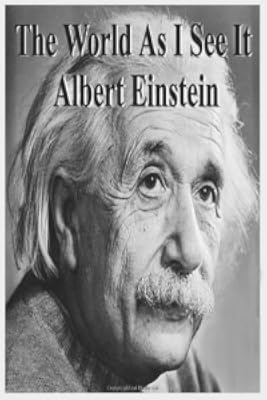
The World as I See It
by Albert Einstein
On This Page
Description
In the aftermath of the First World War, Albert Einstein wrote about his hopes for the League of Nations, his feelings as a German citizen among the growing anti-Semitism and nationalism of his country, and his myriad opinions about the current affairs of his day. In addition to these political perspectives, The World as I See It reveals the idealistic, spiritual, and witty side of this great intellectual as he approaches topics including Good and Evil, Religion and Science, Active Pacifism, show more Christianity and Judaism, and Minorities. Including letters, speeches, articles, and essays written before 1935, this collection offers a complete portrait of Einstein as a humanitarian and as a human being trying to make sense of the world changing around him. show lessTags
Recommendations






















Member Reviews
La prima parte è davvero molto interessante ma la seconda, soprattutto per chi come me ha sempre odiato la fisica, è risultata pesante e di difficile comprensione. Troppe formule e troppe teorie, anche se devo ammettere che la storia dell'evoluzione dei principi della fisica da Newton a Einstein mi ha abbastanza catturata, ma chiaramente solo da un punto di vista narrativo. Chissà se un giorno riuscirò mai a far pace con questo mondo :-)
Known principally for his contribution to science, this book reveals the social conscience of this great thinker. The book is an eclectic collection of notes and letters on a broad range of subjects, all written in the period between the two world wars and provides insight into the views if this extraordinary man.
The subjects covered include the future of science, pacifism, economics, Jewish issues and many personal reflections on people he respected.
I was struck by the quality of the writing. Though many of the contributions are taken from notes or letters, they have the feel of being very precisely honed, displaying great writing skill. As many of the issues discussed remain relevant today this is not merely a historical artefact of show more Einstein's life, but also contains ideas that are well worth revisiting. show less
The subjects covered include the future of science, pacifism, economics, Jewish issues and many personal reflections on people he respected.
I was struck by the quality of the writing. Though many of the contributions are taken from notes or letters, they have the feel of being very precisely honed, displaying great writing skill. As many of the issues discussed remain relevant today this is not merely a historical artefact of show more Einstein's life, but also contains ideas that are well worth revisiting. show less
The book might serve as a good starting point for being familiar with Einstein's ideas about politics, humanity, Jewish community, and the like matters. Those who are willing to read the book must consider that it is just a collection of some letters and other writings by Einstein.
Firstly no human visage is appealing when spread across an entire bookcover, i'm assuming the person who bought me this did so online ;) .
This is fairly worthless, so random, a collection of letters and speeches, it is so tied to its time period in the worst way. Mind numbingly repetitive aswell. The few interesting ideas are told over and over again in various letters with only slight variation until they lose all meaning.
Only the minor traces of sexism or racism doing anything to break the boredom. This collection takes place entirely in the 30's so missing a rather large event in Einstein's (and everyone elses) life.
I don't know if Einstein ever had any interesting opinions but if he did they must be in a different book :P .
This is fairly worthless, so random, a collection of letters and speeches, it is so tied to its time period in the worst way. Mind numbingly repetitive aswell. The few interesting ideas are told over and over again in various letters with only slight variation until they lose all meaning.
Only the minor traces of sexism or racism doing anything to break the boredom. This collection takes place entirely in the 30's so missing a rather large event in Einstein's (and everyone elses) life.
I don't know if Einstein ever had any interesting opinions but if he did they must be in a different book :P .
Short Review
It would be see interesting to see Einstein's thoughts on these if he was alive in today's world. I view him as naive in these essays, however I suspect I am being to harsh. If nothing else they show the idealistic vision needed for forward progress that sadly seems to be in short supply in the modern world.
Rated 2 stars (01/10/09)
It would be see interesting to see Einstein's thoughts on these if he was alive in today's world. I view him as naive in these essays, however I suspect I am being to harsh. If nothing else they show the idealistic vision needed for forward progress that sadly seems to be in short supply in the modern world.
Rated 2 stars (01/10/09)
This book is not my cup of tea so it felt very boring to read but if anyone wants to know more about Einstein's views on politics & religion then it's a good book for them
This book is why he is my hero. You don't have to understand physics it's a sory of life as the title says
Members
- Recently Added By
Lists

ENTENDIENDO LA FILOSOFÍA
16 works; 1 member

In Our Time books
4,934 works; 2 members
Author Information

366+ Works 16,431 Members
Albert Einstein was born on March 14, 1879 in Ulm. He spent his childhood in Munich where his family owned a small machine shop. By the age of twelve, Einstein had taught himself Euclidean Geometry. His family moved to Milan, where he stayed for a year, and he used it as an excuse to drop out of school, which bored him. He finished secondary show more school in Aarau, Switzerland and entered the Swiss Federal Institute of Technology in Zurich. Einstein graduated in 1900, by studying the notes of a classmate since he did not attend his classes out of boredom, again. His teachers did not like him and would not recomend him for a position in the University. For two years, Einstein worked as a substitute teacher and a tutor before getting a job, in 1902, as an examiner for a Swiss patent office in Bern. In 1905, he received his doctorate from the University of Zurich for a theoretical dissertation on the dimension of molecules. Einstein also published three theoretical papers of central importance to the development of 20th Century physics. The first was entitled "Brownian Motion," and the second "Photoelectric Effort," which was a revolutionary way of thinking and contradicted tradition. No one accepted the proposals of the first two papers. Then the third one was published in 1905 and called "On the Electrodynamics of Moving Bodies." Einstein's words became what is known today as the special theory of relativity and said that the physical laws are the same in all inertial reference systems and that the speed of light in a vacuum is a universal constant. Virtually no one understood or supported Einstein's argument. Einstein left the patent office in 1907 and received his first academic appointment at the University of Zurich in 1909. In 1911, he moved to a German speaking university in Prague, but returned to Swiss National Polytechnic in Zurich in 1912. By 1914, Einstein was appointed director of the Kaiser Wilhelm Institute of Physics in Berlin. His chief patron in those early days was German physicist Max Planck and lent much credibility to Einstein's work. Einstein began working on generalizing and extending his theory of relativity, but the full general theory was not published until 1916. In 1919, he predicted that starlight would bend in the vicinity of a massive body, such as the sun. This theory was confirmed during a solar eclipse and cause Einstein to become world renowned after the phenomenon. Einstein received be Nobel Prize in Physics in 1921. With his new fame, Einstein attempted to further his own political and social views. He supported pacifism and Zionism and opposed Germany's involvement in World War I. His support of Zionism earned him attacks from both Anti-Semitic and right wing groups in Germany. Einstein left Germany for the United States when Hitler came into power, taking a position at the Institute for Advanced Study in Princeton, New Jersey. Once there, he renounced his stand on pacifism in the face of Nazi rising power. In 1939 he collaborated with other physicists in writing a letter to President Franklin D. Roosevelt informing him of the possibility that the Nazis may in fact be attempting to create an atomic bomb. The letter bore only Einstein's signature but lent credence to the letter and spurred the U.S. race to create the bomb first. Einstein became an American citizen in 1940. After the war, Einstein was active in international disarmament as well as world government. He was offered the position of President of Israel but turned the honor down. Albert Einstein died on April 18, 1955 in Princeton, New Jersey. (Bowker Author Biography) show less
All Editions
Some Editions
Series
Belongs to Publisher Series
Work Relationships
Common Knowledge
- Canonical title
- The World as I See It
- Original title
- Mein Weltbild
- Original publication date
- 1934
- People/Characters
- Albert Einstein
Classifications
- Genres
- Science & Nature, Nonfiction, Philosophy, General Nonfiction, Biography & Memoir
- DDC/MDS
- 501 — Natural sciences & mathematics Science Philosophy and theory
- LCC
- AC35 .E528 — General Works Collections. Series. Collected works Collections. Series. Collected works Collections of monographs, essays, etc. Other languages
- BISAC
Statistics
- Members
- 1,236
- Popularity
- 19,985
- Reviews
- 15
- Rating
- (3.59)
- Languages
- 11 — Czech, English, French, German, Hungarian, Italian, Romanian, Spanish, Swedish, Portuguese (Portugal), Portuguese (Brazil)
- Media
- Paper, Audiobook, Ebook
- ISBNs
- 74
- UPCs
- 2
- ASINs
- 36