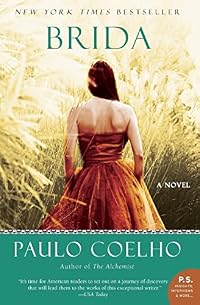
Brida
by Paulo Coelho
On This Page
Description
This is the story of Brida, a young Irish girl, and her quest for knowledge. She has long been interested in various aspects of magic but is searching for something more. Her search leads her to people of great wisdom, who begin to teach Brida about the spiritual world. She meets a wise man who dwells in a forest, who teaches her about overcoming her fears and trusting in the goodness of the world; and a woman who teaches her how to dance to the music of the world, and how to pray to the show more moon. As Brida seeks her destiny, she struggles to find a balance between her relationships and her desire to become a witch. This enthralling novel incorporates themes that fans of Paulo Coelho will recognize and treasure-it is a tale of love, passion, mystery, and spirituality from the master storyteller. show lessTags
Recommendations



Member Reviews
There were a couple of quotes of the book that really stuck out to me... "Brida spead out the contents of her wardrobe on the bed. SHe looked at each item of clothing...[some] brought back happy memories...if she got rid of them, she mught be undoing all the good things she had experienced while wearing them" - as a female I found this COMPLETELY relatable. I couldn't toss a lot of clothes because it reminded me of a special time. "Because anyone who comes into contact with sex knows that they're dealing with something which only happens in all its intensity when they lose control. when were in bed with someone, were giving permission to that person to commune not only with out body but with our whole being." - that was such a raw show more description of what sex is and how intense the connection is/could be/should be. I didn't take the quote down but in the book, Wicca spoke about how we talk on the phone we distance ourselves in which is like how a magical trance is. That made me think that phone calls make us lose intimacy that is often needed. I also loved how they explained soul mates. It is close to how I have always thought souls were which is mind blowing because I thought the idea was very rare. It was not my favorite book in the world, I got really bored in spots. The ending caught my attention again however. show less
After having read several of Paulo Coelho books, Brida is my favorite by far. Combining elements of magical realism with character development and prose that somehow feels more non-fiction than fiction, Brida is the story of a young woman slowly coming to the realization that she is a witch through the study of the Tradition of the Sun and the Tradition of the Moon. She finds her way with the guidance of two teachers, a magus who teachers her to trust in the goodness of the world, and a witch who teaches her to dance to the music of the world. I found much to love about the book, that is until the last few pages. In typical Coelho style, the ending is as anti-climactic and ambiguous as the rest of the book is engaging and delightful. show more For this reason, i give it 4/5 stars. show less
I enjoyed this book and there were a few truths revealed to me in it. Sometimes they were things I should know but prefer to lie to myself about. For instance the fact that you don't have to ignore beauty to have your intellect and ability recognised. I have spent half my life fighting against this and it will take years to undo the damage, I hope I have the courage to persevere and discover what it would mean to be beautiful and intelligent.
I have had mixed emotions while reading this book. Sometimes I think that my ideas may have been prejudiced by pandemic situation of the world today. Nevertheless, I want to post this review as a reminder to myself of my initial thoughts in relation to this book.
At first, I got a hard time getting along with the book. The story started with narratives stating about the gift, the light, the universe, and so on. And by continuously reading several books of Paulo, somehow I got tired of the same point over and over again. However, since I love the way Paulo presented the same idea in The Alchemist, I decided to give this book another chance after putting it down plenty of times.
The mysteries of the topic soulmate or destiny has long show more puzzled me. And being someone who believes that we could live independently on our own and that we should not waste so much time trying to find “the one”, I have raised so many doubts in this book. However, despite that belief, I still found this book worth reading due to the many ideologies presented such as the thought that “people will never know the ultimate reason of existence because that main objective of the Architect of the Universe is to know Him alone and no one else.” I also love how Brida was able to achieve her goal from the very start. She just found about the soulmate thing as an incidental learning from her primary lessons.
Setting aside all the ideas presented in relation to witchcraft (which I found somehow disturbing especially for most parts), the plot seemed ordinary which was good somehow. The plot was simple yet thought-provoking. The ending was not quite clear to me but I think it was the best way to end the story. It gave me a sense of wonder about Brida’s choices. If my interpretation is right, Brida chose to stay with Lorens despite his budding love for The Magus. I think that’s brave. She had said in the earlier part of the story that she is incapable of commitment. And the fact that she honored her commitment with Lorens is one of the things I admire about her. Another thing, I love the way that the story was concluded with a thought that we may have more than one soulmate in this lifetime and even though you may end up with only one, maybe, just maybe, in another lifetime, you may end up finally in each other’s arms, because after all, soulmates always find each other. Always.
Overall, I think the story is nice but still not as good as “The Alchemist”. show less
At first, I got a hard time getting along with the book. The story started with narratives stating about the gift, the light, the universe, and so on. And by continuously reading several books of Paulo, somehow I got tired of the same point over and over again. However, since I love the way Paulo presented the same idea in The Alchemist, I decided to give this book another chance after putting it down plenty of times.
The mysteries of the topic soulmate or destiny has long show more puzzled me. And being someone who believes that we could live independently on our own and that we should not waste so much time trying to find “the one”, I have raised so many doubts in this book. However, despite that belief, I still found this book worth reading due to the many ideologies presented such as the thought that “people will never know the ultimate reason of existence because that main objective of the Architect of the Universe is to know Him alone and no one else.” I also love how Brida was able to achieve her goal from the very start. She just found about the soulmate thing as an incidental learning from her primary lessons.
Setting aside all the ideas presented in relation to witchcraft (which I found somehow disturbing especially for most parts), the plot seemed ordinary which was good somehow. The plot was simple yet thought-provoking. The ending was not quite clear to me but I think it was the best way to end the story. It gave me a sense of wonder about Brida’s choices. If my interpretation is right, Brida chose to stay with Lorens despite his budding love for The Magus. I think that’s brave. She had said in the earlier part of the story that she is incapable of commitment. And the fact that she honored her commitment with Lorens is one of the things I admire about her. Another thing, I love the way that the story was concluded with a thought that we may have more than one soulmate in this lifetime and even though you may end up with only one, maybe, just maybe, in another lifetime, you may end up finally in each other’s arms, because after all, soulmates always find each other. Always.
Overall, I think the story is nice but still not as good as “The Alchemist”. show less
Brida is perhaps the first book I read of Paulo Coelho and not the much revered "The Alchemist" and I am glad I did so. The level of mysticism and paranormal suspense embedded in Brida is just right to make it engaging and the usual Coelho preachiness is on the lower-end making it a far more enjoyable read. Coelho's characters Wicca, Magus, and Brida are much deeply developed in this book than the characters in The Alchemist which makes this book a much more captivating narrative than the latter. There are some sections of Brida which I have read multiple times and perhaps will keep reading them for the rest of my life.
On the surface, the is the story of Brida and her quest to learn magic. I’m sure there are as many interpretations of this book as there are readers, but I read it as the story of a young woman trying to find love and her place in the world. Along the way she has to make some tough decisions about who she loves and what place love has in her life as it becomes filled with her focus on magic.
This book is like 1Q84 in many ways. Both are translated fiction. Both are magical realism. And both were like nothing else I’ve ever read in so many good ways. If you told me I’d like these books before I knew I liked them, but after I knew what they were like, I would tell you that you were crazy and that they were sure to be too literary. show more They are literary and they share with the classics a resonating exploration of human nature. However, Brida is practical and intelligent and fits the plain, down-to-earth narration perfectly. Although she discusses big concepts, she wonders about them in a way that is relatable rather than too literary. We learn about her hopes and dreams and feelings in such a way that she can’t be too literary. She’s just a girl with questions we all wonder about from time to time.
The magic lends the novel a surrealness which, paired with our protagonists easy acceptance of the incredible, gave this book the delightful feel of a fable. I definitely don’t think the author has a moral in mind for you, but the book will give you much to consider as you draw your own conclusions. This was a beautiful novel that speaks to the deep human need to find love and to understand our purpose in life. Vicariously through Brida you’re able to experience one person’s path to doing just that. I loved it, loved it, cannot say enough times how much I loved this book. Just read it :)
This review first published on Doing Dewey. show less
This book is like 1Q84 in many ways. Both are translated fiction. Both are magical realism. And both were like nothing else I’ve ever read in so many good ways. If you told me I’d like these books before I knew I liked them, but after I knew what they were like, I would tell you that you were crazy and that they were sure to be too literary. show more They are literary and they share with the classics a resonating exploration of human nature. However, Brida is practical and intelligent and fits the plain, down-to-earth narration perfectly. Although she discusses big concepts, she wonders about them in a way that is relatable rather than too literary. We learn about her hopes and dreams and feelings in such a way that she can’t be too literary. She’s just a girl with questions we all wonder about from time to time.
The magic lends the novel a surrealness which, paired with our protagonists easy acceptance of the incredible, gave this book the delightful feel of a fable. I definitely don’t think the author has a moral in mind for you, but the book will give you much to consider as you draw your own conclusions. This was a beautiful novel that speaks to the deep human need to find love and to understand our purpose in life. Vicariously through Brida you’re able to experience one person’s path to doing just that. I loved it, loved it, cannot say enough times how much I loved this book. Just read it :)
This review first published on Doing Dewey. show less
Love, love, love! As all of the books I've read by Coelho have, this one hit all of the right chords for me. The story of a woman on a search for what spirituality is and can be, what form her relationships should take, and the exploration of mysticism in today's world... they were perfectly paired with the concepts of uncertainty and growth.
I appreciated the various mentors that came into Brida's life, proving that no one person can be everything for us. No one teacher can explain everything. No one love should be expected to fulfill us. Her experiences showed that momentary love is just as important to personal growth as is lasting and domestic love.
The mix of mysticism and Christianity is rare in writing today, and I thoroughly show more appreciated the way that this juxtaposition was portrayed. Nothing wrong, working jointly, and to the betterment of all those who seek this path. show less
I appreciated the various mentors that came into Brida's life, proving that no one person can be everything for us. No one teacher can explain everything. No one love should be expected to fulfill us. Her experiences showed that momentary love is just as important to personal growth as is lasting and domestic love.
The mix of mysticism and Christianity is rare in writing today, and I thoroughly show more appreciated the way that this juxtaposition was portrayed. Nothing wrong, working jointly, and to the betterment of all those who seek this path. show less
Members
- Recently Added By
Lists

Speculative Fiction from around the World
610 works; 17 members
Author Information

216+ Works 100,516 Members
Paulo Coelho was born in Rio de Janeiro, Brazil on August 24, 1947. As a teenager, he wanted to become a writer, but his parents wanted him to pursue a more substantial and secure career. At the age of 17, his introversion and opposition to his parents led them to commit him to a mental institution. He escaped three times before being released at show more the age of 20. Once released, he abandoned his ideas of becoming a writer and enrolled in law school to please his parents. He stayed in law school for one year. In 1986, Coelho walked the 500-plus mile Road of Santiago de Compostela in northwestern Spain, a turning point in his life. On the path, he had a spiritual awakening, which he described in his book The Pilgrimage. Before becoming a full-time author, he worked as theatre director and actor, lyricist, and journalist. He wrote song lyrics for many famous performers in Brazilian music including Elis Regina, Rita Lee, and Raul Seixas. His first book, Hell Archives, was published in 1982. He has written over 25 books since then including The Alchemist, Brida, The Fifth Mountain, The Devil and Miss Prym, Eleven Minutes, The Zahir, The Witch of Portobello, Like a Flowing River, and Adultery. He received numerous awards including Las Pergolas Prize, The Budapest Prize, Nielsen Gold Book Award, and the Grand Prix Litteraire Elle. In 1996, he founded the Paulo Coelho Institute, which provides aid to children and elderly people with financial problems. In 2007, Coelho was named a Messenger of Peace to the United Nations. (Bowker Author Biography) show less
Series
Belongs to Publisher Series
Common Knowledge
- Canonical title
- Brida
- Original title
- Brida
- Original publication date
- 1990
- Related movies
- Brida (1998 | IMDb)
- Dedication
- For N.D.L., who made the miracles happen, for Christina, who is one of those miracles, and for Brida
- First words
- 'I want to learn about magic,' said the girl.
- Quotations
- True love allows each person to follow his or her own path aware that doing so can never drive them apart.
- Last words
- (Click to show. Warning: May contain spoilers.)He knew this because of the Tradition of the Moon and the Tradition of the Sun.
Classifications
- Genres
- Fiction and Literature, General Fiction, Fantasy
- DDC/MDS
- 869.342 — Literature & rhetoric Spanish Literature Literatures of Portuguese and Galician languages Portuguese fiction 20th Century 1945-1999
- LCC
- PQ9698.13 .O3546 .B7513 — Language and Literature French, Italian, Spanish and Portuguese literatures Portuguese literature Provincial, local, colonial, etc. Brazil
- BISAC
Statistics
- Members
- 2,843
- Popularity
- 6,353
- Reviews
- 64
- Rating
- (3.19)
- Languages
- 34 — Afrikaans, Albanian, Arabic, Bosnian, Bulgarian, Catalan, Chinese, Czech, Dutch, English, Estonian, Finnish, French, German, Greek, Hebrew, Hungarian, Indonesian, Italian, Korean, Latvian, Macedonian, Malayalam, Norwegian (Bokmål), Farsi/Persian, Polish, Portuguese, Romanian, Russian, Slovenian, Spanish, Swedish, Turkish, Ukrainian
- Media
- Paper, Audiobook, Ebook
- ISBNs
- 150
- UPCs
- 2
- ASINs
- 20