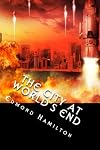
The City At World's End
by Edmond Hamilton
On This Page
Description
The sky split open and Middletown became the "City at Worlds End".
Tags
Recommendations
















Member Reviews
This book started well and had so much promise. Perhaps if it had been written more recently its potential could have been realised.
In short The City at World's End is just plain depressing. The mc is a depressing pessimist, the setting is depressing, the writing is depressing. Nonetheless I pushed on until chapter six when the author threw down this line regarding the mc's irritation at his fiancé because of the "inability of the female mind to grapple with the essentials of a situation".
Now I get that the book was written in a different era, when a woman's place was in the home. But really! Did the author have to present all the women in his book as hysterical simpletons?
The really frustrating thing is I'm going to keep show more encountering this. I'm dependent on audiobooks for a lot of my reading, and I can't afford to buy them. So it's off to the public domain I go. And apparently there are two roles for women in public domain sci fi (on the rare occasion the author notices that there is more than one sex) - the helpless female, and the sex symbol.
Sigh. This has been a depressing review of a depressing book. show less
In short The City at World's End is just plain depressing. The mc is a depressing pessimist, the setting is depressing, the writing is depressing. Nonetheless I pushed on until chapter six when the author threw down this line regarding the mc's irritation at his fiancé because of the "inability of the female mind to grapple with the essentials of a situation".
Now I get that the book was written in a different era, when a woman's place was in the home. But really! Did the author have to present all the women in his book as hysterical simpletons?
The really frustrating thing is I'm going to keep show more encountering this. I'm dependent on audiobooks for a lot of my reading, and I can't afford to buy them. So it's off to the public domain I go. And apparently there are two roles for women in public domain sci fi (on the rare occasion the author notices that there is more than one sex) - the helpless female, and the sex symbol.
Sigh. This has been a depressing review of a depressing book. show less
This is a post-apocalyptic time travel story, written in 1951 at the height of cold war fear of nuclear annihilation. Middletown, in some unspecified part of America, suffers a super-atomic bomb, but instead of being destroyed it is propelled forward in time billions of years to a time when a dead Earth is revolving round a red giant of a sun. They find remnants of a long vanished civilisation. But then the dying Earth is visited by aliens, and the Middletowners are faced with various dilemmas striking to the heart of their existence as the last survivors of the human race. This is a classic novel of ideas and concepts, rather than memorable characters, with interesting reflections on what it means to be human.
I've read many post-apocalypse novels. This one is a pulp story to its core: old fashioned, even quaint in some ways, and once the personal narrative of the protagonist kicks in, entirely predictable. It's also action-packed, imaginative, and a great deal of fun. I may have over-payed for it ($24 for a print-on-demand hardcover) but I think it's a fine, worthy addition to my collection. It reminded me in some ways of the Mars adventures penned by his wife, Leigh Brackett, and that's fine too.
Science fiction from 1951 that keeps the pages turning on a well told tale. Pulp fiction it might be, but when the writing is as smooth as this and the ideas are good then you could do worse than spend an afternoon with this book. The City at World’s end is Middletown America and a mysterious atomic explosion catapults the city through the time and space continuum far into the future. It is still earth but the sun is coming to the end of it’s life and earth is a cold desolate planet.
Middletown is home to its own secret atomic research station and it is the scientist who are the heroes in this book. They must solve the problems of survival for a town of fifty thousand people on a dead planet. When the chance comes to leave their town show more the people do not want to go, they are ferociously proud of their patrimony and led by a short sighted but passionate mayor they dig in their heels.
Largely free of the worst sexism that can make some of the science fiction from this period a struggle to read Hamilton keeps things fairly simple, but not too simple, problems are not solved by American muscle and the characters have some depth. A pretty good story with a theme running through it that might reflect small town American views at the start of the cold war. Imaginative and with it’s own logic it will please readers who like these stories. I do and will be on the lookout for more reads by Edmond Hamilton (who was married to Leigh Brackett one of the few female popular science fiction authors). 3.5 stars. show less
Middletown is home to its own secret atomic research station and it is the scientist who are the heroes in this book. They must solve the problems of survival for a town of fifty thousand people on a dead planet. When the chance comes to leave their town show more the people do not want to go, they are ferociously proud of their patrimony and led by a short sighted but passionate mayor they dig in their heels.
Largely free of the worst sexism that can make some of the science fiction from this period a struggle to read Hamilton keeps things fairly simple, but not too simple, problems are not solved by American muscle and the characters have some depth. A pretty good story with a theme running through it that might reflect small town American views at the start of the cold war. Imaginative and with it’s own logic it will please readers who like these stories. I do and will be on the lookout for more reads by Edmond Hamilton (who was married to Leigh Brackett one of the few female popular science fiction authors). 3.5 stars. show less
A 1950s American town, Middletown, is catapulted millions of years into the future by a super-atomic bomb. The 50,000 residents find themselves on a desolate, cold, and barren Earth orbiting a dying red sun.
Physicist Kenniston leads the community as they try to adapt to a world with almost no life. They discover Earth is abandoned, with humanity having moved to other planets in the League of Stars.
Future humans arrive to evacuate the Middletowners to a new world, but the townspeople refuse to leave their home, leading to a clash of cultures. Kenniston seeks help from galactic authorities and, in an effort to save Earth, finds a way to use a revolutionary scientific method to revive the planet.
Physicist Kenniston leads the community as they try to adapt to a world with almost no life. They discover Earth is abandoned, with humanity having moved to other planets in the League of Stars.
Future humans arrive to evacuate the Middletowners to a new world, but the townspeople refuse to leave their home, leading to a clash of cultures. Kenniston seeks help from galactic authorities and, in an effort to save Earth, finds a way to use a revolutionary scientific method to revive the planet.
A great little 50's nuclear holocaust story transporting a small town millions of years into the future ripping the fabric of space/time transporting the residents into the far future.
Fun and entertaining.
Fun and entertaining.
What's Going On: A nuclear blast has thrown a small mid-west city into the far future. How the town's inhabitants deal with this extreme shock and how they overcome the shock is entertaining.
Up: Adventure. This is standard '50s adventure pulp. Nothing derogatory here. I throughly enjoyed watching the people work through a huge hit to there collective psyche. I was actually proud of them as they dealt with things. The author could have created a much bigger book. But this was quick pulp.
Down: A bit dated now. Other than that, again, I enjoyed it.
Cut to the Chase: A great quick read. A gem from the heyday of pulp sf.
Up: Adventure. This is standard '50s adventure pulp. Nothing derogatory here. I throughly enjoyed watching the people work through a huge hit to there collective psyche. I was actually proud of them as they dealt with things. The author could have created a much bigger book. But this was quick pulp.
Down: A bit dated now. Other than that, again, I enjoyed it.
Cut to the Chase: A great quick read. A gem from the heyday of pulp sf.
Members
- Recently Added By
Lists

Best Science Fiction Novels
816 works; 430 members

Best Time Travel Novels
165 works; 125 members
Author Information

445+ Works 5,146 Members
Some Editions
Series
Belongs to Publisher Series
Work Relationships
Is contained in
Has as a commentary on the text
Common Knowledge
- Canonical title
- The City At World's End
- Original title
- City at World's End
- Original publication date
- 1951-02; 1950
- Original language
- English
Classifications
Statistics
- Members
- 364
- Popularity
- 86,641
- Reviews
- 14
- Rating
- (3.40)
- Languages
- 5 — English, French, German, Portuguese, Swedish
- Media
- Paper, Audiobook, Ebook
- ISBNs
- 25
- ASINs
- 25