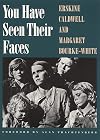
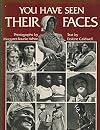
You Have Seen Their Faces
by Erskine Caldwell (Author), Margaret Bourke-White (Photographer)
On This Page
Description
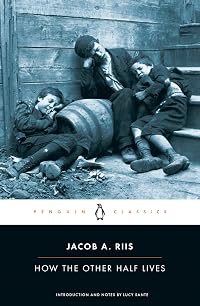
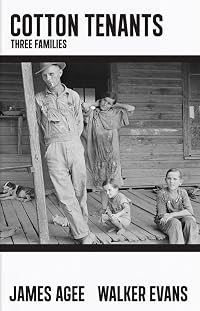
In the middle years of the Great Depression, Erskine Caldwell and photographer Margaret Bourke-White spent eighteen months traveling across the back roads of the Deep South--from South Carolina to Arkansas--to document the living conditions of the sharecropper. Their collaboration resulted in You Have Seen Their Faces, a graphic portrayal of America's desperately poor rural underclass. First published in 1937, it is a classic comparable to Jacob Riis's How the Other Half Lives, and James show more Agee and Walker Evans's Let Us Now Praise Famous Men, which it preceded by more than three years. Caldwell lets the poor speak for themselves. Supported by his commentary, they tell how the tenant system exploited whites and blacks alike and fostered animosity between them. Bourke-White, who sometimes waited hours for the right moment, captures her subjects in the shacks where they lived, the depleted fields where they plowed, and the churches where they worshipped. show lessTags
Recommendations




















Member Reviews
This is a famous work that's received plenty of attention already, both negative and positive. The controversies surrounding the work revolve around the authors and their 'honest' documentation around the world around them, as well as their methods of study and documentation. The work as a whole though, regardless of criticisms, does provide a careful (if biased) documentation of poverty in the United States around the Depression, particularly in regard to share croppers and tenant farmers. The photos are hard-hitting and carry an impact, with short prose sections to describe some of the history involved. If you're interested, the book's critical reception is worth looking up. The prose is dry, but short, but combined with the show more photographs it does make for a quick and memorable look back into U.S. history. show less
A fabulous period piece on America. Great photos by Margaret Bourke-White
Ratings
Members
- Recently Added By
Author Information

Erskine Caldwell has been called one of the most banned and censored authors in the United States. The son of a traveling minister, born in White Oak, Georgia in 1903, Caldwell received little formal education, as a young man, Caldwell took odd jobs and worked in the Southern states. He attended briefly Erskine College, Due West, South Carolina, show more and the Universities of Virginia and Pennsylvania for some semesters. Yet he became a prolific writer whose novels explore the seamy side of life in the American South. At the age of eighteen he went on a gun-running boat to South America, he played professional football and worked as mill-hand, cotton-picker, and in other such occupations. For a time Caldwell was a cub reporter on the Atlanta Journal. In the 1920s Caldwell moved to Maine to devote himself to writing. After several Spartan years, he had three stories accepted for publication. In 1930 Caldwell destroyed all his unpublished work from previous years. 'Country Full of Swedes' was published in the Yale Review, and it received $1,000 award from the journal in 1933. American Earth, a collection of short stories about petty passions and little lecheries, was published in 1931. Some of the stories had first appeared in such magazines as The American Caravan, Blues, Frankfurter Zeitung, Front, The Hound and Horn, Nativity, Pagany, Scribner's Magazine, This Quarter, and transition. The title of one of his novels Tobacco Road (1932) became slang for poverty and degeneracy. The book was made into both a movie (1941) and a long-running Broadway show (1933-1941). Other novels, some of which were made into later films, include The Bastard (1929), Poor Fool (1930), and God's Little Acre (1933). By the late 1940's, Caldwell had sold more books than any writer in the nation's history. Caldwell became a reporter for the Atlanta Journal in 1925, worked as a scriptwriter in Hollywood and was a newspaper correspondent in Mexico, Spain, Czechoslovakia, Russia and China. In 1984, Caldwell was elected, along with Norman Mailer, to the fifty-chair body of the American Academy of Arts and Letters. Caldwell is the author of 25 novels, 150 short stories and 12 nonfiction books. He died in Paradise Valley, Arizona on April 11, 1987. (Bowker Author Biography) show less

Series
Belongs to Publisher Series
Common Knowledge
- People/Characters
- Margaret Bourke-White; Gisèle Freund ; Walter Benjamin
- Important places
- Arkansas, USA; Mississippi, USA; Georgia, USA; Louisiana, USA; South Carolina, USA
- Dedication
- To Patricia
- First words
- "My father doesn't hire any field hands, or sharecroppers."
Classifications
- Genres
- Nonfiction, Art & Design, Economics, History, General Nonfiction
- DDC/MDS
- 333.33 — Society, government, & culture Economics Economics of land and energy Private ownership Real Estate Investment, Buying & Selling
- LCC
- HD207 .C3 — Social sciences Industries. Land use. Labor Industries. Land use. Labor Land use
- BISAC
Statistics
- Members
- 130
- Popularity
- 252,273
- Reviews
- 2
- Rating
- (3.75)
- Languages
- English
- Media
- Paper
- ISBNs
- 3
- ASINs
- 4