On This Page
Description
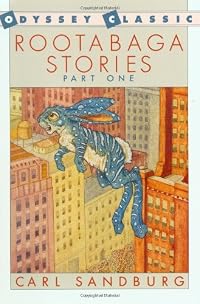
A selection of Sandburg's fanciful, humorous short stories peopled with such characters as the Potato Face Blind Man, Susan Slackentwist, and Dippy the Wisp.Tags
Recommendations
















Member Reviews
In this book of magical realism a series of tall tales take us through adventures that are akin to L Frank Baum's Wizard of Oz. A three legged man dances on rooftops. A cat visits a rabbit kingdom and comes home to whisper her story to her owner. All told in beautiful, lyrical poetry.
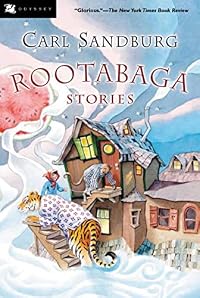
I love this book. I will admit it's a deep dive from my childhood, but it had a huge influence on me. These are beautiful tales set in a strange version of the Mid-West. The writing is lovely and the illustrations amazing.
I love this book. I will admit it's a deep dive from my childhood, but it had a huge influence on me. These are beautiful tales set in a strange version of the Mid-West. The writing is lovely and the illustrations amazing.
For 1920s picturebooks in Children's Books group, June 2020.
Not enough illustrations to fit the theme perfectly, but since we're having trouble finding a lot of choices, some of us are reading these.
...
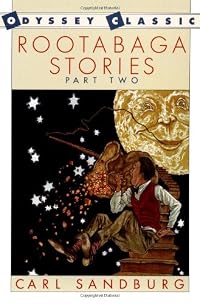
See my review for the first book. Yes I still love the Petershams' illustrations. Yes, I can still hear the music in the words. But no, I still cannot listen with 'little and new ears' and so cannot fully appreciate these nonsense fairy tales from one of the most optimistic decades of America, the 1920s.
"And she told her two boys, 'Pick up your feet now and run. Go to the grass, go to the new green grass. Go the young frogs and ask them why they are shooting songs up into the sky this early spring day. Pick up your feet now and run.'"
Not enough illustrations to fit the theme perfectly, but since we're having trouble finding a lot of choices, some of us are reading these.
...
See my review for the first book. Yes I still love the Petershams' illustrations. Yes, I can still hear the music in the words. But no, I still cannot listen with 'little and new ears' and so cannot fully appreciate these nonsense fairy tales from one of the most optimistic decades of America, the 1920s.
"And she told her two boys, 'Pick up your feet now and run. Go to the grass, go to the new green grass. Go the young frogs and ask them why they are shooting songs up into the sky this early spring day. Pick up your feet now and run.'"
I understand why these are of literary value, but I really didn't care much for them.
Ratings
Members
- Recently Added By
Author Information

233+ Works 12,976 Members
The son of Swedish immigrants, Sandburg was born in Galesburg, Illinois. At age 13 he left school to roam the Midwest; he remained on the road for six years, working as a day laborer. Sandburg served in the Spanish-American War and then, from 1898 to 1902, attended Lombard College in Galesburg. After college, he went to Milwaukee, where he worked show more as a journalist; he also married Lillian Steichen there in 1908. During World War I, he served as a foreign correspondent in Stockholm; after the war he returned to Chicago and continued to write about America, especially the common people. Sandburg's first poems to gain wide recognition appeared in Poetry magazine in 1914. Two years later he published his Chicago Poems (1916), and Cornhuskers appeared in 1918. Meanwhile, Sandburg set out to become an authority on Abraham Lincoln (see Vol. 3). His exhaustive biography of the president, which took many years to complete, appeared as Abraham Lincoln: The Prairie Years (2 vols., 1926) and Abraham Lincoln: The War Years (4 vols., 1939), which won a Pulitzer Prize. Sandburg's poetry is untraditional in form. Drawing on Whitman as well as the imagists, its rhymeless and unmetered cadences reflect Midwestern speech, and its diction ranges from strong rhetoric to easygoing slang. Although he often wrote about the uncouth, the muscular, and the primitive, there was a pity and loving kindness that was a primary motive for his poetry. At Sandburg's death, Mark Van Doren, Archibald MacLeish, and President Lyndon Johnson delivered eulogies. In his tribute, President Johnson said that "Carl Sandburg was more than the voice of America, more than the poet of its strength and genius. He was America. . . . He gave us the truest and most enduring vision of our own greatness." The N.Y. Times described Sandburg as "poet, newspaper man, historian, wandering minstrel, collector of folk songs, spinner of tales for children, [whose] place in American letters is not easily categorized. But it is a niche that he has made uniquely his own." Sandburg was the labor laureate of the United States. Sandburg received the Pulitzer Prize for poetry in 1951 for his Complete Poems (1950). Among his many other awards were the gold medal for history and biography (1952) from the American Academy of Arts and Letters; the Poetry Society of America's gold medal (1953) for distinguished achievement; and the Boston Arts Festival Award (1955) in recognition of "continuous meritorious contribution to the art of American poetry." In 1959 he traveled under the auspices of the Department of State to the U.S. Trade Fair in Moscow, and to Stockholm, Paris, and London. In 1960 he received a citation from the U.S. Chamber of Commerce as a great living American for the "significant and lasting contribution which he has made to American literature." (Bowker Author Biography) show less

Carl Sandburg has a Legacy Library. Legacy libraries are the personal libraries of famous readers, entered by LibraryThing members from the Legacy Libraries group.
Awards and Honors
Distinctions
Series

Work Relationships
Contains
The Skyscraper to the Moon and How the Green Rat With the Rheumatism Ran a Thousand Miles Twice [short story] by Carl Sandburg (indirect)
Slipfoot and How He Nearly Always Never Gets What He Goes After [short story] by Carl Sandburg (indirect)
How Six Pigeons Came Back to Hatrack the Horse After Many Accidents and Six Telegrams [short story] by Carl Sandburg (indirect)
How the Three Wild Babylonian Baboons Went Away in the Rain Eating Bread and Butter [short story] by Carl Sandburg (indirect)
How Six Umbrellas Took Off Their Straw Hats to Show Respect to the One Big Umbrella [short story] by Carl Sandburg (indirect)
How Bozo the Button Buster Busted All His Buttons When a Mouse Came [short story] by Carl Sandburg (indirect)
How Googler and Gaggler the Two Christmas Babies Came Home with Monkey Wrenches [short story] by Carl Sandburg (indirect)
How Pink Peony Sent Spuds the Ballplayer Up to Pick Four Moons [short story] by Carl Sandburg (indirect)
The Haystack Cricket and How Things Are Different Up in the Moon Towns [short story] by Carl Sandburg (indirect)
Why the Big Ball Game Between Hot Grounders and the Grand Standers Was a Hot Game [short story] by Carl Sandburg (indirect)
Common Knowledge
- Canonical title
- More Rootabaga Stories
- Original publication date
- 1993
- Dedication
- To Three Illinois Pigeons - C. S.
- First words
- Blixie Bimber's mother was chopping hash.
- Last words
- (Click to show. Warning: May contain spoilers.)It was then the king said, "We shall put the crossed arms in the alphabet; we shall have a new letter called X, so everybody will understand a funeral is beautiful if there are young singing playmates."
- Canonical DDC/MDS
- 398.4
Classifications
- Genre
- Children's Books
- DDC/MDS
- 398.4 — Society, Government, and Culture Customs, etiquette & folklore Folklore & Folktales Paranatural and legendary phenomena as subjects of folklore
- LCC
- PZ8 .S25 .M — Language and Literature Fiction and juvenile belles lettres Fiction and juvenile belles lettres Juvenile belles lettres
- BISAC
Statistics
- Members
- 140
- Popularity
- 228,109
- Reviews
- 5
- Rating
- (4.43)
- Languages
- English
- Media
- Paper
- ISBNs
- 4