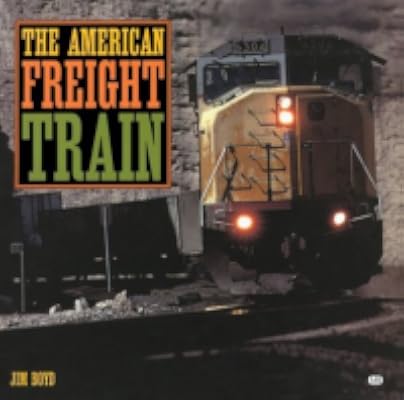
American Freight Train
by Jim Boyd
On This Page
Description
A celebration of the American freight train! The freight train movement began as quickly as the first railroads were laid down. Since then, the freight train has become the backbone of shipping, moving food, automobiles, lumber, and thousands of other commodities. Discover the history of freight trains in America as they evolved from the early 1800s on the East Coast through today. Includes all forms of freight train activity such as types of rolling stock, operations, and much more!Tags
Recommendations

















Member Reviews
Everybody has been stuck waiting at a grade crossing for a freight train, but as the author of this book points out, the first thing that comes to most people’s mind when you mention “train” is passenger service. (The second thing is the nostalgic lament that there isn’t any. Not that they would take one themselves, but they figure it would make the airports less crowded if everybody else did.).
I rate this attempt to rectify that a modest success. All train books have to have pictures, so we have the obligatory ones here. There’s an interesting if selective discussion of the history of rail freight in the US, with a lot of detail about gravity freight lines in the Pennsylvania coal fields. And there’s a chapter that does a show more much better job of explaining what a freight classification yard does than a whole book purportedly on that subject (North American Railyards) which I reviewed earlier. Of course, if you’re looking for train pictures what you really want to see is locomotives - specifically steam locomotives. Thus there are several chapters devoted to freight locomotives with a lot of 2-8-2s and such.
Another chapter discusses coal moving, with a dramatic picture why coal hopper cars don’t have bottom dump doors anymore. Coupled with Infrastructure’s (also reviewed earlier) discussion of the coal consumption rate at a large electric plant, this gives quite a bit of insight into what needs to get done to turn on a light switch.
What the book lacks is a real in-depth discussion of anything; a little too many pictures, not quite enough explanation (I know, half the time I’m complaining about too many pictures; the other half not enough.) Still, if you’re trying to explain to a neoLuddite exactly what has to happen to get a crate of certified organic carrots from the Imperial Valley to Philadelphia, this isn’t too bad a way to start. I love the opening line: “Stuff tends to be heavy, and it usually has to be somewhere else to be of use to anybody.” About two thirds of civilization right there. show less
I rate this attempt to rectify that a modest success. All train books have to have pictures, so we have the obligatory ones here. There’s an interesting if selective discussion of the history of rail freight in the US, with a lot of detail about gravity freight lines in the Pennsylvania coal fields. And there’s a chapter that does a show more much better job of explaining what a freight classification yard does than a whole book purportedly on that subject (North American Railyards) which I reviewed earlier. Of course, if you’re looking for train pictures what you really want to see is locomotives - specifically steam locomotives. Thus there are several chapters devoted to freight locomotives with a lot of 2-8-2s and such.
Another chapter discusses coal moving, with a dramatic picture why coal hopper cars don’t have bottom dump doors anymore. Coupled with Infrastructure’s (also reviewed earlier) discussion of the coal consumption rate at a large electric plant, this gives quite a bit of insight into what needs to get done to turn on a light switch.
What the book lacks is a real in-depth discussion of anything; a little too many pictures, not quite enough explanation (I know, half the time I’m complaining about too many pictures; the other half not enough.) Still, if you’re trying to explain to a neoLuddite exactly what has to happen to get a crate of certified organic carrots from the Imperial Valley to Philadelphia, this isn’t too bad a way to start. I love the opening line: “Stuff tends to be heavy, and it usually has to be somewhere else to be of use to anybody.” About two thirds of civilization right there. show less
Ratings
Members
- Recently Added By
Author Information
46+ Works 260 Members
Born in Dixon, Illinois, in 1941, Jim Boyd had a deep interest in railroading almost from the start. This fascination with railroads and how they operated eventually manifested itself into a career for Jim, who in the 1960s worked as a traveling locomotive inspector for the Electro-Motive Division of General Motors. Early in the 1970s he also show more worked in freight-train service on the Illinois Central Railroad, and then went on to covering railroads from a journalistic aspect. From 1974 to 1997, Jim served as editor of Railfan and Railroad Magazine, documenting the ever-changing railroad industry. In addition, Jim has authored a number of railroad books--this being his sixth--and scripted and narrated more than two dozen rail videotapes show less
Classifications
Statistics
- Members
- 20
- Popularity
- 1,283,608
- Reviews
- 1
- Rating
- (4.00)
- Languages
- English
- Media
- Paper
- ISBNs
- 1
- UPCs
- 1