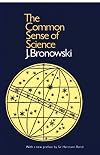
The Common Sense of Science
by J. Bronowski
On This Page
Description
Jacob Bronowski was, with Kenneth Clarke, the greatest popularizer of serious ideas in Britain between the mid 1950s and the early 1970s. Trained as a mathematician, he was equally at home with painting and physics, and wrote a series of brilliant books that tried to break down the barriers between 'the two cultures'. He denounced 'the destructive modern prejudice that art and science are different and somehow incompatible interests'. He wrote a fine book on William Blake while running the show more National Coal Board's research establishment. The Common Sense of Science, first published in 1951, is a vivid attempt to explain in ordinary language how science is done and how scientists think. He isolates three creative ideas that have been central to science: the idea of order, the idea of causes and the idea of chance. For Bronowski, these were common-sense ideas that became immensely powerful and productive when applied to a vision of the world that broke with the medieval notion of a world of things ordered according to their ideal natures. Instead, Galileo, Huyghens and Newton and their contemporaries imagined 'a world of events running in a steady mechanism of before and after'. We are still living with the consequences of this search for order and causality within the facts that the world presents to us. show lessTags
Recommendations

























Member Reviews
In the first chapter, Bronowski suggests that science and the arts are very similar, although the last few generations of scientists and artists have fought against that idea. In his opinion, the only reason science does not seem accessible to most people (in the way the arts are accessible, for example) is because our society lacks a common language to communicate scientific ideas in. He goes on to explain his ideas through the history of scientific discovery: the scientific revolution of the seventeenth century, Isaac Newton’s contribution to science, the idea of order in the eighteenth century, the idea of causes in the nineteenth century, and the idea of chance. He concludes the book with of discussion stemming from the creation show more and use of the atomic bomb: whether science is a creator or a destroyer.
After reading the first chapter, I was intrigued by the comparison of arts and science. The rest of the book was harder to get into, I think because Bronowski’s writing style was difficult. I was pleasantly surprised that even though the book was published in 1978, it didn’t seem dated until the last chapter. Overall, it was a decent read with a lot of interesting ideas that approached science from a different perspective, although I won’t be picking up anything else by this author.
I think the following quotes sum up the book as well as anything I could write about it:
“In a book about science, I have looked at the growth of its concepts: the machine and the model, order, cause and chance, prediction and the future, the fundamental concept of law and the particular concepts which range from waves to matter and the cell. But all these are expressions of the relation of man and his societies to the universal nature. None is achieved without man’s judgment of that order, what is like and what is unlike, what in it matters and what does not.”
“Science is a great many things, and I have called them a great many names; but in the end they all return to this: science is the acceptance of what works and the rejection of what does not. That needs more courage than we might think.”
“I believe that science can create values: and will create them precisely as literature does, by looking into the human personality; by discovering what divides it and what cements it.” show less
After reading the first chapter, I was intrigued by the comparison of arts and science. The rest of the book was harder to get into, I think because Bronowski’s writing style was difficult. I was pleasantly surprised that even though the book was published in 1978, it didn’t seem dated until the last chapter. Overall, it was a decent read with a lot of interesting ideas that approached science from a different perspective, although I won’t be picking up anything else by this author.
I think the following quotes sum up the book as well as anything I could write about it:
“In a book about science, I have looked at the growth of its concepts: the machine and the model, order, cause and chance, prediction and the future, the fundamental concept of law and the particular concepts which range from waves to matter and the cell. But all these are expressions of the relation of man and his societies to the universal nature. None is achieved without man’s judgment of that order, what is like and what is unlike, what in it matters and what does not.”
“Science is a great many things, and I have called them a great many names; but in the end they all return to this: science is the acceptance of what works and the rejection of what does not. That needs more courage than we might think.”
“I believe that science can create values: and will create them precisely as literature does, by looking into the human personality; by discovering what divides it and what cements it.” show less
Ratings
Members
- Recently Added By
Author Information
8+ Works 346 Members
Common Knowledge
- Canonical title
- The Common Sense of Science
- Original publication date
- 1951
Classifications
Statistics
- Members
- 262
- Popularity
- 124,139
- Reviews
- 1
- Rating
- (4.08)
- Languages
- Czech, English, Portuguese, Spanish
- Media
- Paper, Ebook
- ISBNs
- 10
- ASINs
- 12