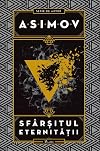
Sfârșitul Eternității
by Isaac Asimov
On This Page
Tags
Member Reviews
Originally published as The End of Eternity.
In a world where time travel was discovered, a select group of men (The Eternals) control humanity's fate from "out of time", set on enhancing its overall happiness.
Andrew Harlan is an outstanding Eternal technician, whose job is to implement the reality changes that higher-ranked analysts have come up with to tweak historical events. Rather low on Eternity's totem pole, Harlan is nevertheless content with his role as the best technician of all, happy to uphold their monk-like lifestyle in the interest of the greater good. An unexpected encounter with a woman upsets him so much, that he resorts to several rash actions, endangering the Eternity's very cornerstones.
The idea itself is of course show more very interesting, and it definitely made me ponder the pros and cons of a controlled evolution of the human race. It is, after all, said that hindsight is 20/20. So who better than people with unfettered access to hundreds of thousands of millennia to analyse and fix all of humanity's mishaps? At least until someone points out the flip side of things...
So much for the theory, but when it came to executing acting everything out with characters, things spiraled out of control. On the one hand, it felt like Asimov put so much effort into building the scientific basis for the Eternity, that he didn't have enough energy left for character development.
Harlan is often at his most palatable when holding lengthy lectures on various in universe-specific scientific terms. Even his interest in Primitive Timeline, discouraged among Eternals, doesn't show a more likeable part of him, as he's always grumbling about being criticized for it. As a matter of fact, he's always suspecting people of either looking down on him, wanting to trick him, or needing to be reported.
I'm guessing that somewhere along the line we were meant to empathize with him as he desperately tries to hide his romance from his superiors, yet I kept rooting for the Eternals to discover everything. His initial misogyny didn't help either, as it was hard for me to understand why he actually fell in love. I mean, he was clearly in lust with Noÿs from the get go, but his change of tune was apparently caused by getting roofied...? I knew Asimov's romantic subplots were cringe-worthy at best, but this is just incomprehensible.
Then again, perhaps it's a problem with the translation...
Score: 2.4/5 stars
If you're like me and only want to know why there are no aliens in the Foundation Universe save yourself some time and skip to the last two chapters.
Great concept, terrible character development and storytelling. show less
In a world where time travel was discovered, a select group of men (The Eternals) control humanity's fate from "out of time", set on enhancing its overall happiness.
Andrew Harlan is an outstanding Eternal technician, whose job is to implement the reality changes that higher-ranked analysts have come up with to tweak historical events. Rather low on Eternity's totem pole, Harlan is nevertheless content with his role as the best technician of all, happy to uphold their monk-like lifestyle in the interest of the greater good. An unexpected encounter with a woman upsets him so much, that he resorts to several rash actions, endangering the Eternity's very cornerstones.
The idea itself is of course show more very interesting, and it definitely made me ponder the pros and cons of a controlled evolution of the human race. It is, after all, said that hindsight is 20/20. So who better than people with unfettered access to hundreds of thousands of millennia to analyse and fix all of humanity's mishaps? At least until someone points out the flip side of things...
So much for the theory, but when it came to executing acting everything out with characters, things spiraled out of control. On the one hand, it felt like Asimov put so much effort into building the scientific basis for the Eternity, that he didn't have enough energy left for character development.
Harlan is often at his most palatable when holding lengthy lectures on various in universe-specific scientific terms. Even his interest in Primitive Timeline, discouraged among Eternals, doesn't show a more likeable part of him, as he's always grumbling about being criticized for it. As a matter of fact, he's always suspecting people of either looking down on him, wanting to trick him, or needing to be reported.
I'm guessing that somewhere along the line we were meant to empathize with him as he desperately tries to hide his romance from his superiors, yet I kept rooting for the Eternals to discover everything. His initial misogyny didn't help either, as it was hard for me to understand why he actually fell in love. I mean, he was clearly in lust with Noÿs from the get go, but his change of tune was apparently caused by getting roofied...? I knew Asimov's romantic subplots were cringe-worthy at best, but this is just incomprehensible.
Then again, perhaps it's a problem with the translation...
Score: 2.4/5 stars
If you're like me and only want to know why there are no aliens in the Foundation Universe save yourself some time and skip to the last two chapters.
Great concept, terrible character development and storytelling. show less
De obicei romanele Asimov pt mine sunt de 4 sau 5 stele, dar acesta efectiv nu are nicio calitate. Personajul e enervant și neinteresant, iar motivațiile lui nejustificate. SF-ul din roman a îmbătrânit uluitor de prost. Fundalul și ideile nu oferă nimic interesant. E genul de SF naiv și simplist, cu un singur fir narativ extrem de mono-clar, care nu poate fi apreciat decât cel mult de un băiat de 12 ani. Nu mai vorbesc de abordarea personajului feminin, că e mai jenantă decât secretarele de la Heinlein (nu la fel de rău ca la Niven totuși). Nu-i de mirare că mi-a scăpat până acum deși am citit cam tot de Asimov...
Ratings
Members
- Recently Added By
Author Information

2,396+ Works 292,729 Members
Isaac Asimov was born in Petrovichi, Russia, on January 2, 1920. His family emigrated to the United States in 1923 and settled in Brooklyn, New York, where they owned and operated a candy store. Asimov became a naturalized U.S. citizen at the age of eight. As a youngster he discovered his talent for writing, producing his first original fiction at show more the age of eleven. He went on to become one of the world's most prolific writers, publishing nearly 500 books in his lifetime. Asimov was not only a writer; he also was a biochemist and an educator. He studied chemistry at Columbia University, earning a B.S., M.A. and Ph.D. In 1951, Asimov accepted a position as an instructor of biochemistry at Boston University's School of Medicine even though he had no practical experience in the field. His exceptional intelligence enabled him to master new systems rapidly, and he soon became a successful and distinguished professor at Columbia and even co-authored a biochemistry textbook within a few years. Asimov won numerous awards and honors for his books and stories, and he is considered to be a leading writer of the Golden Age of science fiction. While he did not invent science fiction, he helped to legitimize it by adding the narrative structure that had been missing from the traditional science fiction books of the period. He also introduced several innovative concepts, including the thematic concern for technological progress and its impact on humanity. Asimov is probably best known for his Foundation series, which includes Foundation, Foundation and Empire, and Second Foundation. In 1966, this trilogy won the Hugo award for best all-time science fiction series. In 1983, Asimov wrote an additional Foundation novel, Foundation's Edge, which won the Hugo for best novel of that year. Asimov also wrote a series of robot books that included I, Robot, and eventually he tied the two series together. He won three additional Hugos, including one awarded posthumously for the best non-fiction book of 1995, I. Asimov. "Nightfall" was chosen the best science fiction story of all time by the Science Fiction Writers of America. In 1979, Asimov wrote his autobiography, In Memory Yet Green. He continued writing until just a few years before his death from heart and kidney failure on April 6, 1992. (Bowker Author Biography) show less
Classifications
Statistics
- Members
- 8
- Popularity
- 2,496,361
- Reviews
- 2
- Rating
- (2.50)
- Languages
- Romanian
- Media
- Paper
- ISBNs
- 1