On This Page
Description
The Last Days of Krypton is the epic story of the destruction of the planet Krypton, an explosive event that sent Superman and his legacy to earth. Written by award-winning science fiction writer Kevin J. Anderson, author of the international bestselling Dune prequels, The Last Days of Krypton tells of the marriage of Superman's parents, their struggle to save their planet, and the menace of General Zod, future arch-enemy of Superman. It's the story science fiction and Superman fans have show more been waiting for! show lessTags
Recommendations





Member Reviews
Despite the mixed reviews, I thought Kevin J. Anderson did a good job portraying life on Krypton. I have often wondered, if Krypton were so much more advanced than Earth, why didn't they explore new worlds? Why when the planet exploded, there were no Kryptonians around except those that barely escaped? Anderson answers these and more in a thick book about the rise and fall of Krypton.
Krypton is like Rome was in its waning days of the Empire. Fat from its long, proud history, there is little creativity amongst the people. There are a few who stand out but their potential is squashed. The civilization on Krypton is old, decadent and very conservative.
Jor-El, his brother Zor-El and Jor-El's wife, Lara, are the triangle that keeps the show more story flowing. Zod, who wants Jor-El's technology for himself, is playing like he is following Council's orders to suppress all "dangerous" tech. The Council represents Krypton's ruling class and they're not about to repeat history and let their planet again go to war or fight the alien threat that may come from space, or from their own backyard. Keep the status quo very status'd and very 'quo'd.
It's a story about taking chances, about doing what you think is right and about fighting back against suppression. It's also about learning and taking advantage of what you could know (Jor-El's adventure with an alien who lands on Krypton and tells him marvels is such an event).
Overall, I was happy with the book. A bit over-long in going over Zod's megalomanic plans. The Braniac scene where Kandor gets sucked out of the planet and what's left is a black scar on the surface and how Zod takes advantage is great. You just want to strangle the old Council for being so backward and stupid. And you want to kick people for letting Zod take control.
Clearly the book takes a lot of its material of crystal technology from the original Superman film -- there are many allusions to it throughout the novel. Recommended for the Superman fan. show less
Krypton is like Rome was in its waning days of the Empire. Fat from its long, proud history, there is little creativity amongst the people. There are a few who stand out but their potential is squashed. The civilization on Krypton is old, decadent and very conservative.
Jor-El, his brother Zor-El and Jor-El's wife, Lara, are the triangle that keeps the show more story flowing. Zod, who wants Jor-El's technology for himself, is playing like he is following Council's orders to suppress all "dangerous" tech. The Council represents Krypton's ruling class and they're not about to repeat history and let their planet again go to war or fight the alien threat that may come from space, or from their own backyard. Keep the status quo very status'd and very 'quo'd.
It's a story about taking chances, about doing what you think is right and about fighting back against suppression. It's also about learning and taking advantage of what you could know (Jor-El's adventure with an alien who lands on Krypton and tells him marvels is such an event).
Overall, I was happy with the book. A bit over-long in going over Zod's megalomanic plans. The Braniac scene where Kandor gets sucked out of the planet and what's left is a black scar on the surface and how Zod takes advantage is great. You just want to strangle the old Council for being so backward and stupid. And you want to kick people for letting Zod take control.
Clearly the book takes a lot of its material of crystal technology from the original Superman film -- there are many allusions to it throughout the novel. Recommended for the Superman fan. show less
Despite the mixed reviews, I thought Kevin J. Anderson did a good job portraying life on Krypton. I have often wondered, if Krypton were so much more advanced than Earth, why didn't they explore new worlds? Why when the planet exploded, there were no Kryptonians around except those that barely escaped? Anderson answers these and more in a thick book about the rise and fall of Krypton.
Krypton is like Rome was in its waning days of the Empire. Fat from its long, proud history, there is little creativity amongst the people. There are a few who stand out but their potential is squashed. The civilization on Krypton is old, decadent and very conservative.
Jor-El, his brother Zor-El and Jor-El's wife, Lara, are the triangle that keeps the show more story flowing. Zod, who wants Jor-El's technology for himself, is playing like he is following Council's orders to suppress all "dangerous" tech. The Council represents Krypton's ruling class and they're not about to repeat history and let their planet again go to war or fight the alien threat that may come from space, or from their own backyard. Keep the status quo very status'd and very 'quo'd.
It's a story about taking chances, about doing what you think is right and about fighting back against suppression. It's also about learning and taking advantage of what you could know (Jor-El's adventure with an alien who lands on Krypton and tells him marvels is such an event).
Overall, I was happy with the book. A bit over-long in going over Zod's megalomanic plans. The Braniac scene where Kandor gets sucked out of the planet and what's left is a black scar on the surface and how Zod takes advantage is great. You just want to strangle the old Council for being so backward and stupid. And you want to kick people for letting Zod take control.
Clearly the book takes a lot of its material of crystal technology from the original Superman film -- there are many allusions to it throughout the novel. Recommended for the Superman fan. show less
Krypton is like Rome was in its waning days of the Empire. Fat from its long, proud history, there is little creativity amongst the people. There are a few who stand out but their potential is squashed. The civilization on Krypton is old, decadent and very conservative.
Jor-El, his brother Zor-El and Jor-El's wife, Lara, are the triangle that keeps the show more story flowing. Zod, who wants Jor-El's technology for himself, is playing like he is following Council's orders to suppress all "dangerous" tech. The Council represents Krypton's ruling class and they're not about to repeat history and let their planet again go to war or fight the alien threat that may come from space, or from their own backyard. Keep the status quo very status'd and very 'quo'd.
It's a story about taking chances, about doing what you think is right and about fighting back against suppression. It's also about learning and taking advantage of what you could know (Jor-El's adventure with an alien who lands on Krypton and tells him marvels is such an event).
Overall, I was happy with the book. A bit over-long in going over Zod's megalomanic plans. The Braniac scene where Kandor gets sucked out of the planet and what's left is a black scar on the surface and how Zod takes advantage is great. You just want to strangle the old Council for being so backward and stupid. And you want to kick people for letting Zod take control.
Clearly the book takes a lot of its material of crystal technology from the original Superman film -- there are many allusions to it throughout the novel. Recommended for the Superman fan. show less
I suppose most of the shortcomings of this book are really due to the source material; maybe some comics just don't lend themselves to novelization. It's not ideal for the bad guy to share two of the three letters of his name with one of the good guys. It's also not ideal for the two good guys to have names that are 80% identical. But beyond those superficial irritants that make it an awkward read (and might be solved by listening to it in audiobook form), the real problem here is that all of the characters are ridiculously flat. I could summarize them each character in one phrase, and not one single character deviates from their type throughout the book. The good guys are going to do the right thing no matter what, the bad guys are show more going to do the bad thing no matter what, and the in-betweens are just going to be stupid and ineffectual no matter what. So, even though there are a lot of big scary threats to the survival of Krypton (aliens and tsunamis and nova javelins, oh my!), the book actually ends up being pretty boring. show less
...even though we know the final story.
As many of you know I am a comic book fan and I love Smallville so to have a book that goes into the issues on Krypton prior to Kal-El is fascinating.
Mr. Anderson does a great job stitching together the fragmented history as it has been laid out in movies and in the comics. Krypton comes together in a clear and concise manner that exposes the weaknesses (culturally, politically, and environmental) that the planet had to endure.
The rise and fall of Zod...the Phantom Zone...Kandor...Brainiac...all story lines that have never been fully explained and here they all are in a nice story. The final vivid description of the end of Krypton was well worth the wait.
If you are a fan of the Superman series show more in any of its form I strongly recommend this book. It provides valuable background in a way you wouldn't expect...even though we know the final story. show less
As many of you know I am a comic book fan and I love Smallville so to have a book that goes into the issues on Krypton prior to Kal-El is fascinating.
Mr. Anderson does a great job stitching together the fragmented history as it has been laid out in movies and in the comics. Krypton comes together in a clear and concise manner that exposes the weaknesses (culturally, politically, and environmental) that the planet had to endure.
The rise and fall of Zod...the Phantom Zone...Kandor...Brainiac...all story lines that have never been fully explained and here they all are in a nice story. The final vivid description of the end of Krypton was well worth the wait.
If you are a fan of the Superman series show more in any of its form I strongly recommend this book. It provides valuable background in a way you wouldn't expect...even though we know the final story. show less
When I heard there was a book coming out that finally put all of the pieces of Krypton together, I jumped at the chance to read it. And I wasn't disappointed, although I guess I'm easier to please than some of the reviewers on Amazon. The hard thing for any book that backtracks on an already in-place mythology with a huge following is that it will have critics who thought it should have come together differently. Many fans will already have a picture in their minds of what happened and if it doesn't add up then, well, they just won't like it regardless of how well done it is.
With Superman this may have been slightly easier to avoid because the mythology regarding Krypton has been so scattered over the years. Readers have seen several show more potential causes for the end of Krypton, including the sun going supernova, major geological pressure causing the world to explode and civil war breaking out causing Kryptonians to destroy themselves. The awesome thing is that Anderson addresses all of these in his book. It's obvious the author did his research and tried to include everything in the plot line.
In The Last Days of Krypton, we follow the last year or so of the history of Krypton, home planet of Superman (Kal-El, Clark Kent). It is told from the perspectives of many of the main characters - Jor-El (Kal-El's dad), Zor-El, Zod and Aethyr to name but a few. We learn of the great war in Krypton's past, which gives us the reasoning behind their world's fear of space travel and connecting with alien species. We discover how Jor-El came across the spaceship in which he eventually sends Kal-El to Earth. And we learn the origins of the green Kryptonite. We also have questions answered about the phantom zone and General Zod, which is huge if you're a Superman fan.
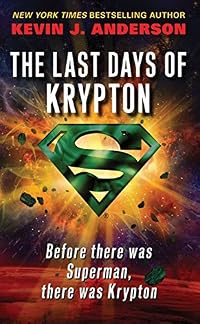
I, for one, have been confused about a lot of these things for a long time and was happy to have these questions addressed in such a gripping book. While I enjoyed most of the book, I thought the part about General Zod's takeover of the Kryptonian government was a little long, but it was also suspenseful and kept me reading. And I was thoroughly confused by Aethyr's turn-around. She starts of hating the authority of Krypton and researching its past. She is non-conformist to say the least, but then becomes an adamant Zod follower, even as he leads Krypton to near destruction. Somehow, I didn't get this abrupt change. Being non-conformist doesn't necessarily mean you'd want one person to take over the whole country and be OK with them killing off anyone who disagrees. Other than those two things though, I thought the book was well done. And the cover rocks (it's a hologram!).
Oh, and if you're unfamiliar with Superman lore, don't feel like you couldn't pick up this book. Anderson does a much better job of explaining each character's role than I have done here. Plus, there's a list of characters in the front of the book, along with a description of who they are in relation to each other, in case you get lost. I don't think you'll get lost though. The book follows a fairly linear timeline, introducing characters as you go along as with any other book. show less
With Superman this may have been slightly easier to avoid because the mythology regarding Krypton has been so scattered over the years. Readers have seen several show more potential causes for the end of Krypton, including the sun going supernova, major geological pressure causing the world to explode and civil war breaking out causing Kryptonians to destroy themselves. The awesome thing is that Anderson addresses all of these in his book. It's obvious the author did his research and tried to include everything in the plot line.
In The Last Days of Krypton, we follow the last year or so of the history of Krypton, home planet of Superman (Kal-El, Clark Kent). It is told from the perspectives of many of the main characters - Jor-El (Kal-El's dad), Zor-El, Zod and Aethyr to name but a few. We learn of the great war in Krypton's past, which gives us the reasoning behind their world's fear of space travel and connecting with alien species. We discover how Jor-El came across the spaceship in which he eventually sends Kal-El to Earth. And we learn the origins of the green Kryptonite. We also have questions answered about the phantom zone and General Zod, which is huge if you're a Superman fan.
I, for one, have been confused about a lot of these things for a long time and was happy to have these questions addressed in such a gripping book. While I enjoyed most of the book, I thought the part about General Zod's takeover of the Kryptonian government was a little long, but it was also suspenseful and kept me reading. And I was thoroughly confused by Aethyr's turn-around. She starts of hating the authority of Krypton and researching its past. She is non-conformist to say the least, but then becomes an adamant Zod follower, even as he leads Krypton to near destruction. Somehow, I didn't get this abrupt change. Being non-conformist doesn't necessarily mean you'd want one person to take over the whole country and be OK with them killing off anyone who disagrees. Other than those two things though, I thought the book was well done. And the cover rocks (it's a hologram!).
Oh, and if you're unfamiliar with Superman lore, don't feel like you couldn't pick up this book. Anderson does a much better job of explaining each character's role than I have done here. Plus, there's a list of characters in the front of the book, along with a description of who they are in relation to each other, in case you get lost. I don't think you'll get lost though. The book follows a fairly linear timeline, introducing characters as you go along as with any other book. show less
A bit disappointing. All of the things that make Superman exciting are non-existent; the entire story, understandably, takes place on Krypton where the red sun does not give Kryptonians special powers. Anderson had far too many tongue-in-cheek moments here... was the "Is it a bird? or some sort of flying device?" from one character really necessary?
On it's own, the book isn't terrible. The writing is really only mediocre, but the Zor-El and Jor-El characters are fun. However, when held up to Anderson's other work and when compared with the non-stop action and 'wow' factor of most Superman literature, The Last Days of Krypton leaves fans wanting.
One big annoyance that I had was that in classic Superman fiction, Superman is almost show more completely invulnerable (save to Kryptonite), so it's necessary that the authors give him a weakness in that he is less than clever. I'm a huge Superman fan but it's true, his main downfall is that he's outsmarted over and over again (if you're going to compete with Superman, play chess). Unfortunately Anderson seems to ignore (or avoid) this since Kal-El's father, uncle, and grandfather are super-geniuses on Krypton. Jor-El constantly invents new fantastic devices based on his own personal research and theories - he seems to be able to set his mind on something and rather quickly find a way to make it work; Kal-El (as far as I'm aware) has never shown anything close to that level of intelligence. Are we to blame the yellow sun for this lack of intelligence as well as his super powers?
***Spoiler Alert***
And one final annoyance... Zor-El, Kal-El's uncle, is a genius and works with his brother to achieve incredible things. Unfortunately when the end of Krypton is upon him, all that logic and reason goes out the window when he activates a force-field around his city in case, just maybe, it could save the city. Seriously? The interior of the planet is disappearing and the outer crust is collapsing inward. Does this genius not realize the implications? The implosion causes an explosive reaction (shooting Kryptonite out into space), but even if it didn't, did Zor-El really think that the force-field would protect the city from the initial impact? Or the massive decrease in gravity since the entire interior of the planet has disappeared? Or the change in orbit that would occur causing what's left of the planet to freeze as it moves farther from the sun? Throughout the novel the El brothers showed level-headedness, but at the last moment (while still being written as acting logical) Zor-El pulls a pointless and pathetic act of desperation. It just didn't make sense for Anderson to write it this way.
***End Spoiler***
So I guess the final message here is, if you're a huge Superman fan you'll probably need to read this book just to be able to say you have. If you're a huge Kevin J. Anderson fan, skip this book or else it'll disappoint you. If you're only a reader who is mildly interested in Superman, but wants a fun read, check out The Death and Life of Superman by Roger Stern. show less
On it's own, the book isn't terrible. The writing is really only mediocre, but the Zor-El and Jor-El characters are fun. However, when held up to Anderson's other work and when compared with the non-stop action and 'wow' factor of most Superman literature, The Last Days of Krypton leaves fans wanting.
One big annoyance that I had was that in classic Superman fiction, Superman is almost show more completely invulnerable (save to Kryptonite), so it's necessary that the authors give him a weakness in that he is less than clever. I'm a huge Superman fan but it's true, his main downfall is that he's outsmarted over and over again (if you're going to compete with Superman, play chess). Unfortunately Anderson seems to ignore (or avoid) this since Kal-El's father, uncle, and grandfather are super-geniuses on Krypton. Jor-El constantly invents new fantastic devices based on his own personal research and theories - he seems to be able to set his mind on something and rather quickly find a way to make it work; Kal-El (as far as I'm aware) has never shown anything close to that level of intelligence. Are we to blame the yellow sun for this lack of intelligence as well as his super powers?
***Spoiler Alert***
And one final annoyance... Zor-El, Kal-El's uncle, is a genius and works with his brother to achieve incredible things. Unfortunately when the end of Krypton is upon him, all that logic and reason goes out the window when he activates a force-field around his city in case, just maybe, it could save the city. Seriously? The interior of the planet is disappearing and the outer crust is collapsing inward. Does this genius not realize the implications? The implosion causes an explosive reaction (shooting Kryptonite out into space), but even if it didn't, did Zor-El really think that the force-field would protect the city from the initial impact? Or the massive decrease in gravity since the entire interior of the planet has disappeared? Or the change in orbit that would occur causing what's left of the planet to freeze as it moves farther from the sun? Throughout the novel the El brothers showed level-headedness, but at the last moment (while still being written as acting logical) Zor-El pulls a pointless and pathetic act of desperation. It just didn't make sense for Anderson to write it this way.
***End Spoiler***
So I guess the final message here is, if you're a huge Superman fan you'll probably need to read this book just to be able to say you have. If you're a huge Kevin J. Anderson fan, skip this book or else it'll disappoint you. If you're only a reader who is mildly interested in Superman, but wants a fun read, check out The Death and Life of Superman by Roger Stern. show less
This book takes place about 2 years before the birth of Superman, a.k.a. Kal-el. We follow Jor-el and Lara (Kal-el's parents); Zor-el (brother to Jor-el); and General Zod, Aethyr and Nam-Ek (the main bad guys). It tells a story about people trying to survives through great crisis. I had not really read many comicbook-based novel, so this was new to me.
The flow of the book moves smoothly through each of the chapters, which are short but have a lot of action throughout. The characters are entertaining, the good guys likable and the bad unlikable in a likable sort of way. It was entertaining to see characters from movies and comic book react with each other, like an appearance of Brainac I wasn't expecting. I have not read many Superman show more comics, but in the ones I have read more recently, Superman tends to have a negative, "I am superior to all" ... I don't know, I actually prefer Batman. That said, I liked this book because it was not about Superman, but his family and where he came from, and thus where he's coming from.
I thought it was a little redundant to keep having all these catastrophes happen all at once, but I guess the action had to come from somewhere. There are many series I see clearly--like Jor-el creating the Phantom Zone and Lara saving him from it, which helped spark their romance.
I enjoyed this book a lot and will have my eyes out for more comicbook-based novels. show less
The flow of the book moves smoothly through each of the chapters, which are short but have a lot of action throughout. The characters are entertaining, the good guys likable and the bad unlikable in a likable sort of way. It was entertaining to see characters from movies and comic book react with each other, like an appearance of Brainac I wasn't expecting. I have not read many Superman show more comics, but in the ones I have read more recently, Superman tends to have a negative, "I am superior to all" ... I don't know, I actually prefer Batman. That said, I liked this book because it was not about Superman, but his family and where he came from, and thus where he's coming from.
I thought it was a little redundant to keep having all these catastrophes happen all at once, but I guess the action had to come from somewhere. There are many series I see clearly--like Jor-el creating the Phantom Zone and Lara saving him from it, which helped spark their romance.
I enjoyed this book a lot and will have my eyes out for more comicbook-based novels. show less
Members
- Recently Added By
Author Information

461+ Works 86,183 Members
Kevin J. Anderson was born on March 27, 1962. Before becoming a full-time author, he worked in California for twelve years as a technical writer and editor at the Lawrence Livermore National Laboratory. His science fiction books include Resurrection, Inc., the Star Wars Jedi Academy Trilogy, the Young Jedi Knights series, Ground Zero, Ruins, show more Climbing Olympus, Blindfold, and The Dark Between the Stars. He has also written several books with Doug Beason including Ignition, Virtual Destruction, Fallout, and Ill Wind. (Bowker Author Biography) Kevin J. Anderson has written twenty seven bestsellers and has been nominated for the Nebula Award, the Bram Stoker Award, and the SFX Reader's Choice Award. He also holds the Guinness world record for "The Largest Single-Author Signing". (Publisher Provided) show less
Some Editions
Awards and Honors
Awards
Series


Work Relationships
Common Knowledge
- Canonical title
- The Last Days of Krypton
- Alternate titles
- Last Days of Krypton
- Original publication date
- 2007-10-23
- People/Characters
- Jor-El; Lara; General Zod; Brainiac; Zor-El; Alura (show all 64); Yar-El; Charys; Fro-Da; Lor-Van; Ora; Ki-Van; Dru-Zod; Cor-Zod; Nam-Ek; Bel-Ek; Aethyra-Ka; Bur-al; Vor-pm; Hopk-Ins; Gur-Va; Shor-Em; Donodon; Kirana-Tu; Jul-us; Maruo-Ji; Cera-Si; Pol-Ev; Kor-te; Silber-Za; Al-an; Bary-On; Sor-Ay; Rul-Ar; Jun-Do; Jax-Ur; Sor-El; Kol-Ar; Pol-Us; Nok; Kak-Ik; Hur-Om; Fra-Jo; Gil-Ex; Tyr-Us; Gal-Eth; Or-Om; Korth-Or; Koll-Em; No-Ton; Mon-Ra; Ran-Ar; Da-Es; Zhon-Za; Frer-Si; Cren-Te; Oel-Ay; Poel-Or; Bal-Un; Wri-Vo; Mir-Xa; Naer-Zed; Yri-Ri; Tres-Ok
- Important places
- Krypton
- Dedication
- To Julius Schwatz
Superman's fairy godfather.
Long paragraph about why - First words
- The Red Sun of Krypton, loomed in the sky, an unquiet
- Last words
- (Click to show. Warning: May contain spoilers.)Kal-El's new home.
- Blurbers
- Wolfman, Marv; David, Peter
Classifications
- Genres
- Fiction and Literature, Science Fiction, Graphic Novels & Comics
- DDC/MDS
- 813.54 — Literature & rhetoric American literature in English American fiction in English 1900-1999 1945-1999
- LCC
- PS3551 .N37442 .L37 — Language and Literature American literature American literature Individual authors 1961-
- BISAC
Statistics
- Members
- 497
- Popularity
- 60,425
- Reviews
- 17
- Rating
- (3.47)
- Languages
- English, Italian, Portuguese (Portugal)
- Media
- Paper, Audiobook, Ebook
- ISBNs
- 15
- ASINs
- 7