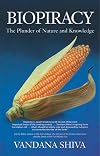
Biopiracy: The Plunder of Nature and Knowledge
by Vandana Shiva
On This Page
Description
Genetic engineering and the cloning of organisms are "the ultimate expression of the commercialization of science and the commodification of nature.... Life itself is being colonized," according to renowned environmentalist Vandana Shiva. The resistance to this biopiracy, she argues, is the struggle to conserve both cultural and biological diversity. As the land, forests, oceans, and atmosphere have already been colonized, eroded, and polluted, corporations are now looking for new colonies show more to exploit and invade for further accumulation--in Shiva's view, the interior spaces of the bodies of women, plants, and animals. Featuring a new introduction by the author, this edition of Biopiracy is a learned, clear, and passionately stated objection to the ways in which Western businesses are being allowed to expropriate natural processes and traditional forms of knowledge. show lessTags
Recommendations










































Member Reviews
If you needed a(nother) reason to regret the existence of Monsanto and Big Pharm, Vandana Shiva provides ample material here. The core story is the attempt by US and international corporations to extend the ability to patent cell lines and bioengineered organisms, currently allowed in US patent law, to international trade agreements. However, if you're not already convinced, this book isn't going to change your mind. It's less a well-reasoned argument than a string of examples of advances in bioengineering glued together with Carolyn Merchant's theory on science.
The TRIP/GATT material is already dated (the agreement referenced in the book is from 1994), but the basic argument that US intellectual property law becomes farcical and show more dangerous when applied to living organisms is worth reading. The last two chapters, on the values of self-determination and diversity and on the political implications of ecological disaster, are also a good read.
There is a lot of name calling in the beginning: patriarchy, colonialism, etc. I sometimes wonder if authors, in constructing a narrative of "everything was better before those old white guys got here" are ascribing an almost superhuman power to a group of people that really don't deserve it. How can one overcome an invading army who has the power to rewrite history, religion, interpersonal relations, political relations and cosmology? show less
The TRIP/GATT material is already dated (the agreement referenced in the book is from 1994), but the basic argument that US intellectual property law becomes farcical and show more dangerous when applied to living organisms is worth reading. The last two chapters, on the values of self-determination and diversity and on the political implications of ecological disaster, are also a good read.
There is a lot of name calling in the beginning: patriarchy, colonialism, etc. I sometimes wonder if authors, in constructing a narrative of "everything was better before those old white guys got here" are ascribing an almost superhuman power to a group of people that really don't deserve it. How can one overcome an invading army who has the power to rewrite history, religion, interpersonal relations, political relations and cosmology? show less
Ratings
Members
- Recently Added By
Lists

The Venus Project Recommended Books - Contemporary sources
53 works; 2 members
Author Information

105+ Works 2,872 Members
Vandana Shiva is a world-renowned environmental leader, activist, and scholar who has dedicated her life to defending the sovereignty of biological and Indigenous knowledge.
Classifications
- Genres
- Science & Nature, Nonfiction, Economics, Politics and Government, General Nonfiction, Sexuality and Gender Studies, History, Business
- DDC/MDS
- 341.758 — Society, government, & culture Law International Law - United Nations, EU Law of international cooperation International Economic and Business Law
- LCC
- K1519 .B54 .S53 — Law Comparative law. International uniform law Intellectual property Industrial property
- BISAC
Statistics
- Members
- 257
- Popularity
- 126,158
- Reviews
- 1
- Rating
- (3.58)
- Languages
- 7 — Chinese, English, French, German, Portuguese, Spanish, Swedish
- Media
- Paper, Ebook
- ISBNs
- 15
- ASINs
- 2