Max: A Play
by Günter Grass
On This Page
Description
A play set in Germany, in which young political activists oppose an older generation which practices persuasion.Tags
Member Reviews
Freedom of choice and second helpings, that's what they mean by democracy.
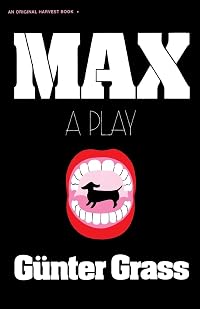
Max: A Play is a stage adaptation of Grass' novel Local Anesthetic. I read the novel almost 20 years ago. The primary tension in the novel as well as the play is between generations, a pair of students and a pair of their teachers, separated by largely twenty years. One of the students wishes to protest the Vietnam War by incinerating his dog in a posh area of West Berlin. There was an echo and rippling vertigo while reading a second version of the events, one almost a generation or so after my initial encounter. Debate ensues about action, resistance and the folly of activism. Matters then appear quaint -- or at least sincere.
There is a fifth character, a show more dentist and like Lear's Fool - he has all the best lines. One of the teachers harbors a secret, she attempted to denounce a neighbor during WWII: she is plagued by this memory. It is fair to think that the author did as well. show less
Max: A Play is a stage adaptation of Grass' novel Local Anesthetic. I read the novel almost 20 years ago. The primary tension in the novel as well as the play is between generations, a pair of students and a pair of their teachers, separated by largely twenty years. One of the students wishes to protest the Vietnam War by incinerating his dog in a posh area of West Berlin. There was an echo and rippling vertigo while reading a second version of the events, one almost a generation or so after my initial encounter. Debate ensues about action, resistance and the folly of activism. Matters then appear quaint -- or at least sincere.
There is a fifth character, a show more dentist and like Lear's Fool - he has all the best lines. One of the teachers harbors a secret, she attempted to denounce a neighbor during WWII: she is plagued by this memory. It is fair to think that the author did as well. show less
Members
- Recently Added By
Author Information

213+ Works 22,875 Members
Günter Wilhelm Grass was born on October 16, 1927 in the Free City of Danzig, which is now Gdansk, Poland. He was a member of the Hitler Youth and at the age of 17, he was drafted into the German army. Near the end of the war, he served as a tank gunner in the 10th SS Panzer Division. He was captured by the Americans and forced to visit the newly show more liberated Dachau concentration camp. After his release from a POW camp in 1946, he worked in a potash mine and as a stonemason's apprentice and studied painting and sculpture in Düsseldorf. His first novel, The Tin Drum, was published in 1959. It was adapted into a film and won the Academy Award for Best Foreign Film in 1979. His other works included Cat and Mouse, Dog Years, From the Diary of a Snail, The Flounder, The Rat, and Crabwalk. He also wrote a memoir entitled Peeling the Onion. He received the Nobel Prize for Literature in 1999. He was also a political activist and liberal provocateur. He advocated for environmental conservation, debt relief for poor countries, and generous policies regarding political asylum. He died on April 13, 2015 at the age of 87. (Bowker Author Biography) show less
Classifications
Statistics
- Members
- 14
- Popularity
- 1,680,895
- Reviews
- 1
- Rating
- (4.00)
- Languages
- English, German
- Media
- Paper
- ISBNs
- 2