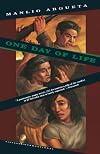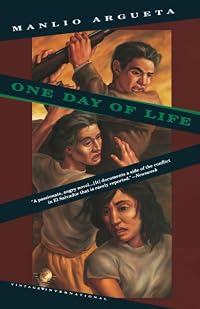
One Day of Life
by Manlio Argueta
On This Page
Description
Depicts a typical day in the life of a peasant family caught up in the terror and corruption of civil war in El Salvador.Tags
Recommendations











Member Reviews
This is a beautiful, compelling, poetic, horrific book about village life in El Salvador during the worst days of the Death Squads. The book was written in 1980, during the height of the troubles. Told in deceptively lovely language (Argueta was a well known poet before he turned his hand to novels), and through the eyes of several characters, One Day of Life brings us right inside the terror, hope and determination found within a single peasant household. The characters are at the complete mercy of the "Authorities" and their purposeful brutality, yet we see through their eyes a nascent awareness that organizing and fighting for their rights is worth the danger, if only for their childrens' sakes. As the story unfolds, the danger and show more violence of become so bad that the men of the village are forced to leave their homes and sleep up in the hills rather than risk being dragged away in the night.
As an American, I can recall hearing the stories during the 70s and 80s of these death squads. It's easy to forget, but this book puts a reader right in the middle of that horror, but in a way that emphasizes the humanity of the situation.
Argueta was a well known author when this novel, his third, was published in 1980. The El Salvadorean authorities ordered the confiscation of all copies and forbade the printing of any further editions. Argueta was forced into a 10-year exile in Costa Rica. He is now back in El Salvador where he serves as the Director of Art and Culture at the national university, the University of El Salvador, in San Salvador.
I found this book at random in a used bookstore, having never heard of it or of Argueta. It's amazing how a random pickup like this can, in 215 beautiful pages, open up a whole world of historical knowledge for a heretofore ignorant reader. show less
As an American, I can recall hearing the stories during the 70s and 80s of these death squads. It's easy to forget, but this book puts a reader right in the middle of that horror, but in a way that emphasizes the humanity of the situation.
Argueta was a well known author when this novel, his third, was published in 1980. The El Salvadorean authorities ordered the confiscation of all copies and forbade the printing of any further editions. Argueta was forced into a 10-year exile in Costa Rica. He is now back in El Salvador where he serves as the Director of Art and Culture at the national university, the University of El Salvador, in San Salvador.
I found this book at random in a used bookstore, having never heard of it or of Argueta. It's amazing how a random pickup like this can, in 215 beautiful pages, open up a whole world of historical knowledge for a heretofore ignorant reader. show less
In this at times poetic, at times harrowing novel, Argueta traces the life of Lupe, a grandmother apparently in her 40s, over the course of one day that turns out to be an eventful one. A Salvadoran peasant, her day begins at 5:30 AM when she hears a particular bird and sees a big star reach the hole in the thatch roof of her home. Lupe's story, which is told in chapters titled by the time of day, is mixed with chapters told by other characters, including her 15-year-old granddaughter Adolfina who has become involved in farmer protests int he capital, a local boy who has joined the police and become trained for "special" services, and others. It develops over the course of the day and the novel that Lupe's husband and other men, partly show more under the influence of younger priests who have taken something of an activist role, have joined a Christian farmworkers organization which has, needless to say, aroused the ire of the large landowners as well as the government which is (although unsaid) supported by the US as part of the global cold war against communism (this novel presumably takes place in the 70s). Several of the men have taken to the hills, Lupe's son has been gruesomely killed, and when the police come calling no good can result. Reference is also made to the events of 1932, when a peasant uprising against a US-supported government was brutally suppressed in what became known as "the massacre."
The strength of this novel lies in Lupe's connection to the natural world and in its depiction of the horrors of this particular time and place. It's weakness lies in its expression of the politics of the situation and in some of the characters' reflections on their personal and political growth -- both tend towards the didactic and can be repetitive. In addition, I noticed a few instances where Lupe used words that no peasant who barely reached first grade would use -- "predilection," for example -- and I found these jarring.
All that said, I found much of this novel compelling, and I appreciated Argueta telling it largely from a woman's point of view (indeed, several women, if you include Adolfina's sections). It also reminded me of historical events, as part of Adolfina's story involves the occupation of the cathedral, and Archbishop Romero plays a role helping the protestors -- as those of us who are old enough remember, he was later assassinated while celebrating mass. El Salvador is once again in the news, along with other Central American countries, with its children fleeing to the US to escape violence, and it is difficult not to see that the issues confronted in this novel have repercussions today. show less
The strength of this novel lies in Lupe's connection to the natural world and in its depiction of the horrors of this particular time and place. It's weakness lies in its expression of the politics of the situation and in some of the characters' reflections on their personal and political growth -- both tend towards the didactic and can be repetitive. In addition, I noticed a few instances where Lupe used words that no peasant who barely reached first grade would use -- "predilection," for example -- and I found these jarring.
All that said, I found much of this novel compelling, and I appreciated Argueta telling it largely from a woman's point of view (indeed, several women, if you include Adolfina's sections). It also reminded me of historical events, as part of Adolfina's story involves the occupation of the cathedral, and Archbishop Romero plays a role helping the protestors -- as those of us who are old enough remember, he was later assassinated while celebrating mass. El Salvador is once again in the news, along with other Central American countries, with its children fleeing to the US to escape violence, and it is difficult not to see that the issues confronted in this novel have repercussions today. show less
Argueta tells the story from Lupe's (a woman's) point of view of the struggles of a family who barely scrap out a life in the middle of civil war and political unrest in El Salvador. This book is graphic, violent, and upsetting. Argueta is a master of using language to convey the emotions of living a life of struggle and pain.
A grim fictional look at El Salvador. Good reading for those of us who want to understand further what people in the US, like members of CISPES, were protesting about in the 1980s & beyond.
Summary: Depicts a typical day in the life of a peasant family caught up in the terror and corruption of civil war in El Salvador
Ratings
Members
- Recently Added By
Lists

Books translated from Romance Languages into English
102 works; 7 members
Author Information

17+ Works 670 Members
Some Editions
Awards and Honors
Awards
Series
Belongs to Publisher Series
Work Relationships
Common Knowledge
- Original title
- Un dia en la vida
- Original publication date
- 1980
- People/Characters*
- Lupe Guardado; Adolfina; José Guardado
- Important places
- El Salvador
- First words*
- Justo Mejia werd op 9 november 1977 door vier politieagenten gearresteerd.
- Last words*
- (Click to show. Warning: May contain spoilers.)Er gaat een schok door me heen terwijl ik de olielampen aansteek.
*Some information comes from Common Knowledge in other languages. Click "Edit" for more information.
Classifications
Statistics
- Members
- 421
- Popularity
- 73,573
- Reviews
- 5
- Rating
- (3.79)
- Languages
- Danish, Dutch, English, Spanish
- Media
- Paper, Audiobook
- ISBNs
- 18
- ASINs
- 4