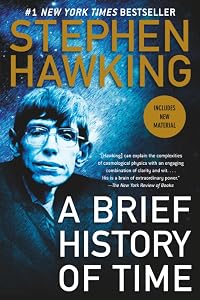
A Brief History of Time
by Stephen Hawking
On This Page
Description
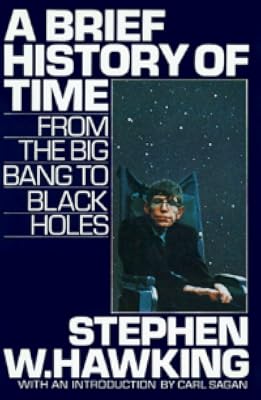
Stephen Hawking's classic work has become a landmark volume in scientific writing, with more than nine million copies in forty languages sold worldwide. The intervening years have seen extraordinary advances in the technology of observing both the micro- and the macrocosmic worlds. These observations have confirmed many of Professor Hawking's theoretical predictions in the first edition of his book, including the recent discoveries of the Cosmic Background Explorer satellite (COBE), which show more probed back in time to within 300,000 years of the universe's beginning and revealed wrinkles in the fabric of space-time that he had projected. show lessTags
Recommendations





Member Reviews
A friend of mine loves this book and has read it more than once. Reassuring, since like me, she doesn't hold a doctorate in the sciences! In fact, as someone who used to do a lot of science reading--I read many a astronomy book by Isaac Asimov and Carl Sagan once upon a time--most of the concepts here were very familiar. Well, until we reached the very weird land of quantum mechanics and string theory and imaginary numbers, where I admit I was pretty lost.
Hawking gives the history of the science surrounding the ultimate questions of the universe starting from the arguments of Aristotle in 340 B.C. for a round earth to the very strange land of today's physics of quantum mechanics with its different colored quarks and antimatter on the show more micro level and the strange interstellar beasties of relativistic physics of dark matter, black holes, quasars, and neutron stars and the very weird string theory that might unite both. I do think his explanations are lucid and elegant. I can't remember a better description of Einstein's General Theory of Relativity by explaining its historic relationship to Newton and how the theory tried to answer questions about the relationship between space and time. And Hawking manages to explain some sophisticated concepts without loading the book with jargon or equations. Hawking was also great at explaining how the theory of Relativity fits--or rather doesn't fit--with Quantum Mechanics and the search for a theory that could unify them both. I'm not saying I understood everything in the book. The concepts are counter-intuitive and hard to digest, and there's only so far you can go in explaining difficult subjects in simple terms to people lacking the background. But I understood it better, and certainly got the implications Hawking spelled out.
About the only stylistic quirk I had an issue with was Hawking's refusal to use the B-word. (A Briticism?). I find it a lot easier to wrap my mind around ten billion than "ten thousand million." The edition I read was written in 1996, updated from the first edition from 1988 which was a enormous bestseller. In the Foreword to that revised edition, Hawking wrote he thought that "within a few years we should know whether we can believe that we live in a universe that is completely self-contained and without beginning or end." Hawking definitely leaves me wanting to read more to find out the verdict. Worth reading, although not always easy to grasp. show less
Hawking gives the history of the science surrounding the ultimate questions of the universe starting from the arguments of Aristotle in 340 B.C. for a round earth to the very strange land of today's physics of quantum mechanics with its different colored quarks and antimatter on the show more micro level and the strange interstellar beasties of relativistic physics of dark matter, black holes, quasars, and neutron stars and the very weird string theory that might unite both. I do think his explanations are lucid and elegant. I can't remember a better description of Einstein's General Theory of Relativity by explaining its historic relationship to Newton and how the theory tried to answer questions about the relationship between space and time. And Hawking manages to explain some sophisticated concepts without loading the book with jargon or equations. Hawking was also great at explaining how the theory of Relativity fits--or rather doesn't fit--with Quantum Mechanics and the search for a theory that could unify them both. I'm not saying I understood everything in the book. The concepts are counter-intuitive and hard to digest, and there's only so far you can go in explaining difficult subjects in simple terms to people lacking the background. But I understood it better, and certainly got the implications Hawking spelled out.
About the only stylistic quirk I had an issue with was Hawking's refusal to use the B-word. (A Briticism?). I find it a lot easier to wrap my mind around ten billion than "ten thousand million." The edition I read was written in 1996, updated from the first edition from 1988 which was a enormous bestseller. In the Foreword to that revised edition, Hawking wrote he thought that "within a few years we should know whether we can believe that we live in a universe that is completely self-contained and without beginning or end." Hawking definitely leaves me wanting to read more to find out the verdict. Worth reading, although not always easy to grasp. show less
I have wanted to read this book for a long time. I understood well about the first 1/3 but then it got into quantum physics and I got lost at the donut shop. What's that? There is no donut shop? Well, no wonder I got lost. It is not Hawking's fault that I did not follow what he was saying. It's that I don't comprehend how to observe mathematics, particularly when it is mathematics for something an ordinary person can't see. I understood the book on and off. I did learn some new things so it ws not a total loss of time for me. I was startled every time I ran into an explanation point
What book covering physics ever has an explanation point!
All told, the book, while interesting in the parts I could understand, was mostly a giraffe book. show more You know, way over my head. show less
What book covering physics ever has an explanation point!
All told, the book, while interesting in the parts I could understand, was mostly a giraffe book. show more You know, way over my head. show less
“A Mind-Bending Journey Through Space and Time” 5-Stars by Rebecca Raffle
⭐️⭐️⭐️⭐️⭐️
I first read A Brief History of Time in my twenties, during a period of intense curiosity about the universe and how everything fits together. Stephen Hawking didn’t just explain physics, he reshaped the way I think about reality itself.
This book is a masterclass in making the complex understandable. Hawking takes us through black holes, time warps, relativity, and the Big Bang, distilling some of the most profound discoveries in physics into something readable, even for non-scientists.
What makes it so compelling isn’t just the science, it’s Hawking’s ability to communicate a deep sense of wonder about the cosmos.
“If show more time travel is possible, where are the tourists from the future?”
That’s the charm of this book. It’s as playful as it is profound. Hawking never talks down to the reader, and even when the material gets dense, he encourages you to keep thinking, keep questioning, and keep exploring.
Why This Book Stands Out 🔥
✔️ Makes Physics Fascinating – Black holes, wormholes, the arrow of time—Hawking explains it all with clarity and wit.
✔️ Short Yet Deeply Impactful – It’s under 250 pages, but it packs a lifetime’s worth of knowledge and questions.
✔️ Leaves You Wondering – Hawking doesn’t just give answers—he leaves you with new questions to ponder long after you finish.
Who Should Read This?
✔️ Anyone Curious About the Universe – If you’ve ever wanted to understand space, time, and existence itself, this book is essential.
✔️ Readers Who Enjoy Books Like Cosmos or The Elegant Universe – If you love big ideas explained simply, you’ll love this.
✔️ Those Who Want to Understand Hawking’s Legacy – This book cemented his place as one of the greatest scientific minds of our time.
Final Thoughts 😍
I’m giving A Brief History of Time 5 stars because it’s a rare book that makes you feel smarter with every page. Hawking had a gift for explaining the inexplicable, and this book is proof.
If you’ve ever looked up at the stars and wondered about the nature of time, space, and the universe itself, this book will change the way you see everything.
📚 Enjoy my reviews? Let’s connect!
📖 Read more in-depth reviews & essays on Medium: medium.com/@RebeccaRaffle
📷 Follow my Instagram @RebeccaRaffle for book updates & foodie adventures: https://www.instagram.com/rebeccaraffle
🌍 Explore more on my website: https://www.rebeccaraffle.com show less
⭐️⭐️⭐️⭐️⭐️
I first read A Brief History of Time in my twenties, during a period of intense curiosity about the universe and how everything fits together. Stephen Hawking didn’t just explain physics, he reshaped the way I think about reality itself.
This book is a masterclass in making the complex understandable. Hawking takes us through black holes, time warps, relativity, and the Big Bang, distilling some of the most profound discoveries in physics into something readable, even for non-scientists.
What makes it so compelling isn’t just the science, it’s Hawking’s ability to communicate a deep sense of wonder about the cosmos.
“If show more time travel is possible, where are the tourists from the future?”
That’s the charm of this book. It’s as playful as it is profound. Hawking never talks down to the reader, and even when the material gets dense, he encourages you to keep thinking, keep questioning, and keep exploring.
Why This Book Stands Out 🔥
✔️ Makes Physics Fascinating – Black holes, wormholes, the arrow of time—Hawking explains it all with clarity and wit.
✔️ Short Yet Deeply Impactful – It’s under 250 pages, but it packs a lifetime’s worth of knowledge and questions.
✔️ Leaves You Wondering – Hawking doesn’t just give answers—he leaves you with new questions to ponder long after you finish.
Who Should Read This?
✔️ Anyone Curious About the Universe – If you’ve ever wanted to understand space, time, and existence itself, this book is essential.
✔️ Readers Who Enjoy Books Like Cosmos or The Elegant Universe – If you love big ideas explained simply, you’ll love this.
✔️ Those Who Want to Understand Hawking’s Legacy – This book cemented his place as one of the greatest scientific minds of our time.
Final Thoughts 😍
I’m giving A Brief History of Time 5 stars because it’s a rare book that makes you feel smarter with every page. Hawking had a gift for explaining the inexplicable, and this book is proof.
If you’ve ever looked up at the stars and wondered about the nature of time, space, and the universe itself, this book will change the way you see everything.
📚 Enjoy my reviews? Let’s connect!
📖 Read more in-depth reviews & essays on Medium: medium.com/@RebeccaRaffle
📷 Follow my Instagram @RebeccaRaffle for book updates & foodie adventures: https://www.instagram.com/rebeccaraffle
🌍 Explore more on my website: https://www.rebeccaraffle.com show less
If your understanding of physics is limited to describing interactions between your coffee cup, the force of gravity, and your kitchen floor, "A Brief History of Time" is your kind of book about astrophysics. There's hardly any math in the book, and Hawking's prose is remarkably accessible. It's even, at times, elegant, using a variety of metaphors that will help curious non-scientists get a handle on some pretty wild ideas. Hawking takes things slow, emphasizes repeats his most important points, and doesn't forget that that it's often the scientists themselves that make science interesting. He's good about providing the historical background of the theories he discusses and often provides short biographies or anecdotes of the show more scientists who originated them. "A Brief History" isn't exactly bedtime reading, but probably not as challenging a read as some people might assume.
I also enjoyed this book for other, perhaps less obvious, reasons. I'm a very textually-oriented reader, and while a few people have told me that they think mostly in pictures, I've never quite understood what that might feel like. "A Brief History of Time," however, is the sort of book that forces you into that mode of thinking -- it all but guides its readers through the formulation of a set of science-related mental images. It's challenging, if you're not accustomed to thinking that way, but imagining how, say, light particles act at the rim of a black hole is a fun exercise nonetheless. Hawking deals with extremes: the infinitesimally tiny, the awesomely large. There's a chilling sort of grandeur to many of his descriptions of the universe, which is largely composed of huge expanses of cold, empty space. Some readers might find some of Hawking's descriptions disconcerting, but there's a hint of the sublime here, too. "A Brief History" made me very aware that my mind spends most of its time considering things on a relatively familiar human scale; it is, perhaps, a sign of Hawking's intelligence that he can consider the immensity of the universe without having his mind simply boggle at its size. There's a lot in this book that is, from an anthropomorphic perspective, pretty humbling, a blow to anyone's ego. Still, maybe it's not a terrible thing to be asked to consider oneself a tiny speck in an infinitely large and indifferent universe, at least once in a while. show less
I also enjoyed this book for other, perhaps less obvious, reasons. I'm a very textually-oriented reader, and while a few people have told me that they think mostly in pictures, I've never quite understood what that might feel like. "A Brief History of Time," however, is the sort of book that forces you into that mode of thinking -- it all but guides its readers through the formulation of a set of science-related mental images. It's challenging, if you're not accustomed to thinking that way, but imagining how, say, light particles act at the rim of a black hole is a fun exercise nonetheless. Hawking deals with extremes: the infinitesimally tiny, the awesomely large. There's a chilling sort of grandeur to many of his descriptions of the universe, which is largely composed of huge expanses of cold, empty space. Some readers might find some of Hawking's descriptions disconcerting, but there's a hint of the sublime here, too. "A Brief History" made me very aware that my mind spends most of its time considering things on a relatively familiar human scale; it is, perhaps, a sign of Hawking's intelligence that he can consider the immensity of the universe without having his mind simply boggle at its size. There's a lot in this book that is, from an anthropomorphic perspective, pretty humbling, a blow to anyone's ego. Still, maybe it's not a terrible thing to be asked to consider oneself a tiny speck in an infinitely large and indifferent universe, at least once in a while. show less
Hawking breaks complex modern theoretical physics concepts down enough for the layman to understand it, without bogging them down with too much detail. It is well written, and has a good flow, where the chapters build on each other. While reading, it makes me feel smart and incredibly stupid at the same time, and I love it.
Well-written and concise discussion of some nifty theoretical physics including black holes, the big bang, time, and the search for a unified theory of everything. Hawking explains complex science well (I've come away with a satisfying, if non-working*, understanding of most of the concepts he discusses), and his funky sense of humor helps make this a fun read.
*By which I mean that I grasp the concepts in general terms but would have a hard time teaching them to anyone else and certainly could not draw conclusions from or otherwise use my knowledge.
*By which I mean that I grasp the concepts in general terms but would have a hard time teaching them to anyone else and certainly could not draw conclusions from or otherwise use my knowledge.
Although very good, the title is quite apt in calling it the "Brief" History of Time. The book is barely 200 pages in length, but the content more than makes up for it by being really accessible and enjoyable. The book covers the basics of fundamental cosmology; it considers the Big Bang and all of that along with the Arrow of Time, Time Travel, Wormholes and other things.
Members
- Recently Added By
Lists

100 books to read in a lifetime
102 works; 37 members

Non-Fiction Worth Reading
1,016 works; 256 members

25 Greatest Science Books of All Time
33 works; 6 members
Big tags
15 works; 1 member

el
1,139 works; 1 member

Five star books
1,767 works; 110 members

The r/AskScience Reading List
159 works; 3 members

Mind Expanding Books by hackerkid
581 works; 8 members

1980s
356 works; 23 members

Books Read in 2019
4,052 works; 110 members

KIB Non-Fiction Book Cloud
41 works; 1 member

The Joe Rogan Experience Library
254 works; 3 members

Books Read in 2017
4,249 works; 130 members

Books Read in 2016
4,666 works; 199 members

The Books I Read in 2017
96 works; 1 member

Physics
29 works; 3 members

I Can't Finish This Book
189 works; 22 members

Independent Reading Suggestions
69 works; 3 members

Books referenced in Jim Holt's Why Does the World Exist?
119 works; 1 member

To Read
6 works; 1 member

Atheism, humanism, freethought, &c. — Best nonfiction books in favour of
167 works; 14 members

Unread books
1,063 works; 87 members
Author Information

133+ Works 54,838 Members
Stephen William Hawking was born in Oxford, England on January 8, 1942. He received a first class honors degree in natural science from Oxford University and a Ph.D. from Cambridge University. He was a theoretical physicist and has held the post of Lucasian Professor of Mathematics at Cambridge University from 1982 until his death. In 1974, he was show more elected a Fellow of the Royal Society, the world's oldest scientific organization. In 1963, he learned he had amyotrophic lateral sclerosis, a neuromuscular wasting disease also known as Lou Gehrig's disease. The disease confined him to a wheelchair and reduced his bodily control to the flexing of a finger and voluntary eye movements, but left his mental faculties untouched. He became a leader in exploring gravity and the properties of black holes. He wrote numerous books including A Brief History of Time: From the Big Bang to Black Holes, Black Holes and Baby Universes, On the Shoulders of Giants, A Briefer History of Time, The Universe in a Nutshell, The Grand Design, and Brief Answers to the Big Questions. In 1982, he was named a commander of the British Empire. A film about his life, The Theory of Everything, was released in 2014 and was based on his first wife Jane Hawking's book Traveling to Infinity: My Life with Stephen. He died on March 14, 2018 at the age of 76. (Bowker Author Biography) show less
Work Relationships
Has as a reference guide/companion
Classifications
Statistics
- Members
- 7,703
- Popularity
- 1,475
- Reviews
- 110
- Rating
- (3.97)
- Languages
- English
- Media
- Paper, Ebook
- ISBNs
- 1