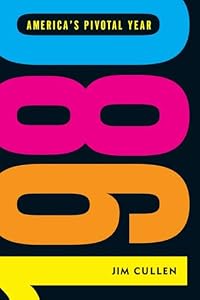
1980: America's Pivotal Year
by Jim Cullen
On This Page
Description
"1980 was a turning point in American history. When the year began, it was still very much the 1970s, with Jimmy Carter in the White House, a sluggish economy marked by high inflation, and the disco still riding the airwaves. When it ended, Ronald Reagan won the presidency in a landslide, inaugurating a rightward turn in American politics and culture. We still feel the effects of this tectonic shift today, as even subsequent Democratic administrations have offered neoliberal economic and show more social policies that owe more to Reagan than to FDR or LBJ. To understand what the American public was thinking during this pivotal year, we need to examine what they were reading, listening to, and watching. 1980: American Culture in Transition puts the news events of the era-everything from the Iran hostage crisis to the rise of televangelism-into conversation with the year's popular culture. Separate chapters focus on the movies, television shows, songs, and books that Americans were talking about that year, including both the biggest hits and some notable flops that failed to capture the shifting zeitgeist. As he looks at the events that had Americans glued to their screens, from the Miracle on Ice to the mystery of Who Shot JR, cultural historian Jim Cullen garners surprising insights about how Americans' attitudes were changing as they entered the 1980s"-- show lessTags
Member Reviews
1980: America's Pivotal Year, by Jim Cullen, is an interesting and well-presented argument for just what the title claims. Even if you don't come away thinking it is THE pivotal year one can't argue with the fact it was A pivotal year.
The book is thematically organized, so while some discussion within each chapter may cross media lines, the chapter is about a particular medium or topic (film, music, publishing, politics primarily because it was an election year, etc). This works well for both presenting each case and for then showing the cumulative effect.
Don't let an asinine review from a "Dr" (should all of us who could use that designation do so, or just the self-righteous?) keep you from reading the book. Trump is mentioned no more show more than most figures that came after 1980 so it is the Dr's bias that is showing, not the writer's. This is not about the decade of the 80s, as reading the entire title would tell most people, but this guy must either have a serious reading comprehension problem or just skimmed some of the text to be able to make a very poor and slanted review. Especially since these aren't even remotely "lists," though a number of examples are mentioned to show how the work Cullen centered each chapter on is pivotal. But those examples have a discussion explaining why he believes they make good examples. Emeritus, yeah, from U of North Podunk, all while working for investment firms through an "information services" company. And his (mostly edited by rather than written by) publications and expertise is in the economics of media, not the social and cultural influences or ramifications, so he is as "expert" as whoever the next person you may see is. In other words, not one. Enough about that hideous excuse for an "educator."
If you were at least a teenager in 1980 (I was past that) you will remember a lot of what is in here but perhaps not the way Cullen contextualizes it. Additionally, if you tended toward the less popular in an area you may well not be as aware of just how popular (numbers and profit wise) some of these examples were. I personally wasn't watching much TV at the time so while I knew, for example, that Dallas was a big deal, we didn't gather 'round the reactor on the sub and discuss episodes.
Yes, there is a lot of political discussion throughout, in large part because it was an election year and in large part because the way politics pivoted from that point until now is the single strongest argument for 1980 being pivotal. From two parties that warred but understood that democracy requires compromise, to a two-party system where they are both to the right of center and the one furthest to the right has authoritarian leanings.
While my comment, and the blatantly dishonest review from numbnuts, gives the impression the book is largely a political book, it isn't. In fact, until I saw that just mentioning facts brought a "dr" to full-fledged lies, it was largely a trip down memory lane that made me think, for each area, to what degree I agreed. And the argument Cullen makes holds pretty well for the separate areas as well as for the country as a whole.
Recommended for those who might remember 1980 and want to reconsider the year as an important one as well as social historians who enjoys looking at how various threads in our society influences each other.
Reviewed from a copy made available by the publisher via NetGalley. show less
The book is thematically organized, so while some discussion within each chapter may cross media lines, the chapter is about a particular medium or topic (film, music, publishing, politics primarily because it was an election year, etc). This works well for both presenting each case and for then showing the cumulative effect.
Don't let an asinine review from a "Dr" (should all of us who could use that designation do so, or just the self-righteous?) keep you from reading the book. Trump is mentioned no more show more than most figures that came after 1980 so it is the Dr's bias that is showing, not the writer's. This is not about the decade of the 80s, as reading the entire title would tell most people, but this guy must either have a serious reading comprehension problem or just skimmed some of the text to be able to make a very poor and slanted review. Especially since these aren't even remotely "lists," though a number of examples are mentioned to show how the work Cullen centered each chapter on is pivotal. But those examples have a discussion explaining why he believes they make good examples. Emeritus, yeah, from U of North Podunk, all while working for investment firms through an "information services" company. And his (mostly edited by rather than written by) publications and expertise is in the economics of media, not the social and cultural influences or ramifications, so he is as "expert" as whoever the next person you may see is. In other words, not one. Enough about that hideous excuse for an "educator."
If you were at least a teenager in 1980 (I was past that) you will remember a lot of what is in here but perhaps not the way Cullen contextualizes it. Additionally, if you tended toward the less popular in an area you may well not be as aware of just how popular (numbers and profit wise) some of these examples were. I personally wasn't watching much TV at the time so while I knew, for example, that Dallas was a big deal, we didn't gather 'round the reactor on the sub and discuss episodes.
Yes, there is a lot of political discussion throughout, in large part because it was an election year and in large part because the way politics pivoted from that point until now is the single strongest argument for 1980 being pivotal. From two parties that warred but understood that democracy requires compromise, to a two-party system where they are both to the right of center and the one furthest to the right has authoritarian leanings.
While my comment, and the blatantly dishonest review from numbnuts, gives the impression the book is largely a political book, it isn't. In fact, until I saw that just mentioning facts brought a "dr" to full-fledged lies, it was largely a trip down memory lane that made me think, for each area, to what degree I agreed. And the argument Cullen makes holds pretty well for the separate areas as well as for the country as a whole.
Recommended for those who might remember 1980 and want to reconsider the year as an important one as well as social historians who enjoys looking at how various threads in our society influences each other.
Reviewed from a copy made available by the publisher via NetGalley. show less
An in-depth look at the cultural, political, and social trends of 1980, rightly seen as a time of major transition in American society.
The author explores in depth the 1980 Presidential campaign as well as the music, the books, the television shows, and the movies which defined 1980. The author goes to great lengths to show the fading of many of the cultural and social trends which had defined the 1970s and even all the way back to the end of WWII by 1980 and the points of emergence of a new, laissez-faire conservative perspective. The author concluded with an analysis of the 1980 election and how it ushered in the Eighties as we understand it, and seeing in the events of 2001, 2008, and 2020 the final end of the age inaugurated in show more 1980.
The work is interesting but has a "laundry list" feel to it: the author felt compelled to discuss almost everything, and in the process the analysis and the explanation of importance got lost. In many ways it is important to make it clear how things were changing around 1980 since new generations have arisen which did not live to see it; and yet plenty of eulogies have been made for the spirit of the 1980s and yet somehow many of its platitudes and ideologies persist. Only in future generations will there be sufficient distance to be able to better assess such things. But for now this is an accessible work to explain a pretty important year in American history.
**--galley received as part of early review program show less
The author explores in depth the 1980 Presidential campaign as well as the music, the books, the television shows, and the movies which defined 1980. The author goes to great lengths to show the fading of many of the cultural and social trends which had defined the 1970s and even all the way back to the end of WWII by 1980 and the points of emergence of a new, laissez-faire conservative perspective. The author concluded with an analysis of the 1980 election and how it ushered in the Eighties as we understand it, and seeing in the events of 2001, 2008, and 2020 the final end of the age inaugurated in show more 1980.
The work is interesting but has a "laundry list" feel to it: the author felt compelled to discuss almost everything, and in the process the analysis and the explanation of importance got lost. In many ways it is important to make it clear how things were changing around 1980 since new generations have arisen which did not live to see it; and yet plenty of eulogies have been made for the spirit of the 1980s and yet somehow many of its platitudes and ideologies persist. Only in future generations will there be sufficient distance to be able to better assess such things. But for now this is an accessible work to explain a pretty important year in American history.
**--galley received as part of early review program show less
Members
- Recently Added By
Author Information

22 Works 574 Members
Jim Cullen, PHD, received his doctorate in American Studies from Brown University and is the author of many books and anthologies. His articles and reviews have appeared in prestigious publications, including The Washington Post, USA Today, CNN.com, the Journal of American History, and the American Historical Review. Jim has taught at Harvard show more University and Sarah Lawrence College and is a member of the faculty at the Greenwich Country, Day School in Greenwich, Connecticut. show less
Classifications
- Genres
- History, Nonfiction, Politics and Government, Music, General Nonfiction
- DDC/MDS
- 306.09730904 — Society, Government, and Culture Social sciences, sociology & anthropology Social Behavior - Dating, Marriage, Divorce Social history North America United States
- LCC
- E169.12 .C855 — History of the United States United States General
- BISAC
Statistics
- Members
- 7
- Popularity
- 2,735,400
- Reviews
- 2
- Rating
- (4.25)
- Languages
- English
- Media
- Paper, Ebook
- ISBNs
- 3
- ASINs
- 1