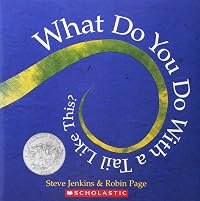
What Do You Do with a Tail Like This?
by Steve Jenkins, Robin Page
On This Page
Description
A nose for digging? Ears for seeing? Eyes that squirt blood? Explore the many amazing things animals can do with their ears, eyes, mouths, noses, feet, and tails in this interactive guessing book, beautifully illustrated in cut-paper collage, which was awarded a Caldecott Honor. This title has been selected as a Common Core Text Exemplar (Grades K-1, Read Aloud Informational Text).Tags
Recommendations








Member Reviews
'What Do You Do With a Tail Like This?' sounds like a sing-along book. After reading through it, someone could sing this with a melody in mind. But if so, it would be a very informative sing-along. 'What Do You Do With a Tail Like This?' by author Steve Jenkins and illustrator Robin Page is a book that informs the readers about different animals, reptiles and insects of the world and what makes them unique. There are animals scattered on each page talking about a specific body part and how that animal uses it in a specific way. The creatures scattered on the pages have a very interesting look to them. Some are clean, others are dotted, while some look very textured. Each brings a certain aspect to set these creatures apart from the show more others; even if they are on the same page about the same body part being represented. I think Page may have mixed in some cutouts, with construction paper and a bit of paint to give these creatures form. My favorite part of the book was on the topic of tails, with one of the creatures being a lizard. The book spoke of its tail breaking off and right in the break of the two page spread is the end of the lizard's tail being cut off book's spine, with the rest of its body remaining on the opposing page. This was not pointed out but it was one of those little things, along with the art, that earned Page a Caldecott Medal. show less
What Do You Do With a Tale Like This? is a read-aloud informational text that challenges young readers to identify different animals by only revealing one part of its body – a tail, nose, eye, etc. The illustrations are colorful and vibrant, yet accurate and the text accompanying it is fun and interesting. The author bares all, even explaining that a mosquito identified by its mouth sucks blood for its food. I believe young readers would find this book engaging because of its interactive nature and detailed writing.
Steve Jenkins knocks it out of the park with another visual gimmick and simplified informational text. What Do You Do with A Tail Like This? lends itself to both read alouds and independent reading by non-readers fascinated with the part/whole structure of the book. Young readers will struggle to sit quietly as they actively make predictions sparked by Jenkins' simple questions and artwork. The selection of animals is incredibly diverse and the arrangement showcases their unique features in a special way and engages children without overwhelming them with walls of text.
Kindergarten-Grade 4-Jenkins, this time in collaboration with his wife, has created yet another eye-opening book. Children will learn that lizards can completely break off their tail as a defense and that it will grow back. And, they'll find out that crickets' ears are on their knees. Most fish have two eyes, but some have four, the better to see above and below the water at the same time. These are just a few of the fascinating facts of nature dangled out front to draw readers into this beautifully illustrated book. On each spread, five different animals' tails, ears, eyes, or other body parts, done in vibrant cut-paper collage, appear with a simple question ("What do you do with a- like this?"). The next spread shows the five show more creatures in their entirety and offers a brief explanation. For example, "If you're an elephant, you use your nose to give yourself a bath." The back pages offer more information for older or more curious readers. This is a great book for sharing one-on-one or with a group. show less
A fun way to learn how body parts have many different uses or abilities on different animals. There's an interactive part where you get to guess what the animal is from a part of its body before you are given interesting and often amazing factoids about it.
“What do you do with a nose (or ears, tail, eyes, feet, or mouth) like this?” This wonderful information book asks children the question on one spread, with five various animals’ body parts in question shown, while the answer is on the next. Even adults will learn something new about an animal they previously didn’t know. I didn’t know that an elephant’s trunk can weigh up to 400 pounds or that whales can hear other whales hundreds of miles apart. Part of the fun of the layout and design is how the text is positioned, shooting out of the nose of a mole, splashing around the head of an elephant, and straight as an arrow down the back of an alligator. The interesting vocabulary such as 'pesky', 'stinky', and 'nasty' will show more entice children to try them out. Body parts are cropped strategically encouraging the reader to guess the animal. Each body part and animal is designed out of paper either torn or cut. As a teacher, I appreciate the glossary at the back of the book explaining characteristics of each animal in more detail. Like Brown Bear Brown Bear, this book could easily lead to class book creations. Highly recommended. Grades Pre-K-2. show less
Packed with facts about all kinds of animals — mammals, insects, birds, reptiles, fish — this picture book is a cleverly organized encyclopedia that engages readers to learn with questions. The close-up colorful collage depictions of the tails or noses or feet of seemingly unrelated animals arouse curiosity. Readers have to predict who the ears, for example, belong to as well to think about why that animal’s ears are unique. Each spread that gives picture clues and poses a question is followed by a spread depicting the animals in their entirety and both identifying them and explaining one purpose of the highlighted feature. It’s a pattern that could easily be imitated by student writers. Moreover, using this book as a mentor show more text for teaching expository writing could get students thinking about how to use questions to engage their readers. It’s also a valuable tool for examining organization. For example, students might consider the effectiveness of grouping facts about disparate animals based on individual features, and then, sifting through the full paragraphs on each animals in a section at the back, challenged to come up with organizational patterns of their own. This model could also translate to other content. show less
Members
- Recently Added By
Published Reviews
Jenkins, this time in collaboration with his wife, has created yet another eye-opening book. Children will learn that lizards can completely break off their tail as a defense and that it will grow back. And, they'll find out that crickets' ears are on their knees. Most fish have two eyes, but some have four, the better to see above and below the water at the same time. These are just a few of show more the fascinating facts of nature dangled out front to draw readers into this beautifully illustrated book. On each spread, five different animals' tails, ears, eyes, or other body parts, done in vibrant cut-paper collage, appear with a simple question ("What do you do with a- like this?"). The next spread shows the five creatures in their entirety and offers a brief explanation. For example, "If you're an elephant, you use your nose to give yourself a bath." The back pages offer more information for older or more curious readers. This is a great book for sharing one-on-one or with a group. show less
added by ReneHohls
Not only does Jenkins (Life on Earth, 2002, etc.) again display a genius for creating paper-collage wildlife portraits with astonishingly realistic skin, fur, and feathers, but here on alternate spreads he zooms in for equally lifelike close-ups of ears, eyes, noses, mouths, feet, and tails. Five examples of each organ thrusting in from beyond the pages’ edges for each “What do you do” show more question precede spreads in which the point of view pulls back to show the whole animal, with a short accompanying caption. Visual surprises abound: a field cricket’s ears are actually on its legs; a horned lizard can (and does, here) squirt blood from its eyes as a defense mechanism; in an ingenious use of page design, a five-lined skink’s breakable tail enters and leaves the center gutter at different points. Capped by a systematic appendix furnishing more, and often arresting, details—“A humpback whale can be 50 feet long and weigh a ton per foot”—this array of wide eyes and open mouths will definitely have viewers responding with wide eyes and open mouths of their own. (Picture book/nonfiction. 6-9) show less
added by ReneHohls
Here's another exceptional cut-paper science book from Jenkins, this time put together with a partner, and like previous books, it's a stunner. An opening page, clearly explaining how to use the book, is followed by a double-page spread picturing the mouths of several different animals, accompanied by the question, "What do you do with a mouth like this?" The next spread shows each animal in show more full, explaining in a few simple words how the part functions. Tail, ears, nose, and eyes are covered in the same manner. A picture glossary at the back shows each animal again, postage-stamp size, with an informative note elaborating on the creature's special adaptation. The notes also neatly answer questions that might arise during a reading (Why do horned lizards squirt blood out their eyes?) and add to the interactive aspect of the book. A variety of animals is represented--some (elephant, hippo, chimp) will be comfortably familiar; others (four-eyed fish, blue-footed booby) are of interest because of their strangeness. Jenkins' handsome paper-cut collages are both lovely and anatomically informative, and their white background helps emphasize the particular feature, be it the bush baby's lustrous, liquid-brown eyes or the skunk's fuzzy tail. This is a striking, thoughtfully created book with intriguing facts made more memorable through dynamic art. show less
added by ReneHohls
Lists

Caldecott Honor Books
296 works; 23 members

Research/Inquiry - questions and wondering
43 works; 3 members

Top-Rated Children's Books
87 works; 16 members

Books Read in 2023
5,547 works; 145 members
Author Information

75+ Works 21,314 Members

26+ Works 7,012 Members
Awards and Honors
Awards
Distinctions
Common Knowledge
- Canonical title
- What Do You Do with a Tail Like This?
- Original publication date
- 2003
- Dedication
- For Jamie, Alec, and Page
- First words
- Animals use their noses, ears, tails, eyes, mouths, and feet in very different ways.
- Quotations
- What do you do with a nose like this?
- Last words
- (Click to show. Warning: May contain spoilers.)If you're an archerfish, you catch insects by shooting them down with a stream of water.
- Original language
- English
Classifications
Statistics
- Members
- 4,570
- Popularity
- 3,188
- Reviews
- 121
- Rating
- (4.26)
- Languages
- 6 — Chinese, English, French, Russian, Spanish, Turkish
- Media
- Paper, Ebook
- ISBNs
- 34
- UPCs
- 2
- ASINs
- 8