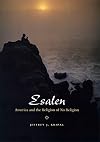
Esalen: America and the Religion of No Religion
by Jeffrey J. Kripal
On This Page
Description
Esalen has always been on the edge. Famous for its natural hot springs and stunning locale on the face of the Pacific coastline, the institute has long been a world leader in alternative and experiential education. Such luminaries as Henry Miller, Joseph Campbell, Aldous Huxley, Jack Kerouac, Allen Ginsberg, Hunter S. Thompson, and others have gathered there to develop their revolutionary ideas, transformative spiritual practices, and innovative art forms. Jeffrey Kripal here recounts the show more spectacular history of Esalen and its birth in the American counterculture. Forged in the literary and mythical leanings of the Beat Generation, inspired in the lecture halls of Stanford by radical scholars of comparative religion, the institute was the remarkable brainchild of Michael Murphy and Richard Price. Set against the heady backdrop of California during the revolutionary 1960s, Esalen recounts in fascinating detail how these two maverick thinkers sought to fuse the spiritual revelations of the East with the scientific revolutions of the West, or to combine the very best elements of Zen Buddhism, Western alchemy, and Indian yoga particularly in its Tantric forms into a decidedly utopian vision that rejected the dogmas of conventional religion. In their religion of no religion, the natural world was just as crucial as the spiritual one, science and faith not only commingled but became staunch allies, and the enlightenment of the body through self-enhancement and, yes, free love could lead to the full realization of our development as human beings. Darwin, Tantric sex, cold war physics, psychedelic drugs, golf, and, of course, religion all come into play in a book that can only be described as monumental. Esalen is a prehistory of our nation s current fascination with Eastern religions, our steadily growing acceptance of the supernatural in everyday life and a surprising page-turner. show lessTags
Recommendations


















Member Reviews
Kripal opens the books by noting that Esalen is a place of synchronicity, where connections form without apparent causes. Synchronicity is something I can confirm myself. On my one visit (so far), I sat down with two strangers: One of them was also there for her birthday which was that evening, and the other one had been in Mammoth Lakes the weekend prior, where I had just had a late summer vacation. The site, perched on cliffs above the Pacific, centered around the waters of the hot springs, is paradise on Earth.
Kripal's book is a serious intellectual history of the mission and accomplishments of Esalen. His framing is that Esalen is a (perhaps the) leading center of the Western development of the Tantra, an inter-religious, show more inter-philosophical practice of enlightenment of the body. Tantra draws from Hindu and Buddhist religious practices, syncretically picking up what is useful where it can, and putting these practices in deep conversation with Freudian beliefs about the unconscious.
The two founders of Esalen, Michael Murphy and Dick Price, were both immensely influenced by Stanford Professor Frederic Spiegelberg, a noted Sanskrit scholar. The Murphy family owned the land the hot springs were on. At the time, the baths were a gay hookup spot, a strange place for 1950s queer culture overseen by the rugged and austere Big Sur locals. Michael kicked out the occupiers in the "Night of the Dobermans", and founded Esalen proper in 1962.
It's easier to list who in the counter-culture wasn't at Esalen. Aldous Huxley, Timothy Leary, and ethnobotany/psychedelia were major early presences. Joan Baez lived on site and gave concerts. Abraham Maslow and Fritz Perls developed humanistic psychological theories through intense hands-ons encounter groups. The institute was profiled in Look, Time, and The New York Times. There were various ups and downs through the decades. Finances were always shaky and Dick Price died in a tragic hiking accident in 1985. In notable successes, a US-Soviet diplomatic program (initially organized around parapsychology research) brought Boris Yeltsin to the US and may have meaningfully contributed to the end of the Cold War.
Kripal acknowledges that Esalen is a flawed organization. Notably, it represents a white and wealthy slice of a spiritual movement. Getting to Big Sur for an extended period of time takes resources. There have been some minor revolts by the staff, and various managerial crises. More than a few people have killed themselves at Esalen, though it also fair to say that the place is a last resort for souls in crisis, and perhaps no community could have healed everybody. The institute has made some progress with the Esselen tribe, who were the original inhabitants. And unlike many in the New Age movement, no one has captured the flag (to borrow an Esalen motto) and it's avoided many excesses of authoritarian guruhood.
A comprehensive survey of a place like Esalen is impossible, but Kripal's book does a solid job of framing the goals and origins of the human potential movement and its key contributors. show less
Kripal's book is a serious intellectual history of the mission and accomplishments of Esalen. His framing is that Esalen is a (perhaps the) leading center of the Western development of the Tantra, an inter-religious, show more inter-philosophical practice of enlightenment of the body. Tantra draws from Hindu and Buddhist religious practices, syncretically picking up what is useful where it can, and putting these practices in deep conversation with Freudian beliefs about the unconscious.
The two founders of Esalen, Michael Murphy and Dick Price, were both immensely influenced by Stanford Professor Frederic Spiegelberg, a noted Sanskrit scholar. The Murphy family owned the land the hot springs were on. At the time, the baths were a gay hookup spot, a strange place for 1950s queer culture overseen by the rugged and austere Big Sur locals. Michael kicked out the occupiers in the "Night of the Dobermans", and founded Esalen proper in 1962.
It's easier to list who in the counter-culture wasn't at Esalen. Aldous Huxley, Timothy Leary, and ethnobotany/psychedelia were major early presences. Joan Baez lived on site and gave concerts. Abraham Maslow and Fritz Perls developed humanistic psychological theories through intense hands-ons encounter groups. The institute was profiled in Look, Time, and The New York Times. There were various ups and downs through the decades. Finances were always shaky and Dick Price died in a tragic hiking accident in 1985. In notable successes, a US-Soviet diplomatic program (initially organized around parapsychology research) brought Boris Yeltsin to the US and may have meaningfully contributed to the end of the Cold War.
Kripal acknowledges that Esalen is a flawed organization. Notably, it represents a white and wealthy slice of a spiritual movement. Getting to Big Sur for an extended period of time takes resources. There have been some minor revolts by the staff, and various managerial crises. More than a few people have killed themselves at Esalen, though it also fair to say that the place is a last resort for souls in crisis, and perhaps no community could have healed everybody. The institute has made some progress with the Esselen tribe, who were the original inhabitants. And unlike many in the New Age movement, no one has captured the flag (to borrow an Esalen motto) and it's avoided many excesses of authoritarian guruhood.
A comprehensive survey of a place like Esalen is impossible, but Kripal's book does a solid job of framing the goals and origins of the human potential movement and its key contributors. show less
wonderful story! Mind_blowing in the technical sense? , except for the wildly out of place psychic and "after death" stuff. Death is the absence of life, not an opposite or other process of life. See darkness as the absence of Light, not a polarity. What's the point of creating atoms and our planet to emerge life and now self-consciousness if we already pre-exist somewhere as souls and spirits? where are these featureless entities? I think is may be the lack of high dose psychedelic experiences as used in the The Leary Metaphor based on the structure, process, function, and evolution of the human body and senses. The point of taking the billions of years to forge atoms and molecules in super-nova is to be able to create atomic machine show more creatures like us! Then this particular universe can get conscious of itself. Where does your spirt/soul/ghost go when you or yourself as an embryo is frozen. We 've got 100's of thousands of frozen embryos on ice. where are the souls hanging out? show less
Ratings
Members
- Recently Added By
Lists

Therapeutic Society
61 works; 1 member
Author Information

23+ Works 875 Members
Jeffrey J. Kripal holds the J. Newton Rayzor Chair in Philosophy and Religious Thought at Rice University and is the associate director of the Center for Theory and Research at the Esalen Institute in Big Sur, California. He has previously taught at Harvard Divinity School and Westminster College and is the author of eight books, including The show more Flip. show less
Classifications
- Genres
- Nonfiction, Religion & Spirituality, History, General Nonfiction, Philosophy
- DDC/MDS
- 150.71 — Philosophy and Psychology Psychology Emotions, Relationships, & Family Education And Teaching
- LCC
- BL2525 .K75 — Philosophy, Psychology and Religion Religions. Mythology. Rationalism Religions. Mythology. Rationalism History and principles of religions American
- BISAC
Statistics
- Members
- 122
- Popularity
- 266,366
- Reviews
- 2
- Rating
- (3.70)
- Languages
- English
- Media
- Paper, Ebook
- ISBNs
- 3
- ASINs
- 1