Bones of Contention: The Archaeopteryx Scandals
by Paul Chambers
On This Page
Description
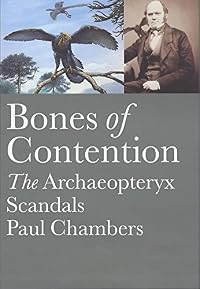
Just when the fuss over Darwin's Origin of Species was getting really heated, an extraordinary fossil was found in Germany. Apparently, half bird, half reptile, it was christened Archaeopteryx and hailed as the missing link which proved that species could change as Darwin had claimed. The reaction was furious and immediate and has remained so to the present day.Tags
Recommendations














Member Reviews
A few years ago I had a notion about the legend of the grail as it appeared in medieval Germany. The Bavarian poet Wolfram von Eschenbach described the grail (grâl or graal he called it) by the strange term lapsit exillis, by which he meant a stone rather than the more familiar dish or chalice. Wolfram has his own conceit about this object: By the power of that stone the phoenix burns to ashes, but the ashes give him life again. Thus does the phoenix [moult] and change its plumage, which afterwards is bright and shining and as lovely as before.*
When reading this I had a sudden vision of the deceased phoenix on its stone as an archaeopteryx fossil, the first of which had been discovered in Bavaria in the middle of the nineteenth show more century. Checking the map I discover that Wolfram’s home town, now re-named Wolframs-Eschenbach in his honour, is not that far distant from the Altmühltal, a river valley where the limestone quarries that first revealed these winged and feathered creatures are situated. Was it possible that this medieval poet had seen a now vanished archaeopteryx fossil, that it too reminded him of the legend of the phoenix, and that he subsequently co-opted that legend for his version of the wondrous quest object?
I included this notion in a short story I wrote, and passed the hypothesis by the odd mildly intrigued expert, but it remains mere speculation, however much I’d like to believe it may be true. And there it stayed until this account of archaeopteryx (from the Greek for ‘ancient’ and ‘wing’) by palaeontologist Paul Chambers started me wondering about it again. The fossils on their beds of stone display odd features for dinosaurs, most obviously the presence of feathers, and have caused, and continue to cause, controversy ever since their discovery and resurrection from the rocks: is archaeopteryx and its ilk a missing evolutionary link between extinct dinosaurs and modern birds?
This is a riveting narrative directed at the general reader. Chambers’ commentary makes it clear that even for a palaeontologist like himself there are a lot of questions still to be answered: research since the book was first published has already moved the discussion on, and will of course continue to do so, as science never stands still. It is also as much a study of the humans involved with archaeopteryx over its 150 years of exposure as with the beast itself and its place in the fossil record. From Richard Owen to Fred Hoyle, and from Thomas Huxley to John Ostrom, the students of archaeopteryx are no less fascinating than this creature from the Jurassic. Darwinians who accept its existence Chambers splits roughly into palaeontologists or BAD adherents (from ‘Birds ARE Dinosaurs’) and ornithologists or BAND supporters (‘Birds are NOT Dinosaurs’). Then there are those who believe the various existing specimens were faked: they consist mostly of Creationists and conspiracy theorists.
Meanwhile, a swift trawl through the web using the key words ‘grail’, ‘palaeontology’ and ‘archaeopteryx’ will reveal journalists’ frequent recourse to the relic as a metaphor for the ultimate or the unattainable in this field. According to one commentator “the holy grail of species evolution” underlines the importance of archaeopteryx to palaeontology and biology; the remains of feathers represent “the Holy Grail that demonstrated … that birds are highly derived dinosaurs” according to another; and, declares a third, “part of the Holy Grail [is] how the development of the limb changed during evolution of birds from their theropod ancestor”. My hunch that Wolfram’s concept of the grail as a resurrection stone for the phoenix could be based on a medieval archaeopteryx fossil may well be shown to be false, or deemed inconclusive from lack of proof; yet in popular culture archaeopteryx is, indeed, already the grail.
* Wolfram von Eschenbach Parzival (translated by Helen M Mustard and Charles E Passage) Vintage Books 1961
http://wp.me/p2oNj1-fX show less
When reading this I had a sudden vision of the deceased phoenix on its stone as an archaeopteryx fossil, the first of which had been discovered in Bavaria in the middle of the nineteenth show more century. Checking the map I discover that Wolfram’s home town, now re-named Wolframs-Eschenbach in his honour, is not that far distant from the Altmühltal, a river valley where the limestone quarries that first revealed these winged and feathered creatures are situated. Was it possible that this medieval poet had seen a now vanished archaeopteryx fossil, that it too reminded him of the legend of the phoenix, and that he subsequently co-opted that legend for his version of the wondrous quest object?
I included this notion in a short story I wrote, and passed the hypothesis by the odd mildly intrigued expert, but it remains mere speculation, however much I’d like to believe it may be true. And there it stayed until this account of archaeopteryx (from the Greek for ‘ancient’ and ‘wing’) by palaeontologist Paul Chambers started me wondering about it again. The fossils on their beds of stone display odd features for dinosaurs, most obviously the presence of feathers, and have caused, and continue to cause, controversy ever since their discovery and resurrection from the rocks: is archaeopteryx and its ilk a missing evolutionary link between extinct dinosaurs and modern birds?
This is a riveting narrative directed at the general reader. Chambers’ commentary makes it clear that even for a palaeontologist like himself there are a lot of questions still to be answered: research since the book was first published has already moved the discussion on, and will of course continue to do so, as science never stands still. It is also as much a study of the humans involved with archaeopteryx over its 150 years of exposure as with the beast itself and its place in the fossil record. From Richard Owen to Fred Hoyle, and from Thomas Huxley to John Ostrom, the students of archaeopteryx are no less fascinating than this creature from the Jurassic. Darwinians who accept its existence Chambers splits roughly into palaeontologists or BAD adherents (from ‘Birds ARE Dinosaurs’) and ornithologists or BAND supporters (‘Birds are NOT Dinosaurs’). Then there are those who believe the various existing specimens were faked: they consist mostly of Creationists and conspiracy theorists.
Meanwhile, a swift trawl through the web using the key words ‘grail’, ‘palaeontology’ and ‘archaeopteryx’ will reveal journalists’ frequent recourse to the relic as a metaphor for the ultimate or the unattainable in this field. According to one commentator “the holy grail of species evolution” underlines the importance of archaeopteryx to palaeontology and biology; the remains of feathers represent “the Holy Grail that demonstrated … that birds are highly derived dinosaurs” according to another; and, declares a third, “part of the Holy Grail [is] how the development of the limb changed during evolution of birds from their theropod ancestor”. My hunch that Wolfram’s concept of the grail as a resurrection stone for the phoenix could be based on a medieval archaeopteryx fossil may well be shown to be false, or deemed inconclusive from lack of proof; yet in popular culture archaeopteryx is, indeed, already the grail.
* Wolfram von Eschenbach Parzival (translated by Helen M Mustard and Charles E Passage) Vintage Books 1961
http://wp.me/p2oNj1-fX show less
Good account suitable for philosophy of science course that is centred on how facts and established, challenged and replaced.
In the British Museum I just happened to have a torch with me. Shining the light sideways across the fossil the feathers became easy to see. Wow! Due to this discovery we now know that all birds are descended from dinosaurs. Forget those images in children's picture books where they are draw as reptiles with scaley skin. They should be depicted with feathers.
Ratings
Members
- Recently Added By
Author Information
15 Works 422 Members
Paul Chambers is a full time author and media consultant. He holds an MSc and PhD in micropalaeontology and has worked as a television producer for the BBC and independent sector (credits include the Walking with Dinosaurs series). He is a passionate and accomplished naturalist and is the author of several natural history books including British show more Seashells, A Sheltered Life and The Complete Guide to Prehistoric Life. Paul's introduction to foraging came via his love for the countryside and over the years it has served to h8|ten his interest British plants and flowers. He currently lives in the Channel Islands with his wife and family. show less
Common Knowledge
- Original title
- Bones of Contention: The Archaeopteryx Scandals
- Original publication date
- 2002
- People/Characters
- Robert Owen; Thomas Henry Huxley; Carl Haberlein; Othniel Marsh; Gerhard Heilmann; John Ostrom (show all 7); Fred Hoyle
- Important places
- Solnhofen, Bavaria, Germany; British Museum, London, England, UK; Berlin Museum, Berlin, Germany; Liaoning quarries, Liaoning Province, China
- Dedication
- To Rachel, my wife, best friend and pillar of support. This book would not have been possible without your encouragement, help and cajoling. My love for you is without limit.
- First words
- The Spring of 1861 was particularly mild in northern Europe.
- Last words
- (Click to show. Warning: May contain spoilers.)Love it or hate it, the Archaeopteryx is a remarkable fossil with a remarkable tradition. I suspect that it will still be talked about for many centuries to come.
Classifications
Statistics
- Members
- 63
- Popularity
- 491,024
- Reviews
- 3
- Rating
- (4.23)
- Languages
- English, German
- Media
- Paper
- ISBNs
- 5