On This Page
Description
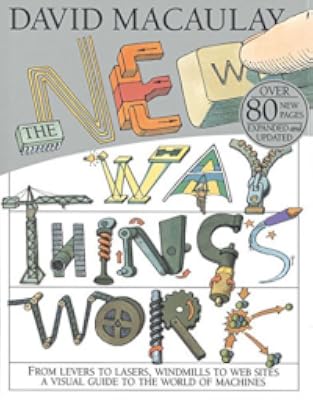
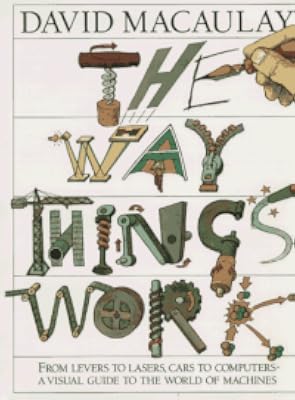
Text and numerous detailed illustrations introduce and explain the scientific principles and workings of hundreds of machines. Includes new material about digital technology.Tags
Recommendations




















Member Reviews
This book has a lot of good information, and, for the most part, the explanations are decently and concisely done. This was a big undertaking, and the end result is... okay. I feel like it's a near miss for what it could have been.
One primary issue was the choice of illustrations. In many circumstances (zippers, inclined planes, etc.) the quasi-cartoony drawings don't matter. But because the book kept with that theme, once it started to get into describing engines and more complicated mechanics, I didn't think the drawings really cut it. If you're introducing this to someone for presumably the first time, more realistic drawings or, gosh, even a picture, would have REALLY helped get some ideas across.
Also, "thematically", ideas didn't show more go for more than two pages. So I was quite surprised by how short some of the explanations were. I get that is aimed at children, but I did think some of the explanations needed a bit more. I used to review engineering topics in schools, and the steps were a little easier to tackle.
For example, the binary details. The book has a narrative use of mammoths throughout. The mammoth is struggling, with various issues, and inventions help him along. (I think this could help keep interest for those less interested in the topics. For those who are more technically-minded and in it for just the info, these sections becoming annoying things to skip.) The author uses his mammoth narrative and a fictional pumpkin patch to try and draw an analogy to how binary works, and that's the introduction. He says there are two digits, and then goes to explain the on-off basis of computers. I thought the mammoth/pumpkin patch mess was an awful attempt at shortening a binary explanation, and he would have been much better served to take an extra paragraph and just cleanly lay out the traditional power of 2s -for those who want to understand.
There were dozens of instances where I couldn't see what age this book was aiming at. I also didn't understand why the author seemed completely gung-ho against equations of any kind. Again, I guess that was the theme. But there are lots of connections where a clean little equation REALLY makes the idea, and those were left completely out. And they belong! For people like myself, those help a bunch.
I had the older version of this book as a child, and I never took to it. I went on to major in Mechanical and Nuclear Engineering, so it wasn't the subjects. Now that I look back as this an adult, I can see why it didn't suit me. This isn't quite right for the young who are really keen on the topics.
Speaking of which...
A few quotes: "The principle of conversation of energy holds good and all machines obey. Or nearly all. Nuclear machines are an exception." And then: "A nuclear reaction in fact creates energy; it does not convert one form of energy into another."
Magic!
The author does later mention mass to energy, briefly (and not to my satisfaction). And of course we can't have the E=mc^2 equation; that'd be sacrilege. But to put the first quote in your introduction, and then include the second quote your blurb out nuclear energy makes it sound like reactors are breaking Newton's laws, and that mass and energy aren't also in a closed system... that's converting energy.
There's more minor things that I just have to mention. Before discussing reactors, the book mentions fission is specific to either uranium or plutonium, and fusion by hydrogen. Really, the process should be explained, because it's misleading to think it's limited to those elements without explaining why those elements are used. Nitpicky, perhaps, but this is my wheelhouse.
Then, there's this gem, when describing nuclear fusion, "Radiation is not emitted." Blinks. (To be fair, the author does mention neutrons, and I know not everyone counts that as radiation. Regardless.) He had just described the gamma radiation from fission, so I'm assuming the author was on the same kick. But to say no radiation is emitted from fusion reactions?? Wow. That is bold. (Shush, alpha and beta! Nobody cares about you! Be scarier!) And are ya reallllly sure there aren't any gamma rays in fusion? I'm stunned.
I feel bad for being caught up on those few pages in a 400 page book. But I can't get over it. If I feel misled in areas where my knowledge is strong, then I start to be wary of the other information. I knew a lot of it, but not all. Suddenly I don't trust you, Mr. Macaulay.
Anyway. Back to my first thoughts. It's decent. Not great. If someone wants a general overview, this would be okay. If a young'n has a sincere interest in engineering, I would look elsewhere. show less
One primary issue was the choice of illustrations. In many circumstances (zippers, inclined planes, etc.) the quasi-cartoony drawings don't matter. But because the book kept with that theme, once it started to get into describing engines and more complicated mechanics, I didn't think the drawings really cut it. If you're introducing this to someone for presumably the first time, more realistic drawings or, gosh, even a picture, would have REALLY helped get some ideas across.
Also, "thematically", ideas didn't show more go for more than two pages. So I was quite surprised by how short some of the explanations were. I get that is aimed at children, but I did think some of the explanations needed a bit more. I used to review engineering topics in schools, and the steps were a little easier to tackle.
For example, the binary details. The book has a narrative use of mammoths throughout. The mammoth is struggling, with various issues, and inventions help him along. (I think this could help keep interest for those less interested in the topics. For those who are more technically-minded and in it for just the info, these sections becoming annoying things to skip.) The author uses his mammoth narrative and a fictional pumpkin patch to try and draw an analogy to how binary works, and that's the introduction. He says there are two digits, and then goes to explain the on-off basis of computers. I thought the mammoth/pumpkin patch mess was an awful attempt at shortening a binary explanation, and he would have been much better served to take an extra paragraph and just cleanly lay out the traditional power of 2s -for those who want to understand.
There were dozens of instances where I couldn't see what age this book was aiming at. I also didn't understand why the author seemed completely gung-ho against equations of any kind. Again, I guess that was the theme. But there are lots of connections where a clean little equation REALLY makes the idea, and those were left completely out. And they belong! For people like myself, those help a bunch.
I had the older version of this book as a child, and I never took to it. I went on to major in Mechanical and Nuclear Engineering, so it wasn't the subjects. Now that I look back as this an adult, I can see why it didn't suit me. This isn't quite right for the young who are really keen on the topics.
Speaking of which...
A few quotes: "The principle of conversation of energy holds good and all machines obey. Or nearly all. Nuclear machines are an exception." And then: "A nuclear reaction in fact creates energy; it does not convert one form of energy into another."
Magic!
The author does later mention mass to energy, briefly (and not to my satisfaction). And of course we can't have the E=mc^2 equation; that'd be sacrilege. But to put the first quote in your introduction, and then include the second quote your blurb out nuclear energy makes it sound like reactors are breaking Newton's laws, and that mass and energy aren't also in a closed system... that's converting energy.
There's more minor things that I just have to mention. Before discussing reactors, the book mentions fission is specific to either uranium or plutonium, and fusion by hydrogen. Really, the process should be explained, because it's misleading to think it's limited to those elements without explaining why those elements are used. Nitpicky, perhaps, but this is my wheelhouse.
Then, there's this gem, when describing nuclear fusion, "Radiation is not emitted." Blinks. (To be fair, the author does mention neutrons, and I know not everyone counts that as radiation. Regardless.) He had just described the gamma radiation from fission, so I'm assuming the author was on the same kick. But to say no radiation is emitted from fusion reactions?? Wow. That is bold. (Shush, alpha and beta! Nobody cares about you! Be scarier!) And are ya reallllly sure there aren't any gamma rays in fusion? I'm stunned.
I feel bad for being caught up on those few pages in a 400 page book. But I can't get over it. If I feel misled in areas where my knowledge is strong, then I start to be wary of the other information. I knew a lot of it, but not all. Suddenly I don't trust you, Mr. Macaulay.
Anyway. Back to my first thoughts. It's decent. Not great. If someone wants a general overview, this would be okay. If a young'n has a sincere interest in engineering, I would look elsewhere. show less
A magnificent achievement. Had I read the first ten pages of this at 10, I would have learned more about engineering (and science) than I did from all my schooling up until high-school physics at 17. Buy for every child and then read it yourself!
Gorgeous, informative and accessible book showing cross sections of every day items with explanations of how they work. Delight for adults and children to read. The 200 version is slightly dated, but typewriters and sewing machines are not mechanically impossible to find just yet! (2019)
Through the use of a wolly Mammoth, David Macaulay explains how machines work. The book is organized into 5 parts: the mechanics of movement, harnessing the elements, working with waves, electricity and automation, and the digital domain. The information is made fun and easy to understand through narratives about a wolly mammoth and its involvement with the machines. The style of the writing makes it easier for the reader to understand the concepts. The pictures are great and they both engage the reader and make it easier for the reader to understand the concepts. Recommended.
Got this for my son. He absolutely LOVES it. I think it's a lot of fun too. I like the little woolly mammoths that illustrate the concepts. Very fun book, recommended especially for children with a mechanical interest.
This delightfully illustrated book makes the potentially confusing conversation about machinery exciting and fun.
An updated version of the 1980s book, The Way Things Work is a great book for curious people of all ages. From levers and pullies, to catapults, this book explains all kinds of different mechanical and engineering concepts.
Members
- Recently Added By
Lists

Satori Smiles Children's Book List
262 works; 7 members

Books Featured on Gilmore Girls
307 works; 21 members

my children books reading list-from 100 great books
101 works; 7 members

Children's Books About Science and Math
461 works; 12 members

Read Alouds for CC Cycle 3
32 works; 1 member

The Complete Rory Gilmore Reading List
506 works; 5 members

Youth: Science, Miscellaneous
34 works; 1 member
Author Information

74+ Works 30,429 Members
David Macaulay was born on December 2, 1946 in Lancashire, England, but moved to Bloomfield, New Jersey when he was 11. He received a bachelor's degree in architecture from the Rhode Island School of Design (RISD). Before becoming an author and illustrator, he worked as an interior designer, a junior high school teacher, and instructor of interior show more design at RISD from 1969 to 1973. His first book, Cathedral: The Story of Its Construction, was published in 1973. His other books include City, Castle, Pyramid, Mill, Underground, Mosque, The Way Things Work, Rome Antics, Shortcut,and How Machines Work. He has received numerous awards including a Caldecott Honor Medal in 1991 for Black and White and the Washington Children's Book Guild Award for a Body of Non-Fiction Work in 1977. He won the Royal Society young people¿s book prize for the best science books for children for his book How Machines Work. (Bowker Author Biography) show less

Awards and Honors
Distinctions
Notable Lists
Series

Common Knowledge
- Original publication date
- 1998
- First words
- Introduction: To any machine, work is a matter of principle, because everything a machine does is in accordance with a set of principles or scientific laws.
- Last words
- (Click to show. Warning: May contain spoilers.)Robots have developed gradually as useful machines have become inceasingly automatic in operation.
- Disambiguation notice
- Do not merge with "The Way Things Work" - this book has different content.
Classifications
- Genres
- Nonfiction, Technology
- DDC/MDS
- 600 — Applied science & technology Technology Technology (Applied sciences)
- LCC
- T47 .M18 — Technology Technology (General)
- BISAC
Statistics
- Members
- 2,019
- Popularity
- 10,388
- Reviews
- 15
- Rating
- (4.21)
- Languages
- 7 — Chinese, English, Finnish, German, Japanese, Spanish, Swedish
- Media
- Paper
- ISBNs
- 18
- UPCs
- 2
- ASINs
- 2