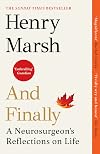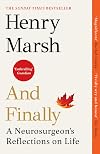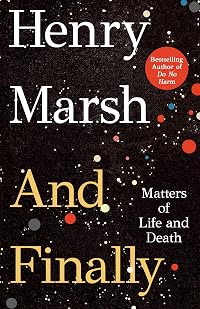
And Finally: Matters of Life and Death
by Henry Marsh
On This Page
Description
"From the bestselling neurosurgeon and author of Do No Harm, comes Henry Marsh's And Finally, an unflinching and deeply personal exploration of death, life and neuroscience. As a retired brain surgeon, Henry Marsh thought he understood illness, but he was unprepared for the impact of his diagnosis of advanced cancer. And Finally explores what happens when someone who has spent a lifetime on the frontline of life and death finds himself contemplating what might be his own death sentence. As show more he navigates the bewildering transition from doctor to patient, he is haunted by past failures and projects yet to be completed, and frustrated by the inconveniences of illness and old age. But he is also more entranced than ever by the mysteries of science and the brain, the beauty of the natural world and his love for his family. Elegiac, candid, luminous and poignant, And Finally is ultimately not so much a book about death, but a book about life and what matters in the end"-- show lessTags
Recommendations






Member Reviews
Review of And Finally
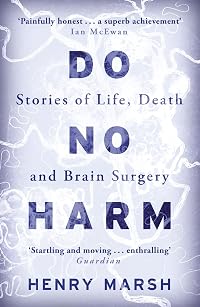
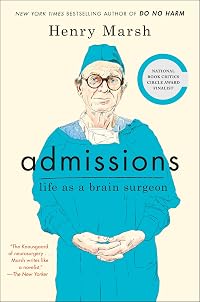
The British neurosurgeon and author Henry Marsh was fascinated by the meanings of life in all its forms and initially read philosophy at Oxford, until he decided that medicine would provide him with a more stable and productive means to earn a living. However, he continued to ponder those thoughts, both privately and in the two books he wrote prior to this one, [Do No Harm: Stories of Life, Death and Brain Surgery], and [Admissions: Life as a Brain Surgeon], in which patients' lives and outcomes were literally in his hands and their recoveries, partial or complete, were far from certain, particularly for the most delicate of cases. In keeping with his profession, and the risks that come with it, Marsh often comes show more across as brash, towards both his staff, junior doctors, and far too often the patients and families that come under his care, one thing which he regrets as his 40 year career comes to a close.
For several years Marsh developed signs of significant urinary tract obstruction, a common phenomenon older men experience but one that should be promptly brought to the attention of a general practitioner, if it is a simple case of benign prostatic hypertrophy that can be managed medically, or a urologist if the patient’s prostate specific antigen (PSA) is particularly high, in order to look for local or invasive prostate cancer by MRI of the prostate and/or prostate biopsy, which can be often be cured if it is caught in time and hasn’t spread outside of the capsule of the prostate. Marsh, however, chose to ignore those signs, and it wasn’t until he looked at his own images from a CT scan of his brain, which he had obtained months previously as part of a study of healthy volunteers, revealed signs of metastases to the brain, which was confirmed after he had an MRI of the brain shortly afterwards. Unfortunately physicians are notorious for thinking that serious and potentially fatal illnesses happen to other people, not themselves, even though they invariably care for other stricken physicians.
Marsh discusses his illness and diagnosis in the context of being a patient, rather than a care provider in hospitals, in the often impersonal British National Health Service (NHS), which his anthropologist wife Kate and he describe as “prisons:”
I was particularly struck by this page of the book. I’ve been hospitalized three times, from 1997 to 2015, and each time I was in a private room, I had no interactions with any other patients, and my hospital stays were short ones, once for removal of an inflamed and infected appendix, and twice for medical management of atrial fibrillation. I was treated far better than Marsh or, apparently, his wife were, and the children’s hospitals I worked in were geared towards making the children and their families as comfortable as possible.
Marsh also discusses his wild swings between hope for a cure and despair over the possibility that his cancer will likely be the cause of his death, according to his oncologists and other specialists, and how this compares with the conversations he had with his own patients, which he realizes he could have done a better job of during his years of practice. He closes with meetings in the neurosurgical department where he once worked, and his urging to junior doctors that they sit down to talk with patients and their families, and discuss their cases open and honestly, rather than hiding bad news from them.
I had two reasons for wanting to read [And Finally]. First, I had read his book [Do No Harm: Stories of Life, Death, and Brain Surgery], but also because I have benign prostatic hypertrophy and my urologist has ordered an MRI of my prostate, which I’ll probably schedule after my cataract surgery in less than two weeks; fortunately my PSA, although elevated, is nowhere near as high as Marsh’s. I liked [Do No Harm] better, but this was a worthwhile read, particularly for its philosophical bent on health and illness and how it is managed in the Western world. show less
The British neurosurgeon and author Henry Marsh was fascinated by the meanings of life in all its forms and initially read philosophy at Oxford, until he decided that medicine would provide him with a more stable and productive means to earn a living. However, he continued to ponder those thoughts, both privately and in the two books he wrote prior to this one, [Do No Harm: Stories of Life, Death and Brain Surgery], and [Admissions: Life as a Brain Surgeon], in which patients' lives and outcomes were literally in his hands and their recoveries, partial or complete, were far from certain, particularly for the most delicate of cases. In keeping with his profession, and the risks that come with it, Marsh often comes show more across as brash, towards both his staff, junior doctors, and far too often the patients and families that come under his care, one thing which he regrets as his 40 year career comes to a close.
For several years Marsh developed signs of significant urinary tract obstruction, a common phenomenon older men experience but one that should be promptly brought to the attention of a general practitioner, if it is a simple case of benign prostatic hypertrophy that can be managed medically, or a urologist if the patient’s prostate specific antigen (PSA) is particularly high, in order to look for local or invasive prostate cancer by MRI of the prostate and/or prostate biopsy, which can be often be cured if it is caught in time and hasn’t spread outside of the capsule of the prostate. Marsh, however, chose to ignore those signs, and it wasn’t until he looked at his own images from a CT scan of his brain, which he had obtained months previously as part of a study of healthy volunteers, revealed signs of metastases to the brain, which was confirmed after he had an MRI of the brain shortly afterwards. Unfortunately physicians are notorious for thinking that serious and potentially fatal illnesses happen to other people, not themselves, even though they invariably care for other stricken physicians.
Marsh discusses his illness and diagnosis in the context of being a patient, rather than a care provider in hospitals, in the often impersonal British National Health Service (NHS), which his anthropologist wife Kate and he describe as “prisons:”
Much of what goes on in hospitals—the regimentation, the uniforms, the notices everywhere—is about emphasising the gap between staff and patients, and helping the staff overcome their natural empathy. It is not about helping patients. Hospitals always remind me of prisons.
As my anthropologist wife Kate—who has been in hospital more frequently than she would like—tells me, patients often ask each other exactly the same question as prisoners: ‘What are you in for?’
{Kate} pointed out to me that the last thing you get in hospital is peace, rest or quiet, and that being a patient is an essentially disempowering and humiliating experience.
I was particularly struck by this page of the book. I’ve been hospitalized three times, from 1997 to 2015, and each time I was in a private room, I had no interactions with any other patients, and my hospital stays were short ones, once for removal of an inflamed and infected appendix, and twice for medical management of atrial fibrillation. I was treated far better than Marsh or, apparently, his wife were, and the children’s hospitals I worked in were geared towards making the children and their families as comfortable as possible.
Marsh also discusses his wild swings between hope for a cure and despair over the possibility that his cancer will likely be the cause of his death, according to his oncologists and other specialists, and how this compares with the conversations he had with his own patients, which he realizes he could have done a better job of during his years of practice. He closes with meetings in the neurosurgical department where he once worked, and his urging to junior doctors that they sit down to talk with patients and their families, and discuss their cases open and honestly, rather than hiding bad news from them.
I had two reasons for wanting to read [And Finally]. First, I had read his book [Do No Harm: Stories of Life, Death, and Brain Surgery], but also because I have benign prostatic hypertrophy and my urologist has ordered an MRI of my prostate, which I’ll probably schedule after my cataract surgery in less than two weeks; fortunately my PSA, although elevated, is nowhere near as high as Marsh’s. I liked [Do No Harm] better, but this was a worthwhile read, particularly for its philosophical bent on health and illness and how it is managed in the Western world. show less
Henry Marsh started out as a student of philosophy at Oxford, but “fled to the more practical world of medicine,” partly (perhaps) because he feared he was “not clever enough to understand philosophy.” For the next forty years he was a neurosurgeon, but modestly explains that he is not a scientist - to claim so would be to “like saying that all plumbers are metallurgists.” He became a man of practical action: he cuts open people’s heads and brains; he is a devoted woodworker and builder of things by hand (even though his roofs may leak). He runs. He bicycles. He hikes across mountain ranges. He keeps bees. He also keeps a journal, and - as his previous books (Admissions: A life in brain surgery and Do No Harm: Stories of show more Life, Death, and Brain Surgery) suggest - ponders questions personal, intellectual, and philosophical about his life and career.
Which is, apparently, coming to a close. After retiring from medicine, he volunteers for a study of brain scans in healthy people. He assumes his scan will be a fine example of a 70-year-old brain kept lively, supple, and unchanged from his long regimen of activity. But when he receives the copy of the scan, he is afraid to look at it. When he finally does, it shows him a shrunken brain speckled with “white-matter hyperintensities,” typical of aging. “…My brain is starting to rot. I am starting to rot. It is the writing on the wall, a deadline,” he says. But he feels fine, lives normally, so learns to shelve the distress.
As he does with some other symptoms, which he ignores or minimizes for years, choosing to think they indicated common older-man benign prostatic hypertrophy. When he at long last seeks medical attention, he initially wants to attribute his sky-high prostate-specific-antigen to pressure on the prostate from his bicycle seat as he rode to his appointment. However, what it really is is advanced prostate cancer. Strangely mixed with his dismay at this dire diagnosis is relief that he has likely been released from a greater fear of dementia, triggered by his father’s decade-long suffering and the ominous “pox” on his brain scan.
George Eliot’s magnificent novel Middlemarch describes a moment when the rigid, lonely, self-absorbed, and bitterly disappointed old scholar Casaubon has been diagnosed with an incurable heart ailment. “Here was a man who now for the first time found himself looking into the eyes of death—who was passing through one of those rare moments of experience when we feel the truth of a commonplace, which is as different from what we call knowing it, as the vision of waters upon the earth is different from the delirious vision of the water which cannot be had to cool the burning tongue. When the commonplace “We must all die” transforms itself suddenly into the acute consciousness “I must die—and soon,” then death grapples us, and his fingers are cruel…” Henry Marsh movingly explores that moment and the months that follow.
At this point, And Finally morphs into a more or less typical health-professional-gets-sick memoir. Theresa Brown’s recent Healing: When a nurse becomes a patient is one such - an expert oncology nurse is diagnosed with breast cancer, and discovers that being at the other end of the radiation beams is a revelation: all the things she never noticed or understood about what her patients actually felt or thought or experienced as she briskly gave treatments and managed complications while tut-tutting “Hey, we saved her life!” if they complained. Similarly, Marsh undergoes uncomfortable, embarrassing, and frightening procedures. Like many other patients, he frantically googles for information on survival rates, treatment options, complications. He, of course, is well equipped to understand the technicalities and statistical probabilities… and he still freaks out at times. Will he die of his disease, or with it? Will he see his granddaughters grow up? (Probably not, he concludes.) He cries. And he looks back on patients he realizes now he did not serve as well as he could have. He recalls a patient (an actor) whose delicate and difficult surgery left her with a permanently damaged face. He meets her again some years later, and she tells him: “I could see that you were so upset when you saw me after the operation, that I forgave you.” He muses on the difference between telling a patient he has a 5% chance of surviving versus a 95% chance - regardless of the actual number used, if there is any chance at all, they will take hope from it. He endures the indignities and depersonalization of the modern healthcare system: his anthropologist wife remarks that hospital patients ask each other the exact same question prisoners do when they meet: “What are you in for?” Information and instructions are provided in the form of generic printed handouts rather than conversation. Hospital balconies with lovely views are locked and off-limits to patients. Radiation departments are often deep in the lower levels, but those who have managed to place a sunlit window or even a mural of a beautiful landscape bolster their patients’ morale. (He got funding for and oversaw the creation of a garden for the use of neurosurgical patients at his hospital, and considers it one of the prime accomplishments of his career.)
This is a smallish book, but Marsh packs a lot into it. His voice is serious, clear, and steers well away from any sort of “inspirational” revelations or triumphant acceptance of his cancer as any sort of “gift.” There are detailed technical explanations of prostate cancer radiation treatments and brachytherapy, which may overwhelm a patient seeking a layperson’s understanding. Marsh’s personal beliefs do not include any sort of afterlife, and his discussion of the life-extension movement is bitterly critical. Even as he so longs to live, he pleads passionately in support of accessible, compassionate assisted-dying services. This is personal and powerful. A reminiscence about the elaborate doll houses he built for his beloved granddaughters is touching; a very long description of fairy tales he has written for them, overstuffed with dragons and unicorns and magical objects of all kinds, is less so. The book rambles and swerves at times, jumping back and forth from memory to contemplation of the future, from former patients to current doctors, from woodworking to brain surgery, from medical journals to children’s stories, from London to Ukraine (where he volunteered for many years, and his heart aches for that country’s woes now), from hope to terror and back again.
In a lovely passage, Marsh muses over his hoard of exotic woods with beautiful names he has collected - burr elm, spalted beechwood, cocobolo, sandalwood - and the places they came from, and what he planned to make with them. What will become of all of it? For “I am constantly having new ideas of things to make with all this wood – but the fact of the matter is, whatever happens, I will not live long enough to use even a fraction of it. I would look at my hoarded wood with deep pleasure, but as old age and decline approach, this pleasure is starting to fade and instead is replaced by a feeling of futility, and even of doom – of the future suggested by my brain scan. Besides, anything I now make will outlive me, and I should only make things that deserve to survive in their own right. I no longer have the excuse of the craftsman – who sees all the faults, often invisible to others, in what he has made – that I will do better next time.”
As it happens, Marsh’s cancer responds well to his therapies. He likely has more time ahead of him than he feared - but perhaps no more books. This rambling, effusive, thoughtful exploration of the mind of a man facing down the “commonplace” that he must die, and soon, is useful and moving.
** Thanks to NetGalley for an advance copy in exchange for an honest review. ** show less
Which is, apparently, coming to a close. After retiring from medicine, he volunteers for a study of brain scans in healthy people. He assumes his scan will be a fine example of a 70-year-old brain kept lively, supple, and unchanged from his long regimen of activity. But when he receives the copy of the scan, he is afraid to look at it. When he finally does, it shows him a shrunken brain speckled with “white-matter hyperintensities,” typical of aging. “…My brain is starting to rot. I am starting to rot. It is the writing on the wall, a deadline,” he says. But he feels fine, lives normally, so learns to shelve the distress.
As he does with some other symptoms, which he ignores or minimizes for years, choosing to think they indicated common older-man benign prostatic hypertrophy. When he at long last seeks medical attention, he initially wants to attribute his sky-high prostate-specific-antigen to pressure on the prostate from his bicycle seat as he rode to his appointment. However, what it really is is advanced prostate cancer. Strangely mixed with his dismay at this dire diagnosis is relief that he has likely been released from a greater fear of dementia, triggered by his father’s decade-long suffering and the ominous “pox” on his brain scan.
George Eliot’s magnificent novel Middlemarch describes a moment when the rigid, lonely, self-absorbed, and bitterly disappointed old scholar Casaubon has been diagnosed with an incurable heart ailment. “Here was a man who now for the first time found himself looking into the eyes of death—who was passing through one of those rare moments of experience when we feel the truth of a commonplace, which is as different from what we call knowing it, as the vision of waters upon the earth is different from the delirious vision of the water which cannot be had to cool the burning tongue. When the commonplace “We must all die” transforms itself suddenly into the acute consciousness “I must die—and soon,” then death grapples us, and his fingers are cruel…” Henry Marsh movingly explores that moment and the months that follow.
At this point, And Finally morphs into a more or less typical health-professional-gets-sick memoir. Theresa Brown’s recent Healing: When a nurse becomes a patient is one such - an expert oncology nurse is diagnosed with breast cancer, and discovers that being at the other end of the radiation beams is a revelation: all the things she never noticed or understood about what her patients actually felt or thought or experienced as she briskly gave treatments and managed complications while tut-tutting “Hey, we saved her life!” if they complained. Similarly, Marsh undergoes uncomfortable, embarrassing, and frightening procedures. Like many other patients, he frantically googles for information on survival rates, treatment options, complications. He, of course, is well equipped to understand the technicalities and statistical probabilities… and he still freaks out at times. Will he die of his disease, or with it? Will he see his granddaughters grow up? (Probably not, he concludes.) He cries. And he looks back on patients he realizes now he did not serve as well as he could have. He recalls a patient (an actor) whose delicate and difficult surgery left her with a permanently damaged face. He meets her again some years later, and she tells him: “I could see that you were so upset when you saw me after the operation, that I forgave you.” He muses on the difference between telling a patient he has a 5% chance of surviving versus a 95% chance - regardless of the actual number used, if there is any chance at all, they will take hope from it. He endures the indignities and depersonalization of the modern healthcare system: his anthropologist wife remarks that hospital patients ask each other the exact same question prisoners do when they meet: “What are you in for?” Information and instructions are provided in the form of generic printed handouts rather than conversation. Hospital balconies with lovely views are locked and off-limits to patients. Radiation departments are often deep in the lower levels, but those who have managed to place a sunlit window or even a mural of a beautiful landscape bolster their patients’ morale. (He got funding for and oversaw the creation of a garden for the use of neurosurgical patients at his hospital, and considers it one of the prime accomplishments of his career.)
This is a smallish book, but Marsh packs a lot into it. His voice is serious, clear, and steers well away from any sort of “inspirational” revelations or triumphant acceptance of his cancer as any sort of “gift.” There are detailed technical explanations of prostate cancer radiation treatments and brachytherapy, which may overwhelm a patient seeking a layperson’s understanding. Marsh’s personal beliefs do not include any sort of afterlife, and his discussion of the life-extension movement is bitterly critical. Even as he so longs to live, he pleads passionately in support of accessible, compassionate assisted-dying services. This is personal and powerful. A reminiscence about the elaborate doll houses he built for his beloved granddaughters is touching; a very long description of fairy tales he has written for them, overstuffed with dragons and unicorns and magical objects of all kinds, is less so. The book rambles and swerves at times, jumping back and forth from memory to contemplation of the future, from former patients to current doctors, from woodworking to brain surgery, from medical journals to children’s stories, from London to Ukraine (where he volunteered for many years, and his heart aches for that country’s woes now), from hope to terror and back again.
In a lovely passage, Marsh muses over his hoard of exotic woods with beautiful names he has collected - burr elm, spalted beechwood, cocobolo, sandalwood - and the places they came from, and what he planned to make with them. What will become of all of it? For “I am constantly having new ideas of things to make with all this wood – but the fact of the matter is, whatever happens, I will not live long enough to use even a fraction of it. I would look at my hoarded wood with deep pleasure, but as old age and decline approach, this pleasure is starting to fade and instead is replaced by a feeling of futility, and even of doom – of the future suggested by my brain scan. Besides, anything I now make will outlive me, and I should only make things that deserve to survive in their own right. I no longer have the excuse of the craftsman – who sees all the faults, often invisible to others, in what he has made – that I will do better next time.”
As it happens, Marsh’s cancer responds well to his therapies. He likely has more time ahead of him than he feared - but perhaps no more books. This rambling, effusive, thoughtful exploration of the mind of a man facing down the “commonplace” that he must die, and soon, is useful and moving.
** Thanks to NetGalley for an advance copy in exchange for an honest review. ** show less
Henry Marsh’s books are compulsively readable for me; I tend to tear through them in a few hours. This book is no exception. Covering mainly the COVID-19 era but with threads throughout Marsh’s life, this book is about his diagnosis of prostate cancer, becoming a patient as a doctor, and coming to grips with mortality. It made for interesting reading immediately after What Doctors Feel, because Marsh is a retired neurosurgeon and is able to reflect on his whole career and discover a new perspective on medicine. I was touched that he found teaching the next generation more rewarding than being a surgeon himself.
More like a 3.5 but I don't see the option. This is a rather weird, disjointed ramble through the mind of a retired British surgeon who has been diagnosed with advanced prostate cancer. This puts him in the position of patient rather than doctor, so on the other side of the table, and it has him reassessing his career and his approach to patient consultations of the past. It certainly has value but he wanders off into pathways and other areas of London that I have no clue about, and his reconstructing a doll house for his granddaughters - wonderful things as stand-alone experiences, but kinda left this reader wondering. Still, lots of inside info on the medical profession and the limits and capabilities of medical science, especially show more the prostate cancer issues. Just be prepared for a bit of meandering. show less
This book focuses on how the doctor becomes a patient himself with advanced stage prostate cancer. In general, most medical professionals make the worst patients and I can make this declaration as a medical professional myself. There always a struggle with the vulnerability of being the patient after years of helping others. It's easier to see the struggles in others probably more so to avoid acknowledging our own issues.
I understand Dr Marsh's mindset of thinking like a doctor after retirement and then as a patient. It's not just an occupation but a part of your identity. I don't think it necessary for me to read his other books to understand that this one is deeply reflective on his unique and unexpected position in life as a cancer show more patient. There are many advances in medicine over the years and being a patient allows a perspective that one might not otherwise imagine. Denial is a powerful coping mechanism which ultimately fails us in the end. Although, I found his writing to be overanalytical I respect his dedication and need to share his life experience. I have read many books about the transformation that can occur when a doctor, particularly a surgeon, becomes a cancer patient. There is a tremendous amount of humility knowing that we all share the same destiny.
I know my review is rather critical but I did say that medical professionals make the worst patients as well as critical thinkers.
Thanks to NetGalley and St Martin's Press for allowing me access to this digital book for review. I provide an honest and unbiased review. All opinions are expressly my own. show less
I understand Dr Marsh's mindset of thinking like a doctor after retirement and then as a patient. It's not just an occupation but a part of your identity. I don't think it necessary for me to read his other books to understand that this one is deeply reflective on his unique and unexpected position in life as a cancer show more patient. There are many advances in medicine over the years and being a patient allows a perspective that one might not otherwise imagine. Denial is a powerful coping mechanism which ultimately fails us in the end. Although, I found his writing to be overanalytical I respect his dedication and need to share his life experience. I have read many books about the transformation that can occur when a doctor, particularly a surgeon, becomes a cancer patient. There is a tremendous amount of humility knowing that we all share the same destiny.
I know my review is rather critical but I did say that medical professionals make the worst patients as well as critical thinkers.
Thanks to NetGalley and St Martin's Press for allowing me access to this digital book for review. I provide an honest and unbiased review. All opinions are expressly my own. show less
A doctor facing, or trying to deny, death; resulting in a somewhat rambling, a little too philosophical and discursive (and I could have done without the fairy tale he told to his granddaughters). I guess his departure from the personal reflects his attempts to deny what eventually happens to all of us.
A candid and well-written memoir about a surgeon's confrontation with his own mortality through his own cancer diagnosis and treatment. This would be a good book for anyone going through a recent cancer diagnosis. Uplifting and down to earth. Totally immersive.
Members
- Recently Added By
Published Reviews
The neurosurgeon Henry Marsh – well known for his two previous books Do No Harm: Stories of life, death and brain surgery (2014) and Admissions: A life in brain surgery (2017) – has now retired from a distinguished career in London and post-retirement work in Nepal and Ukraine, and over the past few years has revealed himself as a stalwart and sane advocate for what is generally called show more “assisted dying”. He points out that “Many countries have now legalised assisted dying – for instance, Belgium, Canada, Spain, New Zealand, Germany, several American states, Austria and the Netherlands. The list steadily grows”. Yet in the UK, even though 84 per cent of those polled in 2019 favoured a change in the law, successive governments have failed to set up a committee to look at real evidence and results elsewhere.
This has led to a series of private members’ bills being talked out by a small but vociferous minority who advance fears of everything from corruption, coercion and bullying by families to law change as an excuse for providing less treatment and hospice care – none of which is borne out by the experience of the countries Marsh lists. Assisted dying, he says, “should be seen as part of palliative care and not in opposition to it … It is, in fact, unofficially practised in the UK but takes the form of ‘terminal sedation’. This is a dishonest fudge … done without any meaningful discussion with patient or family”. He adds a little later that those who wish this system to continue “claim to be compassionate but in reality are responsible for much suffering”.
Marsh himself may not quite live to see the day of liberation. He has advanced prostate cancer, and his belated discovery of this fact forms an integral part of this book, though there are only passing references to it in the first half. It is not until the second half that he supplies the detail, and one understands that the title And Finally may be appropriate. Or not. As Marsh is at pains to explain, doctors do not know as much as their patients want them to, and can only predict in terms of statistical probabilities. Now that he no longer has patients’ feelings to consider, he is able to be admirably cogent and honest. Near the book’s beginning he writes: “Long life is not necessarily a good thing. Perhaps we should not seek it too desperately”. And later: “Will our lives be any more meaningful just because we have managed to postpone death?” Also: “Assisted dying … is about patient autonomy and choice”. “The illegality of assisted dying … means that it is illegal to help somebody do something that is not illegal. Surely this is wildly illogical?”
Yet there is another strand in this intelligent and dynamic man’s attitude to his own demise, that end that we all (except, apparently, for a few American millionaires with tunnel vision) know that we must reach. For in the intervals of explaining with enthusiasm what we do and do not understand about the brain’s function, about consciousness, about how radiotherapy and chemotherapy actually work, about the pan-religious delusion of human exceptionalism and the fact that the very concept of past and future has no place in theoretical physics, we come across a sudden admission of “a deep, irrational fear of death itself, of nothingness”. Having treated us to a detailed and occasionally very funny account of his own treatment, as well as the disconcerting downgrade of finding himself in the “under-class role of patient” (“I got the distinct impression that I had not tried hard enough … and that I was being potty-trained all over again”), he suddenly acknowledges: “if I have a few more years, I will no doubt try to bargain for a few more, once my disease has returned. My urge to go on living is so overwhelming”. Finally, with his cancer having been driven into some sort of abeyance, comes an admission of “my ridiculous inability to accept the inevitability of my death – indeed, its necessity”.
Not all of us feel the need to join Marsh in that particular version of angst, and perhaps we are lucky not to. Perhaps, too, this attachment to the idea of going on and on living is part of the energy that has sent him in retirement to treat patients in distant parts of the world, that has made him bully the management in hospitals for armchairs and rugs, pictures and green plants. The same zest for life, he admits, has led him into a legal quarrel with Oxford neighbours, and into an unwise credulousness when approached by two men offering to mend his roof. It has also led him to tell small granddaughters nightly in lockdown, by Zoom, a complex fairy tale featuring racist dragons, a subsiding fairy castle, a unicorn with Droopy Horn Disease, mixed-race spotted baby dragons and much, much more, going on for six pages near the end of this fascinating, unusually revelatory, ultimately conflicted and poignant account. Acontinuing story to which he himself may not be there to write “The End”. show less
This has led to a series of private members’ bills being talked out by a small but vociferous minority who advance fears of everything from corruption, coercion and bullying by families to law change as an excuse for providing less treatment and hospice care – none of which is borne out by the experience of the countries Marsh lists. Assisted dying, he says, “should be seen as part of palliative care and not in opposition to it … It is, in fact, unofficially practised in the UK but takes the form of ‘terminal sedation’. This is a dishonest fudge … done without any meaningful discussion with patient or family”. He adds a little later that those who wish this system to continue “claim to be compassionate but in reality are responsible for much suffering”.
Marsh himself may not quite live to see the day of liberation. He has advanced prostate cancer, and his belated discovery of this fact forms an integral part of this book, though there are only passing references to it in the first half. It is not until the second half that he supplies the detail, and one understands that the title And Finally may be appropriate. Or not. As Marsh is at pains to explain, doctors do not know as much as their patients want them to, and can only predict in terms of statistical probabilities. Now that he no longer has patients’ feelings to consider, he is able to be admirably cogent and honest. Near the book’s beginning he writes: “Long life is not necessarily a good thing. Perhaps we should not seek it too desperately”. And later: “Will our lives be any more meaningful just because we have managed to postpone death?” Also: “Assisted dying … is about patient autonomy and choice”. “The illegality of assisted dying … means that it is illegal to help somebody do something that is not illegal. Surely this is wildly illogical?”
Yet there is another strand in this intelligent and dynamic man’s attitude to his own demise, that end that we all (except, apparently, for a few American millionaires with tunnel vision) know that we must reach. For in the intervals of explaining with enthusiasm what we do and do not understand about the brain’s function, about consciousness, about how radiotherapy and chemotherapy actually work, about the pan-religious delusion of human exceptionalism and the fact that the very concept of past and future has no place in theoretical physics, we come across a sudden admission of “a deep, irrational fear of death itself, of nothingness”. Having treated us to a detailed and occasionally very funny account of his own treatment, as well as the disconcerting downgrade of finding himself in the “under-class role of patient” (“I got the distinct impression that I had not tried hard enough … and that I was being potty-trained all over again”), he suddenly acknowledges: “if I have a few more years, I will no doubt try to bargain for a few more, once my disease has returned. My urge to go on living is so overwhelming”. Finally, with his cancer having been driven into some sort of abeyance, comes an admission of “my ridiculous inability to accept the inevitability of my death – indeed, its necessity”.
Not all of us feel the need to join Marsh in that particular version of angst, and perhaps we are lucky not to. Perhaps, too, this attachment to the idea of going on and on living is part of the energy that has sent him in retirement to treat patients in distant parts of the world, that has made him bully the management in hospitals for armchairs and rugs, pictures and green plants. The same zest for life, he admits, has led him into a legal quarrel with Oxford neighbours, and into an unwise credulousness when approached by two men offering to mend his roof. It has also led him to tell small granddaughters nightly in lockdown, by Zoom, a complex fairy tale featuring racist dragons, a subsiding fairy castle, a unicorn with Droopy Horn Disease, mixed-race spotted baby dragons and much, much more, going on for six pages near the end of this fascinating, unusually revelatory, ultimately conflicted and poignant account. Acontinuing story to which he himself may not be there to write “The End”. show less
added by AntonioGallo
Lists

Top Five Books of 2022
736 works; 272 members
Author Information

3 Works 1,827 Members
Henry Marsh is a neurosurgeon who authored the memoir Do No Harm: Stories of Life, Death and Brain Surgery which won the PEN/Ackerley Prize 2015. The prize in the amout of £3000 (A$6115) is awarded to the author of a notable work of memoir or autobiography. (Bowker Author Biography)
Awards and Honors
Distinctions
The Guardian Book of the Day (2022-08-29)
The Guardian Book of the Day (2022-08-27)
Classifications
Statistics
- Members
- 179
- Popularity
- 183,068
- Reviews
- 8
- Rating
- (3.71)
- Languages
- English, Spanish
- Media
- Paper, Audiobook, Ebook
- ISBNs
- 13
- ASINs
- 5