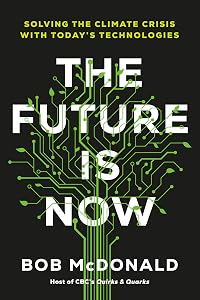
The Future Is Now: Solving the Climate Crisis with Today's Technologies
by Bob McDonald
On This Page
Description
"In the absence of motorized boats and gondolas, Venice's waters have returned to a sparkling blue color. Deer have been spotted roaming cities in Italy, and mountain goats recently took over a small seaside town in Wales. Taking advantage of the decreased boat traffic, whales have returned to roaming Vancouver's harbours. The absence of "regular" human activities has dramatically affected our environment. In this book, Bob McDonald turns his focus to global energy sources, and shows how the show more global shutdowns may have been exactly what we needed to show us that a greener future is achievable. This is not another "wake-up call," and not another plea to heed the climate science. This is an exploration of the incredible technologies that our species can use to get out of the mess we've made for ourselves. It is a work of immense optimism, to counteract the sense of doom that hangs over most discussions of the environment. Many alternative energy sources such as wind, solar, and geothermal have been available for decades--but they alone will not be enough. Additional power will come from small nuclear reactors the size of an office desk, and space-based solar power satellites with enormous mirrors that can capture sunlight, convert it to microwaves, and beam it to the ground to light up entire cities. Energy will be captured from waves, tides, and hydrogen. Vehicles will no longer have tailpipes that emit smog particles. Food will be sourced locally. Green technology is one of the fastest growing sectors of the economy, and will only continue to skyrocket as current products improve their performance and new products emerge. A new green age is upon us--let this book be your guide to the future."-- show lessTags
Recommendations

























Member Reviews
****.5
An excellent and extremely accessible introduction to the various potential technological fixes for global warming/climate change. There are detailed descriptions of the main contenders to replace the burning of carbon emitting fossil fuels for energy and transportation. Especially helpful is a discussion of why they haven't been more widely deployed so far, and potential pitfalls and drawbacks to each, in addition to identifying how and where they can be scaled up as part of the bigger picture.
In particular, he does a great job of debunking the automatic rejection of nuclear power as a continued part of the energy system, assuaging the fears by examining the major accidents and clearly evaluating the risks.
On the negative side, show more despite his assertion that we can reach carbon reduction goals using current technology, the majority of the book demonstrates the opposite; that we are years away (or decades for some) from being able to cost effectively implement many of the ideas presented. Although he rightly points out that a lot of the problem is political (i.e. economic and cultural) rather than limited by technology, it's also important to keep a realistic outlook regarding the speed in which we can practically reduce our dependence on fossil fuel consumption.
A more minor but extremely irksome gripe is his obsequious fawning over Elon Musk, who is hardly a paragon of environmentalism. show less
An excellent and extremely accessible introduction to the various potential technological fixes for global warming/climate change. There are detailed descriptions of the main contenders to replace the burning of carbon emitting fossil fuels for energy and transportation. Especially helpful is a discussion of why they haven't been more widely deployed so far, and potential pitfalls and drawbacks to each, in addition to identifying how and where they can be scaled up as part of the bigger picture.
In particular, he does a great job of debunking the automatic rejection of nuclear power as a continued part of the energy system, assuaging the fears by examining the major accidents and clearly evaluating the risks.
On the negative side, show more despite his assertion that we can reach carbon reduction goals using current technology, the majority of the book demonstrates the opposite; that we are years away (or decades for some) from being able to cost effectively implement many of the ideas presented. Although he rightly points out that a lot of the problem is political (i.e. economic and cultural) rather than limited by technology, it's also important to keep a realistic outlook regarding the speed in which we can practically reduce our dependence on fossil fuel consumption.
A more minor but extremely irksome gripe is his obsequious fawning over Elon Musk, who is hardly a paragon of environmentalism. show less
Members
- Recently Added By
Lists

Globe and Mail | Canadian Non-Fiction: October 22, 2022
10 works; 1 member
Globe and Mail | Canadian Non-Fiction: October 15, 2022
10 works; 1 member
Author Information
6+ Works 68 Members
Classifications
- Genres
- Science & Nature, Economics, Nonfiction, Technology, General Nonfiction
- DDC/MDS
- 333.794 — Society, government, & culture Economics Economics of land and energy Conservation, Alternative Energy Sources Energy - alternative, renewable Renewable and Alternative Energy Sources
- LCC
- TJ808 .M33 — Technology Mechanical engineering and machinery Mechanical engineering and machinery Renewable energy sources
- BISAC
Statistics
- Members
- 39
- Popularity
- 747,519
- Reviews
- 1
- Rating
- (5.00)
- Languages
- English
- Media
- Paper, Audiobook, Ebook
- ISBNs
- 4
- ASINs
- 1