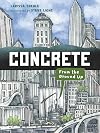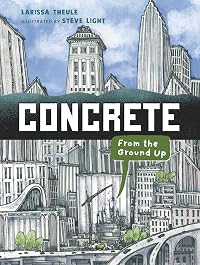
Concrete: From the Ground Up (Material Marvels)
by Larissa Theule
On This Page
Description
"From a lowly mixture of stone, sand, water, and cement have sprung sidewalks, streets, and skyscrapers, . . . lighthouses and . . . palaces, long bridges and massive dams. In ancient building practices, in modern engineering, and in the architecture of the future, humble concrete plays a mighty role in the creation of the human-made world. With facts and . . . running narrative in the form of repartee-filled speech bubbles, [this book] is . . . informative and visually sweeping"--Provided show more by publisher. show lessTags
Recommendations



Member Reviews
Taking a largely forgotten (and maybe, seemingly boring topic), these pages show how amazing concrete is while also taking the reader on an intriguing ride into history.
The first question addressed in these pages circles around the definition of concrete, cement, and other similar terms, and while doing this, it is anything but mundane. After the basics are established, it's a zoom back into history to explain how concrete has been used through time (or similar compounds), starting way back in ancient cultures. From here, the reader visits the various points in architectural history, where forms of concrete were used, what their purpose was, and how it became what it is today.
While this is a book for slightly older readers (ages 7 to show more 10), it brings across the material in a well-laid out, easy-to-understand fashion. Step-by-step the reader dives into the topic...and that while keep the material from growing dry. The illustrations make every situation visually clear and are enjoyable, too. Many of the illustrations contain speech bubbles where more information is presented or broken-down in a fun, conversational form. The vocabulary is kept fairly light so that the terminology doesn't bog down. By the end of this, readers will have a thorough understanding of what concrete is, how it's changed through-out history, and what uses it has.
I do see this one as great for homeschoolers, classrooms, or even those kids, who are interested in the world around them. I received a complimentary copy and found this was a nice way to bring across a rarely-seen topic. show less
The first question addressed in these pages circles around the definition of concrete, cement, and other similar terms, and while doing this, it is anything but mundane. After the basics are established, it's a zoom back into history to explain how concrete has been used through time (or similar compounds), starting way back in ancient cultures. From here, the reader visits the various points in architectural history, where forms of concrete were used, what their purpose was, and how it became what it is today.
While this is a book for slightly older readers (ages 7 to show more 10), it brings across the material in a well-laid out, easy-to-understand fashion. Step-by-step the reader dives into the topic...and that while keep the material from growing dry. The illustrations make every situation visually clear and are enjoyable, too. Many of the illustrations contain speech bubbles where more information is presented or broken-down in a fun, conversational form. The vocabulary is kept fairly light so that the terminology doesn't bog down. By the end of this, readers will have a thorough understanding of what concrete is, how it's changed through-out history, and what uses it has.
I do see this one as great for homeschoolers, classrooms, or even those kids, who are interested in the world around them. I received a complimentary copy and found this was a nice way to bring across a rarely-seen topic. show less
Informative but not intimidating, with clear illustrations and plenty of white space. Definitions are provided in text at the point of need (e.g. "CONCRETE is a composite building material. Composite means made up of different parts"). Fascinating.
Back matter is scant, only a bibliography.
Back matter is scant, only a bibliography.
Gr 1–5—Theule tells the story of concrete, from ancient times to its rediscovery in the 18th century, and in pareddown style introduces readers to advanced vocabulary, architectural monuments, professions, social history, and
more, with clarity, directness, and humor. An utterly compelling read.
more, with clarity, directness, and humor. An utterly compelling read.
Very interesting book; good explanations of words and ideas as you read.
Synergy: Concrete
CONCRETE is a composite material made of stone, sand, water, and cement. From bridges and dams to lighthouses and skyscrapers, concrete is used in a wide range of construction projects.
Create a display featuring concrete examples, building models, and LEGO bricks. Ask children to design a building that could be made with concrete.
Read the recently published nonfiction children’s picture book, then learn more at the website:
CONCRETE: FROM THE GROUND UP by Larissa Theule and illustrated by Steve Light defines concrete and traces its history. Part of the Material Marvels series, readers learn about the many types of structures built with concrete. The illustrator’s use of speech bubbles on captivating color drawings show more along with the author’s short, informational texts combine for an engaging and informative picture book. ARC courtesy of Candlewick Press.
CONCRETE from Kids Britannica defines concrete and provides several examples in an easy-to-read format.
To read the article, go to https://kids.britannica.com/kids/article/concrete/403923.
WHAT IS CONCRETE? from Concrete Network provides an introduction to concrete, its components, and its uses. Users can access numerous articles for further information.
To learn more, go to https://www.concretenetwork.com/concrete.html.
WHAT IS CONCRETE? from Practical Engineering is a short video explaining the basics of concrete. Other videos in the series explore Roman concrete.
To view the video, go to https://youtu.be/UOHURuAf5iY. show less
CONCRETE is a composite material made of stone, sand, water, and cement. From bridges and dams to lighthouses and skyscrapers, concrete is used in a wide range of construction projects.
Create a display featuring concrete examples, building models, and LEGO bricks. Ask children to design a building that could be made with concrete.
Read the recently published nonfiction children’s picture book, then learn more at the website:
CONCRETE: FROM THE GROUND UP by Larissa Theule and illustrated by Steve Light defines concrete and traces its history. Part of the Material Marvels series, readers learn about the many types of structures built with concrete. The illustrator’s use of speech bubbles on captivating color drawings show more along with the author’s short, informational texts combine for an engaging and informative picture book. ARC courtesy of Candlewick Press.
CONCRETE from Kids Britannica defines concrete and provides several examples in an easy-to-read format.
To read the article, go to https://kids.britannica.com/kids/article/concrete/403923.
WHAT IS CONCRETE? from Concrete Network provides an introduction to concrete, its components, and its uses. Users can access numerous articles for further information.
To learn more, go to https://www.concretenetwork.com/concrete.html.
WHAT IS CONCRETE? from Practical Engineering is a short video explaining the basics of concrete. Other videos in the series explore Roman concrete.
To view the video, go to https://youtu.be/UOHURuAf5iY. show less
Ratings
Members
- Recently Added By
Lists

SYES Library Wishlist
1,080 works; 4 members
Author Information
11 Works 288 Members
Awards and Honors
Classifications
- Genre
- Nonfiction
- DDC/MDS
- 620.1 — Applied science & technology Engineering Mechanical & Civil Engineering Engineering Mechanics and Materials Science
- LCC
- TA681 .T44 — Technology Engineering Civil engineering (General). Engineering (General). Civil engineering (General) Structural engineering (General)
- BISAC
Statistics
- Members
- 52
- Popularity
- 583,480
- Reviews
- 5
- Rating
- (4.32)
- Languages
- English
- Media
- Paper, Ebook
- ISBNs
- 3