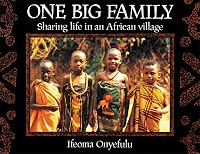
One Big Family: Sharing Life in an African Village
by Ifeoma Onyefulu
On This Page
Description
Offers an insight into African village life and a special way of sharing, celebrating and making important decisions. One little girl tells how each member of her family contributes to the well-being and happiness of their village.Tags
Recommendations






Member Reviews
I absolutely loved reading, "One Big Family," for many reasons. This book was an informational text about a village in Africa. The author goes into description about her village and her whole family throughout the entirety of the book. One thing that I loved that the author did was when she was introducing a new word to her readers she spelled it out phonetically. For example, when introducing herself to the readers she states, "Hello! My name is Obioma (pronounced o-bee-oma)". This is not only helpful for readers who are not familiar with this type of language but it is informational for the readers to see the difference between phonics in English and in this African tongue. I also loved the use of actual photographs throughout the show more book. I love when storybooks are filled with hand-drawn illustrations but for this particular book I found the photographs to be very helpful in visualizing what the author was speaking about. Additionally, the author did a wonderful job at explaining every detail of her tribe that she mentioned throughout the text. The author writes about age groups in the family and how age groups are divided into sets called "Obgo." The author did a great job at informing her readers about things that may be completely foreign to them. One last thing that I enjoyed about this text was the celebration of the culture in Obioma's village. The author writes, "Obinwanne sings sweet songs and dance at special events." All in all, this book was a pleasure to read. show less
This book lightly touches on the typical family structure that one would find in Africa. I had mixed emotions about this book. I liked how this book showed how the family dynamic of an African family is structured with vivid, clear photographs. However, I didn't like how difficult the family dynamic was to follow; I wish there were a chart at the end of the book for reference.
I liked this book, and learned a lot from it. Although fiction books can be wonderful additions to a text set regarding a certain culture, I believe that nonfiction informational books must also be included. Well written, engaging books like this one will both inform the reader and prompt them to ask questions and want to know more about the topic.
This book is engaging to students because it revolves around topics that the students will be able to connect to: family, friends, and leisure time. This book’s message is slightly different from those of many multicultural books, it emphasizes and celebrates the differences between the african culture and american culture. For example, the book begins by noting differences, “In Awkozu, show more every child belongs to an igbo, together with all the other children born within a five-year period. Fat or thin, rich or poor, it does not matter. Everyone has a friend; no one is born alone”. This is very different from how Americans view a family unit, and the author makes this difference positive.
There were some elements of this nonfiction book that also made it an excellent learning tool. I noticed that the author was sure to use the language of the people, Swahili, instead of translations. One feature that I believe helps make the book both interesting and accessible is the inclusions of pronunciation guides for each Swahili word. Additionally, the author used photographs that they had taken themselves, which helped to prove that they were a knowledgable source for this book. show less
This book is engaging to students because it revolves around topics that the students will be able to connect to: family, friends, and leisure time. This book’s message is slightly different from those of many multicultural books, it emphasizes and celebrates the differences between the african culture and american culture. For example, the book begins by noting differences, “In Awkozu, show more every child belongs to an igbo, together with all the other children born within a five-year period. Fat or thin, rich or poor, it does not matter. Everyone has a friend; no one is born alone”. This is very different from how Americans view a family unit, and the author makes this difference positive.
There were some elements of this nonfiction book that also made it an excellent learning tool. I noticed that the author was sure to use the language of the people, Swahili, instead of translations. One feature that I believe helps make the book both interesting and accessible is the inclusions of pronunciation guides for each Swahili word. Additionally, the author used photographs that they had taken themselves, which helped to prove that they were a knowledgable source for this book. show less
I liked this book because although it was an informational text, it was written in first person. This made the information feel like a story rather than rote facts. For example, on the first page it starts out with "I am..." and this character then tells the reader about her African village. This made it more interesting to read. I also enjoyed the real photographs on each page. These photographs can make it easier for the reader to connect the ideas represented in the text to an actual image, such as the women of the village cleaning the river. I did not know what it meant to clean a river until I saw the pictures of them using plants to sift the debris out of the water. I also liked how the author included pronunciations for uncommon show more or African words for the reader. Examples of this are ogbo (or-BO), ilo (ee-LO), and Awkuzu (aw-KOO-zoo). The big idea of this book is to promote a positive African image for the reader. The author also seems to be breaking African stereotypes by allowing the readers to walk away with real knowledge of life in an African village. show less
I liked this book for two ; first is that the language is very clear and informative. I never knew was an Ogbo (age group) was before reading this book. This book informed me through the African language what it is like growing up in an African village. My second reason for liking this book is for the illustrations. The book had real life photos of the children and adults working together to make their village a better place. For me, seeing what people in different parts of the world must do on a daily basis to survive opened my eyes. IN one photo, the woman uses a branch to “sweep” the dead leaves from the stream so the water is drinkable. This stood out for me because through one photo, I know how lucky I am to live the way I do show more and I give great blessings to those in other counties. The big idea in the book is to inform people of the different ways of life around the world and the fun put into making show less
This story was quite different from the others I have read thus far, mostly because it is non-fiction. My favorite part was the vivid photography the author chose to use instead of illustrations. This brought the reality of the story directly to her reader’s eyes. I enjoyed how instead of imagining what the characters looked like, you have the chance to actually see the real people. I also enjoyed how the author chose to set up the plot. She broke the story down into pieces, separating the story by the different parts of an African tribe or family. This helped show the reader the similarities and differences between their own family and the African village in the story. Then to add to the experience of the story the author chose to show more use authentic language. She included African words that the majority of elementary readers are going to be unfamiliar with. She includes both pronunciations and descriptions of the words so that the readers can understand the context and still learn the new word. Through the use of these three writing techniques she was able to convey her main message to her audience with ease. She believes that no one is born alone, no matter their age, culture, wealth, gender or race. Making it easy to American readers to find themselves in this African story. show less
I enjoyed reading this book; I think it would be great for a classroom because it allows students to learn about a culture different than their own and do it through the eyes of a young girl that they may be able to relate to. This can help students think critically about themselves and the world around them. The book focuses on educating students about “ogbo,”
or age groups, that categorize the members of an African village and thus assign them their civilian duties. For example, the narrator has a brother in the age ten ogbo and he has just been given the duties of cleaning up the village. She also gives an example of her uncle, Chike, who helps build homes with his ogbo.The use of a narrator can allow students to be able to relate show more to the information and compare it to their own families and communities.
I also enjoyed the real-life images depicted on every page. It allows the reader to see what the community members do and how it looks in the concept of the whole village. The reader gets an inside view at the narrator’s brother sweeping, the mother cleaning the water stream, and even the aunt ceremonially becoming inducted as chief. Through everything that happens, students get to see actual images to go along with actual facts. I think that this aspect works very well for nonfiction and plays well with the big idea of the book. The book’s main point is to educate students about a culture unlike their own and learn about the different ways people live, specifically, how villages in Africa run. show less
or age groups, that categorize the members of an African village and thus assign them their civilian duties. For example, the narrator has a brother in the age ten ogbo and he has just been given the duties of cleaning up the village. She also gives an example of her uncle, Chike, who helps build homes with his ogbo.The use of a narrator can allow students to be able to relate show more to the information and compare it to their own families and communities.
I also enjoyed the real-life images depicted on every page. It allows the reader to see what the community members do and how it looks in the concept of the whole village. The reader gets an inside view at the narrator’s brother sweeping, the mother cleaning the water stream, and even the aunt ceremonially becoming inducted as chief. Through everything that happens, students get to see actual images to go along with actual facts. I think that this aspect works very well for nonfiction and plays well with the big idea of the book. The book’s main point is to educate students about a culture unlike their own and learn about the different ways people live, specifically, how villages in Africa run. show less
Members
- Recently Added By
Lists

Geography Through Photography for Kids
55 works; 1 member
Author Information

25 Works 1,457 Members
Classifications
- Genres
- Nonfiction, Picture Books, Children's Books
- DDC/MDS
- 305.2309669 — Society, government, & culture Social sciences, sociology & anthropology Social group - Age, Gender, Ethnicity Age groups Young people up to 20
- LCC
- DT515.45 .I33 .O5944 — History of Europe, Asia, Africa and Oceania Africa History of Africa West Africa. West Coast British West Africa Nigeria Ethnography
- BISAC
Statistics
- Members
- 59
- Popularity
- 522,808
- Reviews
- 13
- Rating
- (4.27)
- Languages
- English
- Media
- Paper
- ISBNs
- 6