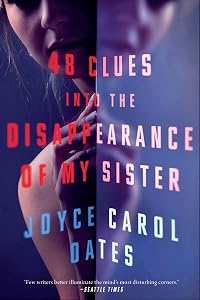
48 Clues into the Disappearance of My Sister
by Joyce Carol Oates
On This Page
Description
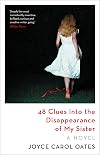
Fiction. Thriller. When a woman mysteriously vanishes, her sister must tally up the clues to discover her fate. Marguerite, a beautiful woman, has disappeared from her small town in Upstate New York. But is foul play involved? Or did she merely take an opportunity to get away for fun, or finally make the decision to leave behind her claustrophobic life of limited opportunities? Her younger sister Gigi wonders if the flimsy silk Dior dress, so casually abandoned on the floor, is a clue to show more Marguerite's having seemingly vanished. The police examine the footprints made by her Ferragamo boots leaving the house, ending abruptly, and puzzle over how that can help lead to her. Gigi, not so pretty as her sister, slowly reveals her hatred for the perfect, much-loved, Marguerite. Bit by bit, like ripping the petals off a flower blossom, revelations about both sisters are uncovered. Subtly, but with the unbearable suspense at which Joyce Carol Oates excels, clues mount up to bring to light the fate of the missing beauty. show lessTags
Recommendations















Member Reviews
(23) I loved this - deliciously creepy, Geogene Fulmer is an incredible creation. Oates is a master of characterization. In the opening scene Georgene describes the last time she sees her young adult sister. In fact, she sees a double reflection of her in the mirror as she is creeping by her sister's bedroom door left ajar one morning .. and then never sees her again. Or does she? Georgene is not the most reliable narrator. The police investigate; a psychic becomes involved, a private investigator. The Fulmers are a old rich family in upstate New York. The patriarch is recently widowed after his wife dies an untimely death from breast cancer and his daughters' lives are upended. Marguerite, the elder sister (the disappeared one,) comes show more home from NYC where she is a successful artist, declining a prestigious fellowship to become the artist in residence at a local college, in order to minister to her younger sister. Georgene, the younger sister, who has gone off the rails after her mother's demise.
And so the premise is set and JCO writes mesmerizingly in the vein of true crime through the lens of the acerbic, intelligent, but potentially mentally unhinged younger sister. It is a brilliant short novel! I am such a fan of Oates macabre fiction - this reminded me of the depiction of the Jon Benet Ramsey case in 'My Sister, My Love' and 'Black Water,' the Chappaquiddick reenactment.
Anyway, from an entertainment standpoint - I think I know what happened. I think the author answered all my questions and tied off loose ends - but I do think there are some parts that are tantalizingly open to interpretation. Bravo! show less
And so the premise is set and JCO writes mesmerizingly in the vein of true crime through the lens of the acerbic, intelligent, but potentially mentally unhinged younger sister. It is a brilliant short novel! I am such a fan of Oates macabre fiction - this reminded me of the depiction of the Jon Benet Ramsey case in 'My Sister, My Love' and 'Black Water,' the Chappaquiddick reenactment.
Anyway, from an entertainment standpoint - I think I know what happened. I think the author answered all my questions and tied off loose ends - but I do think there are some parts that are tantalizingly open to interpretation. Bravo! show less
Marguerite's younger sister begins with her last glimpse of her older, glamorous sister and tells the story of what happened after Marguerite disappeared somewhere between the home she'd moved back to after her mother's death to care for her father and younger sister, and the local college where she worked as an artist-in-residence. M. is beautiful and talented and her disappearance brings a lot of attention to their town and to Gigi and her father. Gigi is very different from her sister, not a beauty and unlike her sister, whose art career is taking off, Gigi works as a clerk in the post office. Gigi begins to explore her sister's life, finding surprises in a sketchbook and in the attentions of a man who claims to have been her show more sister's mentor.
Joyce Carol Oates is playing to her strengths with this novel. There's the young woman both repelled and drawn to an over-bearing man, there's the distant father, there's that sense of being uncomfortable in one's own body and, more than anything, JCO's writing style that gives everything an off-kilter feel, a touch of the creepy. All those things are why I like JCO's writing so much and yet, here, they fail to deliver. JCO is pulling out all the usual tricks, but this novel feels like she's just going through the motions. She's written dozens of books like this one and, for once, it shows. It's not a bad book, but there are so very many better books by her out there. She is an extraordinary author who has written a remarkable number of books so a rare stumble is no doubt to be expected, although her mistakes are usually ones where she takes a chance and fails, not when she's writing to her strengths. A bad book by JCO is still better than most other books, but she's written far better books. show less
Joyce Carol Oates is playing to her strengths with this novel. There's the young woman both repelled and drawn to an over-bearing man, there's the distant father, there's that sense of being uncomfortable in one's own body and, more than anything, JCO's writing style that gives everything an off-kilter feel, a touch of the creepy. All those things are why I like JCO's writing so much and yet, here, they fail to deliver. JCO is pulling out all the usual tricks, but this novel feels like she's just going through the motions. She's written dozens of books like this one and, for once, it shows. It's not a bad book, but there are so very many better books by her out there. She is an extraordinary author who has written a remarkable number of books so a rare stumble is no doubt to be expected, although her mistakes are usually ones where she takes a chance and fails, not when she's writing to her strengths. A bad book by JCO is still better than most other books, but she's written far better books. show less
Jealousy among siblings has been a mainstay of fiction for centuries, and over her long and iconic career Joyce Carol Oates has found it to be an effective motif for her stories and novels. In 48 Clues into the Disappearance of My Sister, it’s 2013 and Georgene Fulmer is narrating the story of her older (by 6 years) sister, Marguerite’s, disappearance, which occurred 22 years earlier, in April of 1991. The Fulmer home is a scene of privilege and comfort, a large Tudor-style structure located on a spacious landscaped lot in a prosperous neighbourhood of Aurora-on-Cayuga, in New York State. Marguerite is an artist, a sculptor. In her late 20s, she has already been the recipient of numerous awards and fellowships. She was living in NYC show more when the girls’ mother died (of cancer) but returned home to be there for her father (Milton, an investment broker) and sister, taking a teaching position at nearby Aurora College. On that fateful April morning, shortly after 7am, Georgene briefly glimpsed her sister through the open door of her bedroom, sitting before a mirror getting ready to go to the college, where in a few hours she was scheduled to teach a class. That’s the last time Georgene saw her, since Marguerite did not join her and their father for breakfast and (presumably, though nobody witnessed her leaving) was soon outside trudging her way to school on foot. By that evening, after Marguerite had missed her class and had not returned home, and her whereabouts could not be confirmed, the police (urged by Milton) designated her a missing person. Marguerite is a silver-blond beauty, slim and stately, sought-after by many men. By contrast, Georgene is frumpy, unattractive, awkward, with big feet and a masculine build. She is often rude and does not suffer fools. The sisters’ stark physical differences colour much of the narrative, in which at one point Georgene states, “Her beauty, that was unjust. For all beauty is unjust,” and asserts that her beauty was the key that opened so many doors for Marguerite. Though a few potential suspects are identified, the police investigation ultimately fails, as does a later inquiry by Leo Drummard, a PI hired by Milton. Throughout the novel, Georgene suggests various theories about what might have happened and recalls the rampant conjecture and myriad hurtful rumours (many of a sexual nature) that circulated in the weeks and months following the disappearance. Georgene Fulmer is a classic unreliable narrator, contemptuous of everything and everyone (except her father), reserving especially venomous disdain for the police and PI Leo Drummard. But as a plain woman who’s been ignored for much of her life, she proves vulnerable to the attention that her sister’s sudden disappearance brings her, especially that of Howard Strucht, a creepy and pretentious artist colleague of Marguerite’s at the college, who worms his way into Georgene’s affections, claiming to be Marguerite’s “intimate” friend and mentor, but whose true intentions turn out to be anything but benevolent. 48 Clues into the Disappearance of My Sister tells a taut tale of sibling rivalry, its considerable narrative momentum driven by the possibility that the solution to the mystery resides just around the next corner. However, the novel ends ambiguously, with many questions left floating—tantalizingly, half-answered—in the ether. Did Georgene really “hate” her sister, as she claims? Is it possible she knows what happened and isn’t telling us? Exactly how unhinged is she? Joyce Carol Oates drops plenty of clues about Marguerite’s possible fate but, in the end, leaves conclusions up to the reader. show less
In April of 1991, 30-year-old Marguerite (M.) Fulmer disappears from her upper middle-class home in Aurora-on-Cayuga in the Finger Lakes region of New York State. Twenty-two years later, her younger sister Georgene (G.), the narrator, reveals snippets of her sister’s life and the various theories developed by police, relatives, colleagues, and even a psychic: was she abducted and murdered or did she run away for some reason? Also revealed are G’s complicated feelings for her perfect, much-loved sister.
The two sisters are foils. M. was beautiful, talented, accomplished, and popular. A sculptor, she received prestigious awards. With her sense of style and designer clothes, hers seemed to be a glamorous life G. could never achieve. G. show more is the exact opposite. She lacks her sister’s beauty and accomplishments. She works in a dead-end job as a postal clerk. Because she tends to be brusque, rude, and dismissive of others, she has no friends or romantic relationships.
G.’s anger, jealousy, and resentment become increasingly obvious. She wants what her sister had: beauty, popularity, and success. She feels unloved by her family and hopes for a romantic relationship. Beneath her peevish and abrasive exterior lies a deeply unhappy, lonely, and insecure woman.
What also becomes clear is that G. is an unreliable narrator. For instance, at one point she says that she refused “to be envious of anyone, ever” but then later admits “All that was secret in my sister, I deeply envied, and resented.” From the beginning she makes clear that she is not totally forthcoming: “Note that much is hypothetical here. Though G. may know exactly what has happened to M., G. is taking care to present ‘clues’ as they appear in sequence.” The line between reality and imagination is often blurred. For instance, there is one episode where G. describes taking a certain action only for the reader to learn later that she was fantasizing. As a consequence, the reader must wonder about other scenes: are they reality or hallucinations?
Readers should be warned that the ending is ambiguous. Of course, this should not come as a surprise since G. states at the beginning, “So many maybes! Yet (this is the tantalizing promise of clues!) one of these maybes however improbable and implausible is the Truth.” G.’s last glimpse of M. is her face “in the bureau mirror reflected in the mirror on the closet door – that is, an image double mirrored.” This suggests a distorted image and that’s really what the narration feels like: not everything is clear.
This is a mystery for those who like to read closely in order to figure out what happened. I have my suspicions, but I think a second reading would be beneficial.
Note: I received a digital galley from the publisher via NetGalley.
Please check out my reader's blog (https://schatjesshelves.blogspot.com/) and follow me on Twitter (@DCYakabuski). show less
The two sisters are foils. M. was beautiful, talented, accomplished, and popular. A sculptor, she received prestigious awards. With her sense of style and designer clothes, hers seemed to be a glamorous life G. could never achieve. G. show more is the exact opposite. She lacks her sister’s beauty and accomplishments. She works in a dead-end job as a postal clerk. Because she tends to be brusque, rude, and dismissive of others, she has no friends or romantic relationships.
G.’s anger, jealousy, and resentment become increasingly obvious. She wants what her sister had: beauty, popularity, and success. She feels unloved by her family and hopes for a romantic relationship. Beneath her peevish and abrasive exterior lies a deeply unhappy, lonely, and insecure woman.
What also becomes clear is that G. is an unreliable narrator. For instance, at one point she says that she refused “to be envious of anyone, ever” but then later admits “All that was secret in my sister, I deeply envied, and resented.” From the beginning she makes clear that she is not totally forthcoming: “Note that much is hypothetical here. Though G. may know exactly what has happened to M., G. is taking care to present ‘clues’ as they appear in sequence.” The line between reality and imagination is often blurred. For instance, there is one episode where G. describes taking a certain action only for the reader to learn later that she was fantasizing. As a consequence, the reader must wonder about other scenes: are they reality or hallucinations?
Readers should be warned that the ending is ambiguous. Of course, this should not come as a surprise since G. states at the beginning, “So many maybes! Yet (this is the tantalizing promise of clues!) one of these maybes however improbable and implausible is the Truth.” G.’s last glimpse of M. is her face “in the bureau mirror reflected in the mirror on the closet door – that is, an image double mirrored.” This suggests a distorted image and that’s really what the narration feels like: not everything is clear.
This is a mystery for those who like to read closely in order to figure out what happened. I have my suspicions, but I think a second reading would be beneficial.
Note: I received a digital galley from the publisher via NetGalley.
Please check out my reader's blog (https://schatjesshelves.blogspot.com/) and follow me on Twitter (@DCYakabuski). show less
Georgene was the last person to see her sister and that was in a mirror reflected in another mirror which sets the tone for the novel. Can we believe what we are seeing or in this case hearing and how is it reflected back to us?
Told through Georgene’s eyes, almost as a stream of consciousness (with a lot of brackets), Marguerite, or M. as her sister was known was a sculptor at a local art college and slowly, very slowly more and more information is revealed. This is a story with suspense and one that never quite tells us what is happening so we are left at the end wondering whether G. murdered M. and buried her in the old cellar or not.
Mirrors can distort images and this is what G. does to M.’s disappearance. She tidies away a dress show more left on the floor, takes her sketch book and clears out her diary and calendar. There are the tantalising suggestions that M. had appointments for mamagrams and a biopsy, with the implication that their mother died of breast cancer, but G. has removed all evidence of these.
As we move through the story we see more clearly G.’s rage at her mother’s death and at being the ugly sister with too large feet and for whom no one (male or female) pays any attention. She is one of the most unreliable narrators I have read for a while. What Oates also describes is the disintegration of the Fulmer family (small though it may be once M. has disappeared) where the father retreats further and further into his study, the housekeeper dies and isn’t replaced and mice take up residency with the Fulmer’s living in two rooms. The loss of their mother and the return home of M. are details of the family disintegrating as M. has to sacrifice her art in order, we presume, to look after G. who is obviously ‘difficult’ and her father. The family offers no respite from the disappearance, not even when a private investigator is hired and it is implied believes G. killed her sister.
Ifyou don’t like ambiguous endings, this is not the novel for you! show less
Told through Georgene’s eyes, almost as a stream of consciousness (with a lot of brackets), Marguerite, or M. as her sister was known was a sculptor at a local art college and slowly, very slowly more and more information is revealed. This is a story with suspense and one that never quite tells us what is happening so we are left at the end wondering whether G. murdered M. and buried her in the old cellar or not.
Mirrors can distort images and this is what G. does to M.’s disappearance. She tidies away a dress show more left on the floor, takes her sketch book and clears out her diary and calendar. There are the tantalising suggestions that M. had appointments for mamagrams and a biopsy, with the implication that their mother died of breast cancer, but G. has removed all evidence of these.
As we move through the story we see more clearly G.’s rage at her mother’s death and at being the ugly sister with too large feet and for whom no one (male or female) pays any attention. She is one of the most unreliable narrators I have read for a while. What Oates also describes is the disintegration of the Fulmer family (small though it may be once M. has disappeared) where the father retreats further and further into his study, the housekeeper dies and isn’t replaced and mice take up residency with the Fulmer’s living in two rooms. The loss of their mother and the return home of M. are details of the family disintegrating as M. has to sacrifice her art in order, we presume, to look after G. who is obviously ‘difficult’ and her father. The family offers no respite from the disappearance, not even when a private investigator is hired and it is implied believes G. killed her sister.
Ifyou don’t like ambiguous endings, this is not the novel for you! show less
I've read a lot of JCO's books over the years, and I've liked most of them, loved more than a few and I've always admired her writing. I'm not sure how she keeps plugging away (she's well into her 80's) I think, and though I'm not far behind her in age and I read her works regularly, I'm sure I have not read even half of her output. (Wiki tells me she's written more than 70 books).
This one was her latest, at least I think it was at the time I read it, and it is very gothic. It reminded me very much of Shirley Jackson's We Have Always Lived In The Castle. Set in a small town in upstate New York, we have a younger sister, Georgene, clearly an unreliable narrator, telling the story of her family, and what happened some 15 years previously show more when her beautiful and talented older sister Marguerite disappeared on her way to a local college where she was a professor of art.
Interesting characters are created, and there is an involving plot as well as things to puzzle out, all the while trying to figure out what games, conscious or unconscious, our narrator Georgene (and behind her author Oates) is playing with us.
Recommended.
3 1/2 stars
First Line: "Silky white fabric. Bodiless."
Last Line: "Dear Sister, Wait! I am almost there."
Factoid: In the afterword (or maybe I read it on Wiki?) it is stated that 600,000 people disappear annually in the US, and of these 90,000 are never found. This doesn't mean they are all murdered, but there is this quote: "The earth is bloody with the bodies of raped, murdered, cast-aside women and girls." show less
This one was her latest, at least I think it was at the time I read it, and it is very gothic. It reminded me very much of Shirley Jackson's We Have Always Lived In The Castle. Set in a small town in upstate New York, we have a younger sister, Georgene, clearly an unreliable narrator, telling the story of her family, and what happened some 15 years previously show more when her beautiful and talented older sister Marguerite disappeared on her way to a local college where she was a professor of art.
Interesting characters are created, and there is an involving plot as well as things to puzzle out, all the while trying to figure out what games, conscious or unconscious, our narrator Georgene (and behind her author Oates) is playing with us.
Recommended.
3 1/2 stars
First Line: "Silky white fabric. Bodiless."
Last Line: "Dear Sister, Wait! I am almost there."
Factoid: In the afterword (or maybe I read it on Wiki?) it is stated that 600,000 people disappear annually in the US, and of these 90,000 are never found. This doesn't mean they are all murdered, but there is this quote: "The earth is bloody with the bodies of raped, murdered, cast-aside women and girls." show less
Although a long-time JCO fan, I couldn’t give this novel more than 3 stars due to the unlikeable character of G and the ambiguity of the ending. She is a brilliant writer and I always look forward to her new books, but this one was a disappointment.
Members
- Recently Added By
Lists

Llibres que he llegit el 2024
77 works; 1 member
Author Information

473+ Works 63,219 Members
Joyce Carol Oates was born on June 16, 1938 in Lockport, New York. She received a bachelor's degree in English from Syracuse University and a master's degree in English from the University of Wisconsin. She is the author of numerous novels and collections of short stories. Her works include We Were the Mulvaneys, Blonde, Bellefleur, You Must show more Remember This, Because It Is Bitter, Because It Is My Heart, Solstice, Marya : A Life, and Give Me Your Heart. She has received numerous awards including the National Book Award for Them, the PEN/Malamud Award for Excellence in Short Fiction, and the F. Scott Fitzgerald Award for Lifetime Achievement in American Literature. She was a finalist for the 2015 Pulitzer Prize for Fiction with her title Lovely, Dark, Deep. She also wrote a series of suspense novels under the pseudonym Rosamond Smith. In 2015, her novel The Accursed became listed as a bestseller on the iBooks chart. She worked as a professor of English at the University of Windsor, before becoming the Roger S. Berlind Distinguished Professor of Humanities at Princeton University. She and her late husband Raymond J. Smith operated a small press and published a literary magazine, The Ontario Review. (Bowker Author Biography) Joyce Carol Oates is one of the most eminent and prolific literary figures and social critics of our times. She has won the National Book Award and several O. Henry and Pushcart prizes. Among her other awards are an NEA grant, a Guggenheim fellowship, the PEN/Malamud Lifetime Achievement Award, and the F. Scott Fitzgerald Award for Lifetime Achievement in American Literature. (Publisher Provided) show less
Classifications
Statistics
- Members
- 165
- Popularity
- 198,943
- Reviews
- 9
- Rating
- (3.46)
- Languages
- English, French, Spanish
- Media
- Paper, Audiobook, Ebook
- ISBNs
- 17
- ASINs
- 4