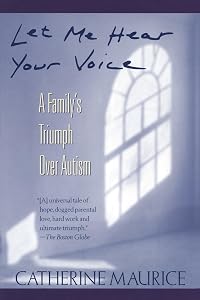
Let Me Hear Your Voice: A Family's Triumph over Autism
by Catherine Maurice
On This Page
Description
Fully documented account of the diagnosis, therapy, and authentic recovery of two autistic children in the Maurice family.Tags
Recommendations












Member Reviews
I work with people with autism, among others. I don't have a child, let alone a child with autism, and while I care deeply for my students/clients and their families, I have no idea what they are going through. I just don't have that kind of life experience. This book gives me a tiny, tiny window into that. For all the tumblrs that want to tell you what the autism experience is like, they can never capture this - the experience of those on the opposite end of the spectrum, the ones that are unable to communicate, unable to care for themselves, possibly even harming themselves. These individuals can't blog about themselves.
This book captures the intense, beautiful devotion of a parent for their child, and details all her efforts to help show more her child as much as possible. It shows the joys, the achievements, the pain, the stress, the confusion. It also shows the hope. I am already passionate about ABA, but this book intensified that. It also illustrates the danger of fad treatments and pseudosciences that prey on vulnerable people.
Marvelous book. show less
This book captures the intense, beautiful devotion of a parent for their child, and details all her efforts to help show more her child as much as possible. It shows the joys, the achievements, the pain, the stress, the confusion. It also shows the hope. I am already passionate about ABA, but this book intensified that. It also illustrates the danger of fad treatments and pseudosciences that prey on vulnerable people.
Marvelous book. show less
An interesting story revealing the sadness of charlatans who take advantage of others for their own promotion. The difficulty in reading this was keeping in mind it was written in 1993 and what they were discussing as the new theories of behavioral modification has become pretty much standard. I dislike the implication which was promoted throughout the book (except at the very end) that autism is curable. Currently there exists no cure for autism and arguments abound on whether it should be. "Recovery" is a term used at the end of the book but again that term is misleading as non neural typicals tend to adapt or can learn to live with their disability as opposed to "recovering" from it. (We recover from alcoholism but we do not recover show more from being male or female.) However, when this story was written is again paramount to the understanding and acceptance of autism. There was a short appendix on how schools need to be involved in the educational process of autism and more of this needs to be addressed still. While many avenues were addressed I do like the fact that the Maurice's mentioned that a mixture of therapies are beneficial noting that what works for one may not work for another. Perhaps the worst part was realizing that at one time (and perhaps still) people (professionals also) felt a need to blame someone for ASD. You would think that by the end of the 20th century we would have gotten beyond that. show less
My sister in law gave me this book when we started getting my son evaluated for autism. Alot of what we went through, the author went through with her children. But this book didn't give me hope-it made me want to throttle the mother and scream "Try to find something positive. For god's sake, you can afford all the best stuff for your kids. You have so many options that most people don't."
There's good information in here, and there's stuff in here that is just depressing and doesn't do anything to help. But some parents might like it, as may educators and therapists. It wasn't my cup of tea, though. I prefer something that is more positive and concrete and less whiny.
There's good information in here, and there's stuff in here that is just depressing and doesn't do anything to help. But some parents might like it, as may educators and therapists. It wasn't my cup of tea, though. I prefer something that is more positive and concrete and less whiny.
Let Me Hear Your Voice is an early book reporting one families' success using behavior therapy as an early intervention for autism. It echoes the continuing truth that the earlier you catch and treat autism, the better your likely outcome. I would have loved an updated edition that discussed how her children faired as they grew.
As other reviews stated, the specific techniques referenced in this book are a bit outdated, though Lovaas' place as a pioneer in behavioral analysis deserves reiterating.
I would not recommend this as a first book to read on the subject, but it is still nice to hear of the successes.
As other reviews stated, the specific techniques referenced in this book are a bit outdated, though Lovaas' place as a pioneer in behavioral analysis deserves reiterating.
I would not recommend this as a first book to read on the subject, but it is still nice to hear of the successes.
Inspiring introduction to ABA therapy for autism, thought-provoking, and I would suggest a must-read for anyone affected by autism. Other books (by Grandin, and others) may give important alternative perspectives, and will be useful as well.
Everything works out well for Catherine Maurice. If your child is autistic, this book gives you hope, then it makes you very sad.
A mother's story of her two autistic children following them from diagnosis to various types of therapy.
Members
- Recently Added By
Author Information
8+ Works 364 Members
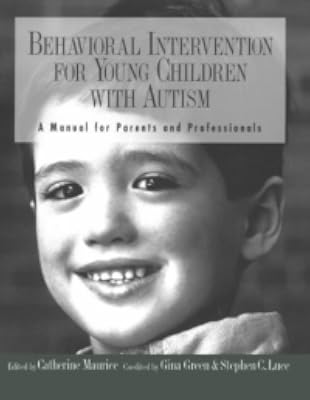
The name Catherine Maurice is a pseudonym. The author is, in real life, the mother of three children, two of whom were diagnosed as autistic. Her best-known book, "Let Me Hear Your Voice: A Family's Triumph over Autism," was published in 1994. It is an uplifting and hopeful account of how her family used a behavior modification method to treat show more their autistic children. The process, devised by O. Ivar Lovaas, a psychologist in California, seeks to disrupt the repetitive patterns of behavior that so many autistic children exhibit. Maurice's book, although positive and uplifting, cautions readers that this type of therapy works with only about 50% of the children who are treated using it. Nevertheless, both of Maurice's children have fully recovered and are now considered "normal." Catherine Maurice is also the editor of a book entitled "Behavioral Intervention for Young Children with Autism: A Manual for Parents and Professionals." (Bowker Author Biography) show less
Work Relationships
Is abridged in
Has as a student's study guide
Has as a teacher's guide
Classifications
- Genres
- Nonfiction, Biography & Memoir, General Nonfiction
- DDC/MDS
- 618.92 — Applied science & technology Medicine & health Gynecology, obstetrics, pediatrics, geriatrics Pediatrics & Geriatrics Pediatric Care
- LCC
- RJ506 .A9 .M39 — Medicine Pediatrics Pediatrics Diseases of children and adolescents Mental disorders. Child psychiatry
- BISAC
Statistics
- Members
- 209
- Popularity
- 156,342
- Reviews
- 8
- Rating
- (3.85)
- Languages
- English
- Media
- Paper
- ISBNs
- 4
- ASINs
- 1