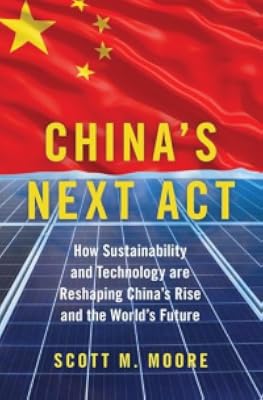
China's Next Act: How Sustainability and Technology are Reshaping China's Rise and the World's Future
by Scott M. Moore
On This Page
Description
"If the COVID-19 pandemic taught us anything, it is that the world is bound together by shared challenges -- and that at the center of those challenges stands China. Thanks to decades of breakneck growth and development, Chinese officials, businesses, and institutions now play a critical role in every major global issue, from climate change to biotechnology. This book rethinks China's role in the world in terms of sustainability and technology. This reframing is essential both because none show more of these increasingly pressing, shared global challenges can be tackled without China, and because they are reshaping China's economy and its foreign policy, with major implications for the world at large. At the same time, sustainability and technology issues present opportunities for intensified economic, geopolitical, and ideological competition - a reality that Beijing recognizes. The danger is that China's next act will drive divergence on the rules and standards the world desperately needs to tackle shared challenges in the decades ahead. In some areas, like clean technology development, competition can be good for the planet. But in others, it could be catastrophic: only cooperation can lower the risks of artificial intelligence and other disruptive new technologies. The challenges posed by climate change, pandemics, and emerging technologies make dealing with China's state, its firms, and other institutions more complex and more critical than ever before. China's Next Act helps foreign countries, companies, and other organizations prepare for a future shaped by sustainability, technology - and a dramatic new chapter for China and the world"-- show lessMembers
- Recently Added By
Published Reviews
Scott Moore offers an intelligent take on why so much of China's future will be determined by the path it forges on climate change and with technology. On climate, he counters the too often binary take that China's relationship with the US on climate must either be defined purely by competition or cooperation, instead offering a pragmatic way through. ― Kevin Rudd, 26th Prime Minister of show more Australia and President of the Asia Society
As the free world responds to Russian aggression in Ukraine, relations with China have come under intense scrutiny. China's Next Act has arrived just in time. Moore helps us understand better how we must reshape economic and diplomatic relations to advance peace and prosperity. ― H.R. McMaster, author of Battlegrounds and Dereliction of Duty
For those not following science and technology developments on the ground in China, Scott Moore's China's Next Act is a wake-up call and a warning. Amid escalating geopolitical competition, Moore paints in sharp relief the conflict between cooperating to elevate the provision of public goods and tackle global challenges versus competition and confrontation over new technologies and how to control and disseminate them. There is no more obvious example of this clash than the ongoing struggle over the COVID-19 pandemic response. Moore gives smart prescriptions about how to do better in the future and makes an impassioned plea for doing so. We need to heed his advice. ― Susan Thornton, former Acting Assistant Secretary for East Asian and Pacific Affairs, U.S. Department of State
China's Next Act convincingly makes the case that there are no global deals on public goods without a carefully calibrated mix of US-China collaboration and competition, despite systemic bilateral tensions. The book overflows with historic precedents, careful observations, and deep insights. It does not flinch at the scale of the challenge. But, most importantly, it succeeds in presenting credible pathways toward dealing with some of the most difficult global issues of our time: public health, climate change, data privacy, and other technological risks. It is an important contribution and should be read widely by all who are concerned with managing increasing risk in uncertain times. ― Craig Allen, President, US-China Business Council
Scott Moore's thought-provoking book wrestles with the most consequential issues of our time: global warming, global pandemics, and rapid technological change. He explores how China's rise has played a pivotal role in all three and makes a strong argument for why enlisting China in addressing them is absolutely vital―but uniquely challenging. Moore makes plain the urgent need for new thinking and new institutions flexible and capacious enough to respond to dynamic, fast-changing challenges. This is a book of big ideas, built on a strong foundation of research and personal experience. ― Kaiser Kuo, host of the Sinica Podcast
L'autore
Scott M. Moore is Director of China Programs and Strategic Initiatives in the Office of the Provost as well as a Lecturer in Political Science at the University of Pennsylvania. Moore was previously a Young Professional with the World Bank Group and served as Environment, Science, Technology, and Health Officer for China at the U.S. Department of State. He is the author of Subnational Hydropolitics: Conflict, Cooperation, and Institution-Building in Shared River Basins, and his research has appeared in a variety of leading scholarly journals and media outlets, including The New York Times, Foreign Affairs, The China Quarterly, and Nature. show less
As the free world responds to Russian aggression in Ukraine, relations with China have come under intense scrutiny. China's Next Act has arrived just in time. Moore helps us understand better how we must reshape economic and diplomatic relations to advance peace and prosperity. ― H.R. McMaster, author of Battlegrounds and Dereliction of Duty
For those not following science and technology developments on the ground in China, Scott Moore's China's Next Act is a wake-up call and a warning. Amid escalating geopolitical competition, Moore paints in sharp relief the conflict between cooperating to elevate the provision of public goods and tackle global challenges versus competition and confrontation over new technologies and how to control and disseminate them. There is no more obvious example of this clash than the ongoing struggle over the COVID-19 pandemic response. Moore gives smart prescriptions about how to do better in the future and makes an impassioned plea for doing so. We need to heed his advice. ― Susan Thornton, former Acting Assistant Secretary for East Asian and Pacific Affairs, U.S. Department of State
China's Next Act convincingly makes the case that there are no global deals on public goods without a carefully calibrated mix of US-China collaboration and competition, despite systemic bilateral tensions. The book overflows with historic precedents, careful observations, and deep insights. It does not flinch at the scale of the challenge. But, most importantly, it succeeds in presenting credible pathways toward dealing with some of the most difficult global issues of our time: public health, climate change, data privacy, and other technological risks. It is an important contribution and should be read widely by all who are concerned with managing increasing risk in uncertain times. ― Craig Allen, President, US-China Business Council
Scott Moore's thought-provoking book wrestles with the most consequential issues of our time: global warming, global pandemics, and rapid technological change. He explores how China's rise has played a pivotal role in all three and makes a strong argument for why enlisting China in addressing them is absolutely vital―but uniquely challenging. Moore makes plain the urgent need for new thinking and new institutions flexible and capacious enough to respond to dynamic, fast-changing challenges. This is a book of big ideas, built on a strong foundation of research and personal experience. ― Kaiser Kuo, host of the Sinica Podcast
L'autore
Scott M. Moore is Director of China Programs and Strategic Initiatives in the Office of the Provost as well as a Lecturer in Political Science at the University of Pennsylvania. Moore was previously a Young Professional with the World Bank Group and served as Environment, Science, Technology, and Health Officer for China at the U.S. Department of State. He is the author of Subnational Hydropolitics: Conflict, Cooperation, and Institution-Building in Shared River Basins, and his research has appeared in a variety of leading scholarly journals and media outlets, including The New York Times, Foreign Affairs, The China Quarterly, and Nature. show less
added by AntonioGallo
Lists

"the china pill"
96 works; 2 members
Author Information
2 Works 5 Members
Common Knowledge
- Quotations*
- "China is famous for its well-laid central plans. Since the 1950s, five-year plans have been the basic organizing principle for state policy and economic planning, guiding allocations of funding and resources and, at least ... (show all)in theory, the work of millions of bureaucrats and employees across the country. Abroad, though, few plans have attracted as much attention, or concern, as the one known as 'Made in China 2025'. First put forward in 2015, the plan aimed to combat a 'two-way squeeze' of automation, on one hand, and growing competition from low-cost manufacturing rivals like Bangladesh and Vietnam, on the other. In true centrally planned fashion, Made in China 2025 set out several key indicators for the nation to achieve by 2025, including increases in the number of patents filed and internal firm expenditure on research and development.
"Given China's Made in 2025 plan, coupled with unfair mercantilist policies it is no exaggeration to suggest that, without aggressive action, leading economies such as ... the United States will, within two decades, likely face a world wherein their industry firms face much stiffer competition and have fewer jobs.' In its report justifying the imposition of tariffs against Chinese goods in 2018, the Office of the US Trade Representative specifically cited the Made in China 2025 industrial policy and its threat to leapfrog the United States in advanced technologies. In 2019, the European Union likewise branded Beijing an 'economic competitor in pursuit of technological leadership and a systemic rival promoting alternative forms of governance.'
"To be sure, the growth of China's scientific research and development apparatus after the late 1970s was astonishing. Beijing made high-technology sectors a high-level priority, and scientific research and development enjoyed lavish investment to boost both economic growth and Chinese military power. In the twenty-first century, Beijing began to place special emphasis on breakthrough technologies it believed would be integral to the economy of the future. The 13th Five-Year Plan (2016-2020) pledged to 'move faster to make breakthroughs in core technologies' like energy, materials, and biomedical research. Just as important, these plans were backed by massive infusions of state funding. Total research and development expenditure increased approximately 30-fold from 1991 to 2016, to some US$410 billion, accounting for roughly 20% of the world total.
"By some estimates, the Chinese government pledged some US$350 billion to support strategic scientific research and technological development initiatives through 2025. China's research and development (R&D) spending accounted for some 2.1 % of gross domestic product (GDP) in the late 2010s -- not far behind the United States, which as the world leader spent approximately 2.7% of its GDP on scientific research and technological development. Perhaps most meaningfully, China's R&D spending as a percentage of GDP was higher than would be expected given its level of per capita income, suggesting that Chinese firms as well as the state viewed it as an unusually high priority relative to their counterparts in other developing countries. Meanwhile, university research spending in China increased at an average rate of some 15% -- a pace equaled in history only in the United States after the launch of Sputnik in the 1950s.
"Just as in the Sputnik era, the scale of this investment created a seemingly serious challenge to America's leadership in science and technology. In 1980, the United States accounted for 37% of the entire world's science and engineering publications, but by 2011, it produced only about one-quarter, a relative decrease due mostly to a boom in Chinese research activity. A landmark shift occurred in 2016, when for the first time, China surpassed the United States as the source of the single largest number of science and engineering publications, producing some 19% of the world's total, compared with 18% for the United States. Over roughly the same period, China became the first developing country to form a manned space program, acquire the ability to design and build supercomputers, and give rise to world-class technology firms like Alibaba and Huawei (more on Huawei in Chapter 5). It also became one of the few developing countries to feature multiple startup ecosystems, centered on Beijing, Hangzhou, Shanghai, and Shenzhen.
"This last feature, a partial embrace of market economics and Americanstyle entrepreneurial capitalism, made technological competition between China and developed democracies decidedly different from its Sputnik-era equivalent. Unlike the West and the Soviet Union, China and developed economies became highly interdependent, technologically as well as economically. The extent of this interdependency was evident even in advanced microchips, often held up as an example of technological competition. Despite decades of effort and billions of dollars spent to develop an independent capacity to produce advanced chips, Chinese manufacturers remained dependent into the 2020s on American vendors for a type of software known as electronic design automation tools needed to design and analyze electronic circuits and the semiconductors that made them work. This dependence created a temptation to try to cement America's technological advantage in chip design by restricting Chinese firms' access to foreign technology, capital, and other resources -- part of an approach known as 'decoupling.'
"Though it could be effective in slowing the development of China's semiconductor sector, it was also costly: US chip companies obtained a significant share of their sales and profits from the Chinese market. At the same time, US firms were themselves largely reliant on foreign supply chains for production of advanced semiconductors. While technological competition meant that decoupling and related strategies became a growing part of Sino-American ties, the reality of technological interdependence meant they would inevitably be limited in scope. As Richard Danzig and Lorand Laski wrote, 'Rather than eliminating interdependencies, Chinese and American leaders appear to be trimming and policing them.' In early 2021, the Chinese Semiconductor Industry Association announced it would create a joint working group with its American counterpart to discuss intellectual property protection, trade policy, and other contentious issues -- a sure sign that Chinese firms, at least, were keen to avoid decoupling. It also reflected China's decidedly mixed track record on the development of other technologies -- so much so, in fact, that it remained unclear whether it would ever be able to declare true technological independence."
*Some information comes from Common Knowledge in other languages. Click "Edit" for more information.
Classifications
Statistics
- Members
- 2
- Popularity
- 6,032,049
- Languages
- English
- Media
- Paper
- ISBNs
- 1