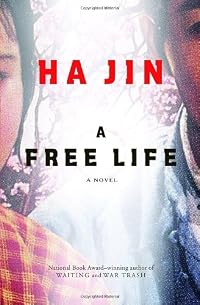
A Free Life
by Ha Jin
On This Page
Description
In the wake of the Tiananmen Square massacre, Nan Wu, who had studied in the U.S. in the mid-1980s, leaves China with his wife and son to seek the freedom of the West, embarking on a migration that takes them through the heart of contemporary America.Tags
Recommendations





Member Recommendations
by anonymous user
Member Reviews
A Free Life is a 660-page treatise on dramatic irony. I am impressed at the editor who got this manuscript (or maybe it was longer to begin with?!?!) and who decided to print it in all its slow, plodding glory.
Nan, a Chinese student studying in the US, is left with a decision after Tiananmen Square: continue his studies or re-envision his life as an immigrant, not a temporary student (there were favorable immigration policies enacted for Chinese students who chose to stay in the US in that era). He quits his studies, brings his son from China to the US, and then has a mostly unremarkable life, which is written in great detail. The entire book is written from Nan's point of view, and he seems to be completely unaware of his useless show more obsession with his former girlfriend, his incredibly shoddy treatment of his wife, and his circular pattern of commitment, despair, surrender, re-commitment, etc.
Nan reminds me of several characters in Margaret Atwood's books, or Edith Wharton's: the man who slowly sucks the life out of the female protagonist, except slightly edgier. He's clearly making Pingping miserable, but there is an abusive dimension: he keeps on recommitting to her when she has health issues, or when others point out that she's extremely loyal, and then he has these sporadic violent outbreaks (e.g. when he burns the cash register money towards the end of the novel).
Ending with Nan's poetry is a brilliant move: the author spends some time making the reader aware that Nan's poetry is not great. He has a few pieces accepted here and there, but he mostly toils in obscurity. And then you can see in the poems that same pattern: some of the lines sing ("Another rain will burst them— / full of teeth, they will grin / through the tiny leaves") and then some are just abjectly awful ("I swear I'll never say good-bye / to my son again, not until / he graduates from Parkview High"). What fun it must be to write bad poetry! show less
Nan, a Chinese student studying in the US, is left with a decision after Tiananmen Square: continue his studies or re-envision his life as an immigrant, not a temporary student (there were favorable immigration policies enacted for Chinese students who chose to stay in the US in that era). He quits his studies, brings his son from China to the US, and then has a mostly unremarkable life, which is written in great detail. The entire book is written from Nan's point of view, and he seems to be completely unaware of his useless show more obsession with his former girlfriend, his incredibly shoddy treatment of his wife, and his circular pattern of commitment, despair, surrender, re-commitment, etc.
Nan reminds me of several characters in Margaret Atwood's books, or Edith Wharton's: the man who slowly sucks the life out of the female protagonist, except slightly edgier. He's clearly making Pingping miserable, but there is an abusive dimension: he keeps on recommitting to her when she has health issues, or when others point out that she's extremely loyal, and then he has these sporadic violent outbreaks (e.g. when he burns the cash register money towards the end of the novel).
Ending with Nan's poetry is a brilliant move: the author spends some time making the reader aware that Nan's poetry is not great. He has a few pieces accepted here and there, but he mostly toils in obscurity. And then you can see in the poems that same pattern: some of the lines sing ("Another rain will burst them— / full of teeth, they will grin / through the tiny leaves") and then some are just abjectly awful ("I swear I'll never say good-bye / to my son again, not until / he graduates from Parkview High"). What fun it must be to write bad poetry! show less
Nan Wu had a slow start as an American immigrant from China. The book had a slow start as well...Part One was lacking in passion...he seemed to be blocked with his poetry writing and his life in general. Once he moved to New York and then to Atlanta, his discipline and determination to succeed took over and gave the book some life. Pun intended.
This was a man tormented by duty vs. creativity. He embraced the former and showed a great capacity for exhausting work. His wife Pingping was an equally hard worker who was sorely underappreciated by him. I got extremely tired of his obsession with a past love when he had a real gem right under his nose.
Ha Jin is a solid writer, and I've enjoyed the other two books I've read by him as well.
This was a man tormented by duty vs. creativity. He embraced the former and showed a great capacity for exhausting work. His wife Pingping was an equally hard worker who was sorely underappreciated by him. I got extremely tired of his obsession with a past love when he had a real gem right under his nose.
Ha Jin is a solid writer, and I've enjoyed the other two books I've read by him as well.
Long, but I couldn't stop listening to this audio although there were many times I wanted to just shake Nan and tell him to stop living in his dream world over his girlfriend and realize that he had the best in Ping Ping. But it took the length of the book, following the ups and downs of their life together, for Nan to get to the point where he understood what he had. A fascinating picture of an immigrant family's life.
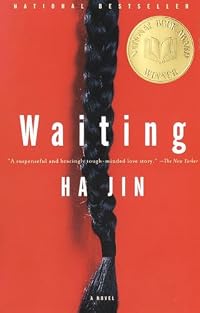
Ha Jin's [b:Waiting|235773|Waiting|Ha Jin|http://d.gr-assets.com/books/1327881519s/235773.jpg|985211] with its precise writing, its absence of adjectives and the cool, objective yet somehow deeply emotional stance was like no style I had ever read before. I am not a fan of the florid, whether paintings, poetry or books, yet minimalism of the written word always seems to me to me to be a self-conscious style, a deliberate attempt at being thought 'an artist'. [b:Waiting|235773|Waiting|Ha Jin|http://d.gr-assets.com/books/1327881519s/235773.jpg|985211] was just perfectly balanced and so I was looking forward to reading another Ha Jin.
It's quite different, much more mature writing, not quite so spare, a deeper exploration of the emotional show more life and an even more enjoyable read. On one level it was a really good family saga showing how Chinese immigrants take what they find useful from American life but, other than superficially, assimilate not at all. It's very insightful and as with all good sagas detailing the triumphs and disasters of the progress of a family through life, both interesting and involving.
And on another level, it is a man's search for meaning in his life. For the balance between necessary materialism and freedom from the baggage of goods, between status and the freedom to do what one's heart truly desires, and from the pressure of two communities, American and Chinese, that a man's measure of his worth is how he succeeds in the eyes of others and, again, for personal freedom.
On every level, this is a 5-star book. It would make a great film too. If a Hollywood movie, the sort that the main character could get an Oscar for, if a European movie, one where you would want to stand at the end and applaud the director. Highly recommended. show less
It's quite different, much more mature writing, not quite so spare, a deeper exploration of the emotional show more life and an even more enjoyable read. On one level it was a really good family saga showing how Chinese immigrants take what they find useful from American life but, other than superficially, assimilate not at all. It's very insightful and as with all good sagas detailing the triumphs and disasters of the progress of a family through life, both interesting and involving.
And on another level, it is a man's search for meaning in his life. For the balance between necessary materialism and freedom from the baggage of goods, between status and the freedom to do what one's heart truly desires, and from the pressure of two communities, American and Chinese, that a man's measure of his worth is how he succeeds in the eyes of others and, again, for personal freedom.
On every level, this is a 5-star book. It would make a great film too. If a Hollywood movie, the sort that the main character could get an Oscar for, if a European movie, one where you would want to stand at the end and applaud the director. Highly recommended. show less
Very low key but insightful into the life of an immigrant, A Free Life tells the story of Nan Wu, a Chinese man who aspires to be a poet and must remain in the United States because his native country labeled him a dissident. The story opens with Nan Wu and his wife Pingping bringing their then 3-year-old son Taotao from China to live with them. The story traces their years together, their disagreements, their joys, their aspirations, their disappointments, and their successes. It is multilayered and thought-provoking.
Be forewarned that this book is very long. I did appreciate its short chapters so that I didn't get weighed down by how long it was. At first, I was not happy with the three main characters, Nan, Pingping, and Taotao, but show more the parents grew on me as they learned to adapt to the American culture. Taotao was always a brat, and I never did like him.
The book ends in an unusual way...with a short journal and then with several poems. My favorite of those was "Groundhog Hour". I guess that was because it was about an animal. My favorite quote came from the poem entitled "Homeland". The lines read as follows:
“Eventually you will learn:
Your country is where you raise your children,
Your homeland is where you build your home.” show less
Be forewarned that this book is very long. I did appreciate its short chapters so that I didn't get weighed down by how long it was. At first, I was not happy with the three main characters, Nan, Pingping, and Taotao, but show more the parents grew on me as they learned to adapt to the American culture. Taotao was always a brat, and I never did like him.
The book ends in an unusual way...with a short journal and then with several poems. My favorite of those was "Groundhog Hour". I guess that was because it was about an animal. My favorite quote came from the poem entitled "Homeland". The lines read as follows:
“Eventually you will learn:
Your country is where you raise your children,
Your homeland is where you build your home.” show less
Ha Jin writes a novel with quiet beauty. His style isn’t flashy or romanticized, which supports his characters’ everyday struggles, but it is a deep prose that is astonishingly simple and elegant. Jin tells the story of immigration, art in a capitalist world, and love. While this novel may resonate deeply with either immigrants or the children of immigrants, it is a subtle and enduring book that may appeal to a much broader audience. Jin has received much critical acclaim for his writing but I agree with another reviewer that it could have been shorter. With each additional 50 pages another layer in his story develops, but it only provides a deeper understanding of the spirit of the novel. It’s nice to have that, but not entirely show more necessary. show less
Nan is a immigrant from China, arriving first to study in the United States and then remaining to eke out a modest life as the owner of a restaurant in Georgia. He yearns to be a poet, but when joined by his wife and child, must first concentrate on survival. He is lost, coping with a foreign language, a marriage that is unsatisfactory and a son who is Americanized. Ha Jin's writing throughout is mundane and prosaic -- an style which is ironic, intentionally I think, to use in telling the life story of a man who writes poetry. The story of the central character, Nan, is more than the typical story of the immigrant who struggles and finds the American dream of owning a home and business to be lacking. It is the story of the friction show more between material success and the life of the mind. show less
Members
- Recently Added By
Lists

AP Lit
363 works; 6 members
Author Information

33+ Works 10,437 Members
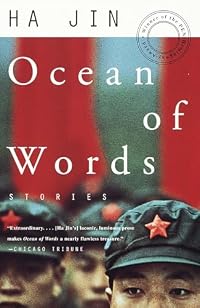
Ha Jin left his native China in 1985 and is now a professor of English at Emory University. He is author of, among other works, two short-story collections: Ocean of Words, which won the PEN/Hemingway Award, and Under the Red Flag, which won the Flannery O'Connor Award for short fiction. His novel Waiting won the National Book Award for fiction in show more 1999. He lives in Atlanta. (Bowker Author Biography) show less
Awards and Honors
Common Knowledge
- Canonical title
- A Free Life
- Original publication date
- 2007
- People/Characters
- Nan Wu; Pingping Wu; Taotao Wu
- Important places
- Boston, Massachusetts, USA; New York, New York, USA; Atlanta, Georgia, USA
- Dedication
- To Lisha and Wen, who lived this book
- First words
- Finally Taotao got his passport and visa.
- Quotations
- Eventually you will learn:
your country is where you raise your children,
your homeland is where you build your home. - Last words
- (Click to show. Warning: May contain spoilers.)He reminded himself that he mustn't nod off on his way home.
Classifications
Statistics
- Members
- 743
- Popularity
- 37,725
- Reviews
- 18
- Rating
- (3.69)
- Languages
- Chinese, English, German, Italian
- Media
- Paper, Audiobook, Ebook
- ISBNs
- 17
- UPCs
- 1
- ASINs
- 3