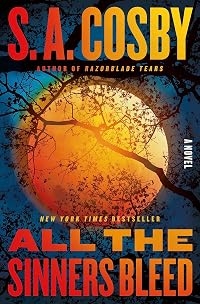
All the Sinners Bleed
by S. A. Cosby
On This Page
Description
"After years of working as an FBI agent, Titus Crown returns home to Charon County, land of moonshine and cornbread, fist fights and honeysuckle. Seeing his hometown struggling with a bigoted police force inspires him to run for sheriff. He wins, and becomes the first Black sheriff in the history of the county. Then a year to the day after his election, a young Black man is fatally shot by Titus's deputies. Titus pledges to follow the truth wherever it leads. But no one expected he would show more unearth a serial killer who has been hiding in plain sight, haunting the dirt lanes and woodland clearings of Charon. Now, Titus must pull off the impossible: stay true to his instincts, prevent outright panic, and investigate a shocking crime in a small town where everyone knows everyone yet secrets flourish. All while also breaking up backroads bar fights and being forced to protect racist Confederate pride marchers. For a Black man wearing a police uniform in the American South, that's no easy feat. But Charon is Titus's home and his heart, and he won't let the darkness overtake it. Even as it threatens to consume him."-- show lessTags
Recommendations




Member Reviews
Gut-punch Rural Noir
Review of the Flatiron Books advanced reading copy paperback (2023) of the Flatiron Books hardcover/eBook/audio original (expected publication June 6, 2023).
Crime writer S.A. 'Shawn' Cosby had a serious breakthrough with his 3rd novel Razorblade Tears (2021) jumping into 70K+ ratings on GR from the previous 31K+ ratings for his 2nd Blacktop Wasteland (2020) and 3K+ for his 1st My Darkest Prayer (2019). This 4th release is guaranteed to keep the momentum going for this writer who situates his plots in small town rural Virginia communities show more with elements of noir and hardboiled fiction with nods to many of the earlier great writers of the genre.
I managed to snag a rare paperback ARC of this upcoming release and found it to be even more of a compelling read than the earlier novels. Cosby is definitely crafting his books into compulsive reading territory and this novel is likely to give him yet another boost.
We are into raw gut-punch territory when the novel opens with a school shooting which is not all that it appears. Without getting spoilery, the shooting opens up an entirely different investigation of a possible team of serial killers who have been operating in the community for many years. Sheriff Titus Crowne is pulled in all directions while he investigates both the current case and the cold cases that it uncovers. He himself is recovering from a PTSD-inducing Waco-like incident which caused him to resign from the FBI and seek refuge in helping his home town. Despite his attempts to balance the conflicting forces of local rednecks marching to defend Confederate era statues and the opposition activism of the local Black community and churches, this is a powder-keg situation ready to explode, with the investigations only feeding the fire.
There is respite and periodic calm between the storms to be had in Crowne's home life, particularly through the relationship with his father and a somewhat estranged brother. Some romance conflicts also appear as he is distracted from his current girlfriend by the appearance of a past love who is a working reporter who suddenly appears on site to break the local news coverage onto the national scene.
I unreservedly recommend this upcoming book to previous S.A. Cosby fans and to new readers who are up for country noir with fast twists and turns!
Other Reviews, Trivia and Links
As I am writing this before the official release, there are no other reviews or interviews to link to yet. I would except an interview at the Poisoned Pen Bookstore YouTube channel as they have done Cosby interviews in the past, so look for that as the June 6, 2023 release date approaches. I will circle back with links when I can. show less
Review of the Flatiron Books advanced reading copy paperback (2023) of the Flatiron Books hardcover/eBook/audio original (expected publication June 6, 2023).
"Ain't that the scary part? Whoever did ... did this is someone you know. Someone I know. Someone we all know," Carla said.
"No," Titus said flatly. "It's someone we thought we knew."
Crime writer S.A. 'Shawn' Cosby had a serious breakthrough with his 3rd novel Razorblade Tears (2021) jumping into 70K+ ratings on GR from the previous 31K+ ratings for his 2nd Blacktop Wasteland (2020) and 3K+ for his 1st My Darkest Prayer (2019). This 4th release is guaranteed to keep the momentum going for this writer who situates his plots in small town rural Virginia communities show more with elements of noir and hardboiled fiction with nods to many of the earlier great writers of the genre.
I managed to snag a rare paperback ARC of this upcoming release and found it to be even more of a compelling read than the earlier novels. Cosby is definitely crafting his books into compulsive reading territory and this novel is likely to give him yet another boost.
We are into raw gut-punch territory when the novel opens with a school shooting which is not all that it appears. Without getting spoilery, the shooting opens up an entirely different investigation of a possible team of serial killers who have been operating in the community for many years. Sheriff Titus Crowne is pulled in all directions while he investigates both the current case and the cold cases that it uncovers. He himself is recovering from a PTSD-inducing Waco-like incident which caused him to resign from the FBI and seek refuge in helping his home town. Despite his attempts to balance the conflicting forces of local rednecks marching to defend Confederate era statues and the opposition activism of the local Black community and churches, this is a powder-keg situation ready to explode, with the investigations only feeding the fire.
There is respite and periodic calm between the storms to be had in Crowne's home life, particularly through the relationship with his father and a somewhat estranged brother. Some romance conflicts also appear as he is distracted from his current girlfriend by the appearance of a past love who is a working reporter who suddenly appears on site to break the local news coverage onto the national scene.
I unreservedly recommend this upcoming book to previous S.A. Cosby fans and to new readers who are up for country noir with fast twists and turns!
Other Reviews, Trivia and Links
As I am writing this before the official release, there are no other reviews or interviews to link to yet. I would except an interview at the Poisoned Pen Bookstore YouTube channel as they have done Cosby interviews in the past, so look for that as the June 6, 2023 release date approaches. I will circle back with links when I can. show less
While I think RAZORBLADE TEARS is a superior novel, I enjoyed ALL THE SINNERS BLEED (Macmillan, June 2023) more. I could easily see it becoming adapted into an Oscar-contender film or popular TV miniseries. Phenomenal pacing is Cosby’s forte, and he settles into a wonderful rhythm in this novel. The cringe-worthy violence is not just for shock value, but serves the plot and ratchets up the suspense. Or maybe I just like my main characters to be the good guys, plain and simple. Dare I hope for a series?
Titus Crown, the main character of ALL THE SINNERS BLEED, is a good and honorable man who can’t abide even his honest misjudgments leading to bad outcomes beyond his control. As a Black sheriff of rural Charon County on the Chesapeake show more Bay in Virginia, and a former FBI agent, Titus is caught at the crossroads of political turmoil while a pedophile mass murderer runs amok. He’s unpopular with the Black Lives Matter crowd who want the confederate statue removed and with the All Lives Matter crowd who want it to stay put. A brilliant perfectionist, Titus ran for office in order to change things for the better, but can anything in Charon County honestly change?
Threads that run through S.A. Cosby’s novels: racism; taking justice into your own hands; being “good enough” or “stable enough” for a wife and family or even just a relationship; loss of religious faith; and adults who let you down by checking out at key points in your young life due to addiction and/or imprisonment and/or death. He asks: how do you separate victimization and villainy when the two are often wrapped up in the same individual–and sometimes that individual is you?
ALL THE SINNERS BLEED reads more like a popular thriller than the two novels that preceded it. The humor is much lighter. - from my blog. Annotated for LibraryReads, June 2023 show less
Titus Crown, the main character of ALL THE SINNERS BLEED, is a good and honorable man who can’t abide even his honest misjudgments leading to bad outcomes beyond his control. As a Black sheriff of rural Charon County on the Chesapeake show more Bay in Virginia, and a former FBI agent, Titus is caught at the crossroads of political turmoil while a pedophile mass murderer runs amok. He’s unpopular with the Black Lives Matter crowd who want the confederate statue removed and with the All Lives Matter crowd who want it to stay put. A brilliant perfectionist, Titus ran for office in order to change things for the better, but can anything in Charon County honestly change?
Threads that run through S.A. Cosby’s novels: racism; taking justice into your own hands; being “good enough” or “stable enough” for a wife and family or even just a relationship; loss of religious faith; and adults who let you down by checking out at key points in your young life due to addiction and/or imprisonment and/or death. He asks: how do you separate victimization and villainy when the two are often wrapped up in the same individual–and sometimes that individual is you?
ALL THE SINNERS BLEED reads more like a popular thriller than the two novels that preceded it. The humor is much lighter. - from my blog. Annotated for LibraryReads, June 2023 show less
Here is a dark and gritty crime novel set in a rural county on the banks of the Chesapeake in Virginia. Titus was with the FBI, but had to leave that job. Returning home to care for his father, he becomes sheriff in a county where the law has previously been unequally applied. He's determined to change that, despite resistance from those who feel threatened by change. A school shooting leads to the gruesome discovery of murdered children buried in a field and Titus is in a race to stop the murderer before he kills again, while simultaneously keeping a lid on the simmering tensions and fears in the county that the murders have fueled.
Cosby is an author who does a lot more than just write an entertaining crime thriller. Here, he sheds show more light on how tradition and habit have imbedded racism into the fabric of a small town's culture and how hard the pushback is to any sort of move towards equality. His portrayal of the people of this small town is clear-eyed and sharp, without ever descending into stereo-type or caricature. Titus is perhaps a little too perfect and too often right, but he's a complex and interesting character. It feels like we may see more of him in future novels and I would be happy to see what he does next. The crimes at the center of this mystery are particularly grim and while the descriptions are not graphic, they were still hard to read. I read Cosby's first novel and it's clear he becomes better with every book he writes and that he still has a great deal to say. show less
Cosby is an author who does a lot more than just write an entertaining crime thriller. Here, he sheds show more light on how tradition and habit have imbedded racism into the fabric of a small town's culture and how hard the pushback is to any sort of move towards equality. His portrayal of the people of this small town is clear-eyed and sharp, without ever descending into stereo-type or caricature. Titus is perhaps a little too perfect and too often right, but he's a complex and interesting character. It feels like we may see more of him in future novels and I would be happy to see what he does next. The crimes at the center of this mystery are particularly grim and while the descriptions are not graphic, they were still hard to read. I read Cosby's first novel and it's clear he becomes better with every book he writes and that he still has a great deal to say. show less
The story seems to balance intense crime thriller elements with profound social commentary and character development. Titus Crown appears to be a thoughtful, determined protagonist navigating both the investigation and his complex position in the community.The novel deeply explores what it means to be a Black man in a position of authority in the American South. Sheriff Titus Crown's experience shows how the badge he wears doesn't shield him from racism—some locals still see him as "just a nigger with a badge" or worse. This tension highlights how authority and racial identity intersect, creating a constant struggle for respect and legitimacy.
Cosby presents the South as "Christ-haunted" but exposes the gap between proclaimed Christian show more values and actual behavior. The novel critiques how religion is weaponized to maintain social hierarchies while abandoning its core principles of compassion and justice. Titus's mother's perspective that "The Word is perfect, but the way men interpret it is corrupt" encapsulates this theme perfectly.
The investigation into Jeff Spearman's crimes reveals the limitations of the justice system, especially in rural communities with limited resources. Titus recognizes when he's "in over his head," showing that justice sometimes requires acknowledging one's limitations and seeking help—a form of moral courage rather than weakness.
The novel examines how violence, especially against children, creates rippling effects through communities. The focus on giving victims "their story" and "justice" speaks to the novel's concern with acknowledging trauma rather than burying it.
Titus Crown is a complex protagonist who navigates dual identities as both a Black man and a sheriff. His character embodies the tension between upholding the law and recognizing its flaws. His biblical knowledge, which surprises "self-righteous people," suggests his nuanced understanding of faith despite his complicated relationship with organized religion.
Titus's Mother, though apparently a secondary character, emerges as a moral compass who helps Titus navigate complex ethical terrain. Her pragmatic approach to faith and her willingness to challenge religious authorities who misuse scripture make her a compelling counterpoint to the religious hypocrisy the novel criticizes.
The Community of Charon County, the town itself functions almost as a character, with its Confederate sympathizers, "New Wave members," and complex history. The divided nature of the community creates the backdrop against which Titus must operate.
Jeff Spearman is a character who represents the novel's exploration of hidden monstrosity—someone who could be either "a beloved teacher" or "a monster," revealing how evil can hide behind respectable facades.
Cosby doesn't shy away from difficult subjects, using direct language to confront readers with harsh realities. The description of the images on Spearman's phone as "the worst he'd ever seen" creates immediate emotional impact without gratuitous detail. His literary style is visceral, with unflinching prose.
The novel is rich with biblical references and quotations, reflecting the religious context of the South while simultaneously critiquing how those texts are misused. This creates a layered commentary on faith and its role in community.
Noir-Inspired Elements
The comparison to Walter Mosley suggests Cosby works within the tradition of noir fiction, Noir-inspired elements, but transforms it through a contemporary lens focused on racial justice. The investigation structure provides tension while allowing for deeper social exploration.
Cosby appears to balance external conversation with Titus's internal reflections, creating both character development and plot momentum.
The novel ultimately succeeds in blending a compelling crime narrative with profound social commentary, making it representative of contemporary crime fiction that uses the genre to explore pressing social issues rather than simply entertain. I enjoyed the immersive reading of this novel narrated by Adam Lazarre-White, with a deep resonating voice that fully embodies the unique main characters. Cosby is a masterful wordsmith and I will revel in his catalog of works. show less
Cosby presents the South as "Christ-haunted" but exposes the gap between proclaimed Christian show more values and actual behavior. The novel critiques how religion is weaponized to maintain social hierarchies while abandoning its core principles of compassion and justice. Titus's mother's perspective that "The Word is perfect, but the way men interpret it is corrupt" encapsulates this theme perfectly.
The investigation into Jeff Spearman's crimes reveals the limitations of the justice system, especially in rural communities with limited resources. Titus recognizes when he's "in over his head," showing that justice sometimes requires acknowledging one's limitations and seeking help—a form of moral courage rather than weakness.
The novel examines how violence, especially against children, creates rippling effects through communities. The focus on giving victims "their story" and "justice" speaks to the novel's concern with acknowledging trauma rather than burying it.
Titus Crown is a complex protagonist who navigates dual identities as both a Black man and a sheriff. His character embodies the tension between upholding the law and recognizing its flaws. His biblical knowledge, which surprises "self-righteous people," suggests his nuanced understanding of faith despite his complicated relationship with organized religion.
Titus's Mother, though apparently a secondary character, emerges as a moral compass who helps Titus navigate complex ethical terrain. Her pragmatic approach to faith and her willingness to challenge religious authorities who misuse scripture make her a compelling counterpoint to the religious hypocrisy the novel criticizes.
The Community of Charon County, the town itself functions almost as a character, with its Confederate sympathizers, "New Wave members," and complex history. The divided nature of the community creates the backdrop against which Titus must operate.
Jeff Spearman is a character who represents the novel's exploration of hidden monstrosity—someone who could be either "a beloved teacher" or "a monster," revealing how evil can hide behind respectable facades.
Cosby doesn't shy away from difficult subjects, using direct language to confront readers with harsh realities. The description of the images on Spearman's phone as "the worst he'd ever seen" creates immediate emotional impact without gratuitous detail. His literary style is visceral, with unflinching prose.
The novel is rich with biblical references and quotations, reflecting the religious context of the South while simultaneously critiquing how those texts are misused. This creates a layered commentary on faith and its role in community.
Noir-Inspired Elements
The comparison to Walter Mosley suggests Cosby works within the tradition of noir fiction, Noir-inspired elements, but transforms it through a contemporary lens focused on racial justice. The investigation structure provides tension while allowing for deeper social exploration.
Cosby appears to balance external conversation with Titus's internal reflections, creating both character development and plot momentum.
The novel ultimately succeeds in blending a compelling crime narrative with profound social commentary, making it representative of contemporary crime fiction that uses the genre to explore pressing social issues rather than simply entertain. I enjoyed the immersive reading of this novel narrated by Adam Lazarre-White, with a deep resonating voice that fully embodies the unique main characters. Cosby is a masterful wordsmith and I will revel in his catalog of works. show less
SHERIFF TITUS CROWN
We're going to start with this character, instead of the plot. He makes or breaks your experience with this book more than anything else.
Titus Crown had a long career in the FBI until he retired and came home to take care of his father after a surgery. (or at least that's what he tells people). An opening in the office of Sheriff presented an opportunity, and Titus was talked into running by many in the community. He's now the first black Sheriff of Charon County, Virginia. It looks likely that he'll be the last one for a while, too.
Electing Titus hadn't initiated a golden era of racial reconciliation. True, minorities weren't routinely pulled over for little reason, aren't beaten, and so on—they're treated fairly show more under the law. As are white men. Because Titus knows he has to play it straight—if he acted the way some of his supporters wanted him to, he'd be no better than his predecessors—and there's no way the county government would let him stay in power. But mostly Titus treats everyone the same no matter their race or financial status because that's the way he's built. It's just not in him to do otherwise.
Sadly, for many of the people that voted for him, that means he's not the first black Sheriff anymore. He's blue.
He is smart, controlled, and driven. For him, these are both strengths and curses—his life would be easier if those qualities weren't so strong in him. Then again, he wouldn't have accomplished almost everything he has otherwise.
When he's not doing a thankless job that he wonders why he asked for, he's trying to keep his girlfriend. He knows he's not good at long-term relationships, but he keeps trying. He wants to be good at them—or at least better.
THE INSTIGATING INCIDENT
I feel okay talking about this because it's in the book description—I wouldn't have otherwise (and am very glad I can because I don't know how I'd have danced around it).
On the two-year anniversary of his taking office, Titus' relaxed morning is interrupted by reports of an active shooter at the high school. In the midst of the chaos he and his deputies encounter when they arrive on the scene, he learns that one teacher has been killed in a targeted attack. They have a brief conversation with the shooter before his deputies open fire and kill him.
Titus has to calm the public, investigate both the shooter and his deputies, and somehow explain to an old friend why his son is dead at the hands of his department. But first...
WHAT THE NOVEL IS REALLY ABOUT...
Until that morning, there'd been two murders in Charon County in the last fifteen years. Following up on something the shooter said, Titus and his deputies stumble onto something that makes the school shooting the least horrible thing imaginable. It turns out that there'd been more than two murders—several more. A serial killer has been active in Charon County for several years.
This is the kind of serial killer that will haunt the dreams of every officer involved in the investigation for the rest of their lives—and more than a few waking hours, as well. There's the sheer number of victims that happened in this supposedly quiet and peaceful community without anyone noticing. There's the brutality (a word that somehow feels inadequate) of what was done to the victims. And then they start to learn about the psychology of the killer—and what kind of life must've driven him to these killings.
Any of those are likely to leave some scars on Titus and his team—the combination is sure to. And when the killer changes up their modus operandi in reaction to people discovering what they've been up to and to discourage Titus? A new level of horror emerges.
SOME OF THE OTHER THINGS GOING ON
On top of all of this are:
* Too many things with Titus' father, brother, and religion to talk about.
* An ongoing investigation into a suspected drug distribution center.
* An internal investigation into a suspected dirty cop.
* Pressure from the County Government for Titus to clear all this up before tourist season is even more endangered than it is.
* Pressure from a group called "The Sons of the Confederacy" to make sure that someone from Titus' "cultural background" offers them adequate protection from protestors during the upcoming Fall Fest celebration/rally to protect a statue commemorating a Confederate officer.
* Titus' last girlfriend, a journalist turned True Crime podcaster who has come to town to report on the killer.
All in all, Titus has to wish that he'd never moved back home.
I'm pretty sure I left some stuff off that list—but this book never feels overstuffed.
SO, WHAT DID I THINK ABOUT ALL THE SINNERS BLEED?
It's this kind of book that makes me wish I was a real reviewer instead of a fanboy yelling by bookish yawp across the rooftops of the world. This begs for literary analysis. Sparse, but rich, prose that further disproves the notion that genre can't be the home of good writing. Cosby tackles hard issues—but really doesn't try to solve them—he merely puts them on display for readers to acknowledge and wrestle with.
It's also just a cracking thriller that could be read as shallowly as you want and would keep you white-knuckled and racing to the final confrontation. Tricksy writer that he is, Cosby's style makes that incredibly easy to do—but if you go that way, you miss the richness of this book.
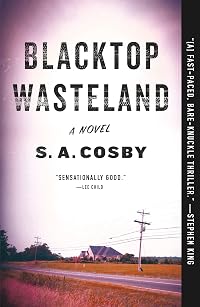
Cosby's Blacktop Wasteland blew me away as did this one. I wrote:
From the first paragraph that made me sit up and say "Oh, this explains the hype," to the devastating last line—and all points in between, Blacktop Wasteland is one of those books that a guy can't describe without seeming hyperbolic.
All the Sinners Bleed starts off more slowly (although the first few lines are dynamite), and it's last line hits far differently, but the quality in between is just the same. Cosby's going to knock you out every time you pick up one of his books, he's just going to come at you from a different direction than last time.
This is not the beginning of a series—but I wish it was. I'd love to spend years with (many of) these people. Instead, we get to join them for one intense period in their lives and in the dark history of their town. That's more than enough.*
* Also, more crimes like this in Charon County would be stretching credulity in a way that would be difficult to do with integrity.
Hopefully, I'm not over-hyping this book. My rating is one of the easiest 5 stars I've ever given. When I finished this book, I texted a friend that "Well, I really don't have to read anything else this year, right? What's going to match this?" Cosby's talked frequently about the impact that some of Dennis Lehane's early books made on him—there's at least one yet-to-be-published crime writer out there who will be talking about All the Sinners Bleed in the same way in the years to come. show less
We're going to start with this character, instead of the plot. He makes or breaks your experience with this book more than anything else.
Titus Crown had a long career in the FBI until he retired and came home to take care of his father after a surgery. (or at least that's what he tells people). An opening in the office of Sheriff presented an opportunity, and Titus was talked into running by many in the community. He's now the first black Sheriff of Charon County, Virginia. It looks likely that he'll be the last one for a while, too.
Electing Titus hadn't initiated a golden era of racial reconciliation. True, minorities weren't routinely pulled over for little reason, aren't beaten, and so on—they're treated fairly show more under the law. As are white men. Because Titus knows he has to play it straight—if he acted the way some of his supporters wanted him to, he'd be no better than his predecessors—and there's no way the county government would let him stay in power. But mostly Titus treats everyone the same no matter their race or financial status because that's the way he's built. It's just not in him to do otherwise.
Sadly, for many of the people that voted for him, that means he's not the first black Sheriff anymore. He's blue.
He is smart, controlled, and driven. For him, these are both strengths and curses—his life would be easier if those qualities weren't so strong in him. Then again, he wouldn't have accomplished almost everything he has otherwise.
When he's not doing a thankless job that he wonders why he asked for, he's trying to keep his girlfriend. He knows he's not good at long-term relationships, but he keeps trying. He wants to be good at them—or at least better.
THE INSTIGATING INCIDENT
I feel okay talking about this because it's in the book description—I wouldn't have otherwise (and am very glad I can because I don't know how I'd have danced around it).
On the two-year anniversary of his taking office, Titus' relaxed morning is interrupted by reports of an active shooter at the high school. In the midst of the chaos he and his deputies encounter when they arrive on the scene, he learns that one teacher has been killed in a targeted attack. They have a brief conversation with the shooter before his deputies open fire and kill him.
Titus has to calm the public, investigate both the shooter and his deputies, and somehow explain to an old friend why his son is dead at the hands of his department. But first...
WHAT THE NOVEL IS REALLY ABOUT...
Until that morning, there'd been two murders in Charon County in the last fifteen years. Following up on something the shooter said, Titus and his deputies stumble onto something that makes the school shooting the least horrible thing imaginable. It turns out that there'd been more than two murders—several more. A serial killer has been active in Charon County for several years.
This is the kind of serial killer that will haunt the dreams of every officer involved in the investigation for the rest of their lives—and more than a few waking hours, as well. There's the sheer number of victims that happened in this supposedly quiet and peaceful community without anyone noticing. There's the brutality (a word that somehow feels inadequate) of what was done to the victims. And then they start to learn about the psychology of the killer—and what kind of life must've driven him to these killings.
Any of those are likely to leave some scars on Titus and his team—the combination is sure to. And when the killer changes up their modus operandi in reaction to people discovering what they've been up to and to discourage Titus? A new level of horror emerges.
SOME OF THE OTHER THINGS GOING ON
On top of all of this are:
* Too many things with Titus' father, brother, and religion to talk about.
* An ongoing investigation into a suspected drug distribution center.
* An internal investigation into a suspected dirty cop.
* Pressure from the County Government for Titus to clear all this up before tourist season is even more endangered than it is.
* Pressure from a group called "The Sons of the Confederacy" to make sure that someone from Titus' "cultural background" offers them adequate protection from protestors during the upcoming Fall Fest celebration/rally to protect a statue commemorating a Confederate officer.
* Titus' last girlfriend, a journalist turned True Crime podcaster who has come to town to report on the killer.
All in all, Titus has to wish that he'd never moved back home.
I'm pretty sure I left some stuff off that list—but this book never feels overstuffed.
SO, WHAT DID I THINK ABOUT ALL THE SINNERS BLEED?
It's this kind of book that makes me wish I was a real reviewer instead of a fanboy yelling by bookish yawp across the rooftops of the world. This begs for literary analysis. Sparse, but rich, prose that further disproves the notion that genre can't be the home of good writing. Cosby tackles hard issues—but really doesn't try to solve them—he merely puts them on display for readers to acknowledge and wrestle with.
It's also just a cracking thriller that could be read as shallowly as you want and would keep you white-knuckled and racing to the final confrontation. Tricksy writer that he is, Cosby's style makes that incredibly easy to do—but if you go that way, you miss the richness of this book.
Cosby's Blacktop Wasteland blew me away as did this one. I wrote:
From the first paragraph that made me sit up and say "Oh, this explains the hype," to the devastating last line—and all points in between, Blacktop Wasteland is one of those books that a guy can't describe without seeming hyperbolic.
All the Sinners Bleed starts off more slowly (although the first few lines are dynamite), and it's last line hits far differently, but the quality in between is just the same. Cosby's going to knock you out every time you pick up one of his books, he's just going to come at you from a different direction than last time.
This is not the beginning of a series—but I wish it was. I'd love to spend years with (many of) these people. Instead, we get to join them for one intense period in their lives and in the dark history of their town. That's more than enough.*
* Also, more crimes like this in Charon County would be stretching credulity in a way that would be difficult to do with integrity.
Hopefully, I'm not over-hyping this book. My rating is one of the easiest 5 stars I've ever given. When I finished this book, I texted a friend that "Well, I really don't have to read anything else this year, right? What's going to match this?" Cosby's talked frequently about the impact that some of Dennis Lehane's early books made on him—there's at least one yet-to-be-published crime writer out there who will be talking about All the Sinners Bleed in the same way in the years to come. show less
Possible Triggers Child Murder, Racial Violence
It involves a "cat-and-mouse" game played out between a twisted white religious killer and the first black sheriff in this small Virginia community. Welcome to Charon County, Virginia... a small peninsula on the Chesapeake Bay with a cursed name and a blood-soaked history, where... (from the book) ... “equality’s surest foothold was found on the autopsy table.” . The place is no stranger to tragedy, and the latest one is something that is becoming all too familiar to us in America...a school shooting. It's awful enough by itself, but it's only the beginning of the new "hell" that's coming to descending on Charon. Both the shooter and the victim are connected to a string of show more unimaginable abuses that target black children. Also, there is a mysterious killer still at large, his gruesome crimes steeped in "Scripture and religious iconography". Titus Crown, the recently elected Sheriff, is organized, decisive, but a bit conflicted between justice and vengeance...but this is his case, and he will use his FBI training to create a profile of a murdering madman. As in any good story of this caliber, everyone is the enemy, and everyone is a suspect. Titus has his hands full. He's being hounded by bigots of all types: biased and prodigious police officers, both extreme, and casually racist locals, and bigoted white supremacists. Basically, Titus is the only three-dimensional character in the story as well as the only really likeable one. The story moves along rather quickly with each new clue and obstacle with graphic scenes and dozens of characters that are fitted into the mix beautifully by this author. I will warn that if religious bias is a big "NO NO" for you, you might want to skip this one because, what I would call "Institutional Christianity" takes a huge "kick in the teeth". Titus’ platitudes about how "broken" the world is.... although I have to say he's mostly right...might become tiring and frustrating, but nevertheless, you will likely cheer at his brutal come backs against those who push him past the point of patience. (From the book) ...“Evil is rarely complicated,” Titus explains. “It’s just f....Ing bold.” I read both of S.A. Cosby’s previous works, Blacktop Wasteland and Razorblade Tears, and would recommend them along with this one...but be prepared for not only brutality but honesty on a lot of controversial subjects. show less
It involves a "cat-and-mouse" game played out between a twisted white religious killer and the first black sheriff in this small Virginia community. Welcome to Charon County, Virginia... a small peninsula on the Chesapeake Bay with a cursed name and a blood-soaked history, where... (from the book) ... “equality’s surest foothold was found on the autopsy table.” . The place is no stranger to tragedy, and the latest one is something that is becoming all too familiar to us in America...a school shooting. It's awful enough by itself, but it's only the beginning of the new "hell" that's coming to descending on Charon. Both the shooter and the victim are connected to a string of show more unimaginable abuses that target black children. Also, there is a mysterious killer still at large, his gruesome crimes steeped in "Scripture and religious iconography". Titus Crown, the recently elected Sheriff, is organized, decisive, but a bit conflicted between justice and vengeance...but this is his case, and he will use his FBI training to create a profile of a murdering madman. As in any good story of this caliber, everyone is the enemy, and everyone is a suspect. Titus has his hands full. He's being hounded by bigots of all types: biased and prodigious police officers, both extreme, and casually racist locals, and bigoted white supremacists. Basically, Titus is the only three-dimensional character in the story as well as the only really likeable one. The story moves along rather quickly with each new clue and obstacle with graphic scenes and dozens of characters that are fitted into the mix beautifully by this author. I will warn that if religious bias is a big "NO NO" for you, you might want to skip this one because, what I would call "Institutional Christianity" takes a huge "kick in the teeth". Titus’ platitudes about how "broken" the world is.... although I have to say he's mostly right...might become tiring and frustrating, but nevertheless, you will likely cheer at his brutal come backs against those who push him past the point of patience. (From the book) ...“Evil is rarely complicated,” Titus explains. “It’s just f....Ing bold.” I read both of S.A. Cosby’s previous works, Blacktop Wasteland and Razorblade Tears, and would recommend them along with this one...but be prepared for not only brutality but honesty on a lot of controversial subjects. show less
It's a toss up as to which novel I'm going to think is the best I read this year. It's either Dennis Lehane's Small Mercies, or it's this one. Both deal with racial issues, though fifty years apart. Both deal with a death that opens up a bigger mystery. Both are incredible reads, and both are very different from each other.
It's perhaps a strange observation, but with Cosby's latest novel—despite the fact that it does not take place on water, nor is there a single aquatic life form to be found—I got a bit of a Jaws vibe from this, when it comes to plot.
- A death happens. The local sheriff investigates, uncovers a larger menace that he mostly keeps under wraps.
- The larger menace keeps coming, and keeps killing.
- The sheriff is show more pressured to keep an annual event happening to get the tourist dollars.
- Of course, this goes awry.
No, it's not exact, but it was a vibe that I got, and thought it worth mentioning.
Aside from that, Cosby, who isn't just blossoming as one of our best authors, but exploding, handles a relatively simple plotline, but imbues it with a cast of well-drawn, complex characters, a town with a richly unsavoury history, layers in racial issues, and does it all effortlessly and with style.
There's the type of writer who can crank out a mystery novel every year, and it's a basic whodunnit, and then there's a few—Dennis Lehane, Joe R. Lansdale, John Hart, David Joy, and probably a couple more that aren't coming readily to mind at the moment—who give the reader such an incredible, immersive reading experience that it goes beyond the written word and drops the reader into a fully-realized world. Cosby is one of those writers now. His first novel was not bad. His second was good. But these last two? Brilliant.
There's books that pull me through because I enjoy the writing style. There's others that pull me through because I enjoy one or more of the characters. There's others that grab me with story. There's a rare few that bring the wonder.
And then there's books like this one, where everything clicks, and I am consumed by the novel. All I want to do is read it, and when I'm not reading it, I'm thinking about it. This is only the second novel this year where that happened.
S.A. Cosby deserves all the accolades. He's one to watch. show less
It's perhaps a strange observation, but with Cosby's latest novel—despite the fact that it does not take place on water, nor is there a single aquatic life form to be found—I got a bit of a Jaws vibe from this, when it comes to plot.
- A death happens. The local sheriff investigates, uncovers a larger menace that he mostly keeps under wraps.
- The larger menace keeps coming, and keeps killing.
- The sheriff is show more pressured to keep an annual event happening to get the tourist dollars.
- Of course, this goes awry.
No, it's not exact, but it was a vibe that I got, and thought it worth mentioning.
Aside from that, Cosby, who isn't just blossoming as one of our best authors, but exploding, handles a relatively simple plotline, but imbues it with a cast of well-drawn, complex characters, a town with a richly unsavoury history, layers in racial issues, and does it all effortlessly and with style.
There's the type of writer who can crank out a mystery novel every year, and it's a basic whodunnit, and then there's a few—Dennis Lehane, Joe R. Lansdale, John Hart, David Joy, and probably a couple more that aren't coming readily to mind at the moment—who give the reader such an incredible, immersive reading experience that it goes beyond the written word and drops the reader into a fully-realized world. Cosby is one of those writers now. His first novel was not bad. His second was good. But these last two? Brilliant.
There's books that pull me through because I enjoy the writing style. There's others that pull me through because I enjoy one or more of the characters. There's others that grab me with story. There's a rare few that bring the wonder.
And then there's books like this one, where everything clicks, and I am consumed by the novel. All I want to do is read it, and when I'm not reading it, I'm thinking about it. This is only the second novel this year where that happened.
S.A. Cosby deserves all the accolades. He's one to watch. show less
Members
- Recently Added By
Lists

READ in 2023
244 works; 1 member

Books Set in Virginia
5 works; 3 members

Everand 2023
53 works; 1 member

Books recommended by Barack Obama
295 works; 28 members

Books Read in 2024
4,727 works; 128 members

Barack Obama's Summer Reading List 2023
9 works; 1 member

ScaredyKIT 2024
13 works; 1 member

Southern Fiction
212 works; 52 members

Fiction Published in 2023
17 works; 2 members
Books Set in Small Towns and Villages
278 works; 16 members

Serial Killer Thrillers
56 works; 6 members

Black Authors
384 works; 32 members

Books We Couldn't Put Down
443 works; 197 members

Obama Reads
181 works; 3 members
Author Information

13+ Works 6,995 Members
Some Editions
Awards and Honors
Awards
Distinctions
Common Knowledge
- Canonical title
- All the Sinners Bleed
- Original title
- All the Sinners Bleed
- Original publication date
- 2023-06
- People/Characters
- Titus Crown
- Important places
- Charon County, Virginia, USA
- Epigraph
- The belief in the supernatural source of evil is not necessary: men alone are quite capable of every wickedness. --Joseph Conrad
Behold, I make all things new. --Revelations 21:5 - Dedication
- To my brother, Darrell Cosby. What we know only we could ever know.
- First words
- Charon County was founded in bloodshed and darkness.
- Last words
- (Click to show. Warning: May contain spoilers.)He laughed all the way to the county line.
- Original language
- English
- Canonical DDC/MDS
- 813.6
- Canonical LCC
- PS3603.O7988
Classifications
Statistics
- Members
- 1,521
- Popularity
- 15,199
- Reviews
- 64
- Rating
- (4.10)
- Languages
- 7 — Dutch, English, French, German, Hungarian, Italian, Swedish
- Media
- Paper, Audiobook, Ebook
- ISBNs
- 22
- ASINs
- 8