The Homesteader
by Oscar Micheaux
On This Page
Description
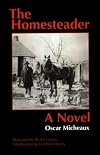
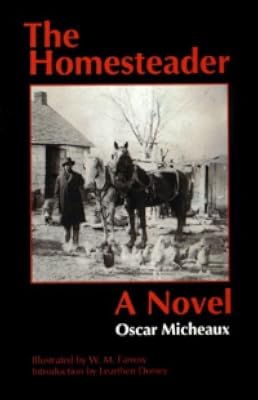
Oscar Micheaux is legendary as one of the first black filmmakers. Never afraid of taking risks, he founded his own company, writing, producing, and directing thirty-some silents and talkies from 1919 to 1948. Earlier, he had published a series of remarkable novels—in 1917 the Homesteader, which would be filmed twice. Autobiographical, The Homesteader expands on and continues the life of a black pioneer first described in The Conquest (also a Bison Book). In this incarnation, Jean Baptiste show more is his name. He has just purchased land in South Dakota when he meets his "dream girl," but to his mind marriage is impossible because she is white. Willful but warm-hearted, refusing to act as if he has no power to shape events, Baptiste cultivates his land and plans his future. In the face of drought, pestilence, and foreclosure, he turns to writing. His first marriage to the daughter of a Chicago minister collapses in acrimony and high drama. The circumstances that lead to its failure are a telling social commentary. Always learning, Baptiste demands respect and embodies the strengths of the pioneer, the vision of the empire builder. His story will impress and inspire in this cynical age without heroic models. The Homesteader appears for the first time in paperback with an introduction by Learthen Dorsey, a professor of history at the University of Nebraska-Lincoln. show lessTags
Recommendations

















Member Reviews
It seems that my spouse and I have a video collection of 100 "classic" mysteries. There's some hyperbole in there, not all are classic. But they're all good-old black and white films from the 30s and 40s (some 50s). One we watched recently was Ten Minutes to Live, which came out in 1932, and featured an all African American cast. It turns out to have been written, directed, and produced by an African American, Oscar Micheaux. The movie was a bit difficult to follow in parts, perhaps due to the poor quality of the digitization and sound. So, I tried to look up the story on which it was based to get a better handle on the plot.
I didn't find the story, but I did find out that Oscar Micheaux started out his adult life homesteading on the show more prairies, moved on to writing novels, from there to film, and finally back to novels in his later years. Well, I like stories of life on the prairies some century or so ago. After all, that was the life my grandmother experienced as a young girl, first in South Dakota and later in Kansas. Anyway, I found The Homesteader: a Novel on Gutenberg and read it forthwith. The book would also fit in with my off-and-on-again forays into trying to understand race relations. The protagonist is, after all, an African American, or as he had it in the book itself, of Ethiopian extraction.
I adored this book. It's an old fashioned romance/melodrama, but actually quite well done, a compelling read. Some of the writing is rather poetic and beautiful. Occasionally a phrase or word choice comes up which seems awkward to me, but then I think Micheaux was mostly self taught. Plus, I'm not a writer by any means, so how can I be so caddish as to criticize the writing of someone who made his living writing?
Whatever, overall the plot line is gripping. It's been quite some time since I found a book so compelling that I was hard pressed to put it down for more mundane domestic duties like child care, dog walking, and cooking. Probably one reason the book was so interesting was that it was semi-autobiographical. Thus Micheaux was writing from experience, which in turn, gives a better sense of reality to the action than one gets from made-up books. show less
I didn't find the story, but I did find out that Oscar Micheaux started out his adult life homesteading on the show more prairies, moved on to writing novels, from there to film, and finally back to novels in his later years. Well, I like stories of life on the prairies some century or so ago. After all, that was the life my grandmother experienced as a young girl, first in South Dakota and later in Kansas. Anyway, I found The Homesteader: a Novel on Gutenberg and read it forthwith. The book would also fit in with my off-and-on-again forays into trying to understand race relations. The protagonist is, after all, an African American, or as he had it in the book itself, of Ethiopian extraction.
I adored this book. It's an old fashioned romance/melodrama, but actually quite well done, a compelling read. Some of the writing is rather poetic and beautiful. Occasionally a phrase or word choice comes up which seems awkward to me, but then I think Micheaux was mostly self taught. Plus, I'm not a writer by any means, so how can I be so caddish as to criticize the writing of someone who made his living writing?
Whatever, overall the plot line is gripping. It's been quite some time since I found a book so compelling that I was hard pressed to put it down for more mundane domestic duties like child care, dog walking, and cooking. Probably one reason the book was so interesting was that it was semi-autobiographical. Thus Micheaux was writing from experience, which in turn, gives a better sense of reality to the action than one gets from made-up books. show less
Story of noble man who loves a white woman but won't marry her and instead marries a Negress who is weak and indecisive and not made for the life of a farm wife. Many trials stand between the hero and his wife culminating in her death. At his trial, his first love aids him and he is found not guilty. She discovers she is not white but a mulatto and they are free to marry after all.
The life of black pioneer Jean Baptiste homesteading in South Dakota.
Ratings
Members
- Recently Added By
Lists

First published in 1917
132 works; 3 members
Author Information

14+ Works 124 Members
Oscar Micheaux is the most prolific African American filmmaker---and perhaps independent filmmaker---in the history of American cinema. He wrote, produced, and directed nearly 40 features between 1919 and 1948, although few of them have survived. Most of his movies, like those of other early African American filmmakers, were independently made show more "race films," which featured African American actors in major roles, unlike the all-white-produced studio films of the time, which employed white actors in blackface, as in D. W. Griffith's "The Birth of a Nation." The racism of this film, in particular, prompted the formation of many all-black companies, including the Lincoln Film Company of Nebraska, which first sparked Micheaux's interest in the cinema. Micheaux worked shining shoes, doing farm labor, and as a porter until 1904, when he purchased a homestead in South Dakota. By 1913, he owned 500 acres and had published the first of 10 semiautobiographical novels, "The Conquest: The Story of a Negro Pioneer" (1913), which he sold successfully door-to-door. In 1918, the Lincoln Film Company approached him about filming "The Homesteader" (1917). When the company refused to produce the film on the scale he wanted, Micheaux decided to do it himself. He founded his own production company and shot the movie in an abandoned studio in Chicago, where it opened in 1919, inaugurating a decade of successful filmmaking for Micheaux. Much of this success can be credited to the promotional strategies he developed while selling his novels. Micheaux toured theaters in African American neighborhoods, soliciting advances from owners and securing screening dates, circumventing the cash flow and distribution problems that other African American companies encountered. He employed relatively cheap, nonprofessional actors and billed actors as black counterparts to white stars. Micheaux was virtually the only African American filmmaker to survive the 1930's and the Depression, the skyrocketing of production costs with the advent of sound, and the entry of Hollywood into the "race" market with all-black musicals produced, directed, and written by whites. Micheaux's films have been controversial from the beginning. Because his budgets were always minimal, the movies have poor production values: poor acting, cheap sets, poor lighting, and amateurish editing, with frequent violations of continuity---coherent spatial and temporal relations from shot to shot. Some film theorists have come to see these "flaws" as virtues, the elements of a perhaps self-conscious aesthetic critical of the Hollywood paradigm. They argue that classic realism and continuity may be complicit with oppressive ideologies in a way that more stylized genres like melodrama are not. Such forms can provoke thought by distancing the viewer from the characters and actions instead of soliciting identification and overinvolvement, as realism does; "poor" production values, like avant-garde techniques, can also have this effect. At least as controversial as his aesthetics is Micheaux's version of "racial uplift." His audiences were frequently ambivalent about the bourgeois ideology of the self-made man that Micheaux seemed to represent in his films, in which only light-skinned blacks succeeded, often by passing as whites. His characters seemed to live in a separate but equal world, as if black poverty and white racism did not exist. Micheaux argued that his films represented a range of images of African American life, rather than reproducing white stereotypes or limiting black actors to roles as servants. In 1948, after a 10-year absence from the industry, Micheaux staged a disastrous comeback with "The Betrayal," which was extensively and negatively reviewed in both the black and white press. Its failure ended his career. He died three years later while on a promotional tour for one of his books. (Bowker Author Biography) show less
Common Knowledge
- Canonical title
- The Homesteader
- Original publication date
- 1917
Classifications
Statistics
- Members
- 39
- Popularity
- 747,373
- Reviews
- 3
- Rating
- (3.33)
- Languages
- English
- Media
- Paper, Audiobook, Ebook
- ISBNs
- 9
- ASINs
- 7