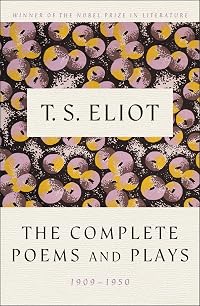
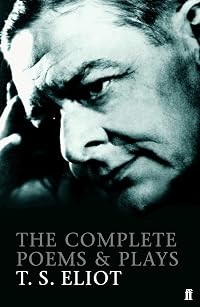
Complete Poems and Plays,: 1909-1950
by T. S. Eliot
On This Page
Description
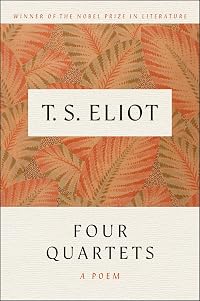
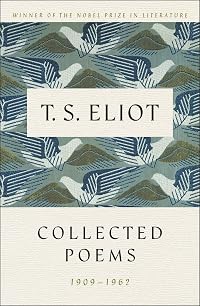
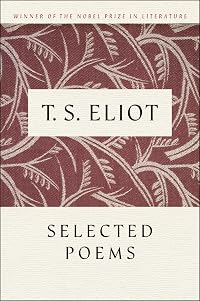
The most discussed poet of our time, T. S. Eliot is perhaps also the most important figure in the modern poetic tradition. "In ten years' time," wrote Edmund Wilson in Axel's Castle, "Eliot has left upon English poetry a mark more unmistakable than that of any other poet writing in English." In 1948 Mr. Eliot was awarded the Nobel Prize "for his work as a trail-blazing pioneer of modern poetry." This book is made up of six individual titles: Four Quartets, Collected Poems: 1909-1935, Murder show more in the Cathedral, The Famiyl Reunion, Old Possum's Book of Practical Cats, and The Cocktail Party. For enjoyment of one of the great poetic talents in contemporary literature and for a deeper understanding of such classics as "The Waste Land," "The Hollow Men," "Ash Wednesday," "Prufrock," "Murder in the Cathedral," and "The Cocktail Party," The Complete Poems and Plays of T. S. Eliot is indispensable. show lessTags
Recommendations





Member Reviews
“I will show you fear in a handful of dust,” T.S. Eliot proclaims in his most quotable poem The Waste Lands. Each line groans under the sheer weight of mortality, despair in the face of the inevitable. But rather than propagate that despair, Eliot’s beauty is in his ability to spawn introspection with the dark plight of the subjects in his poems, to evoke abandon as a counter the inescapable.
As a complete volume, Eliot’s most famous are collected - The Waste Lands and The Love Sond of J. Alfred Prufrock - along with some of his lesser known works. Among those lesser known are Four Quartets, free form tone poems that are equally as evocative as anything he ever wrote.
From Burnt Norton:
“Time present and time past
Are both show more perhaps present in time future,
And time future contained in time past.
If all time is eternally present
All time is unredeemable.”
A look at almost any literary journal or publication will provide evidence that Eliot was perhaps the most influential modernist poet, establishing a voice that has survived through multiple generations and still inspires replication. Few poets, or writers of any kind, can create the same sense of urgency in life with their work. Reading Eliot is like glimpsing fate in a mirror’s darkened reflection; it demands attention and quickens the heart to action.
Also collected in the volume is Eliot’s Old Possum’s Book of Practical Cats. Adapted after his death into the Broadway mega-hit Cats, the original work has been all but lost in the bright lights. The fourteen short poems, each deconstructing a different feline personality, are wonders of word play. Short of some of the master fantasy writers, Eliot is unrivaled in his ability to create words and phrases to capture feeling. And the lyrical, whimsical cheekiness of the works display a far different aspect of the writer’s personality; the light to the darker work.
Though Eliot’s plays are also collected here, I read the volume for the poetry only, leaving the plays for a different time. The poetry alone is a lifetime study.
Bottom Line: A complete collection of Eliot’s poetry, the famous and not-so-famous; all provocative and surprising with each reading.
5 bones!!!!! show less
As a complete volume, Eliot’s most famous are collected - The Waste Lands and The Love Sond of J. Alfred Prufrock - along with some of his lesser known works. Among those lesser known are Four Quartets, free form tone poems that are equally as evocative as anything he ever wrote.
From Burnt Norton:
“Time present and time past
Are both show more perhaps present in time future,
And time future contained in time past.
If all time is eternally present
All time is unredeemable.”
A look at almost any literary journal or publication will provide evidence that Eliot was perhaps the most influential modernist poet, establishing a voice that has survived through multiple generations and still inspires replication. Few poets, or writers of any kind, can create the same sense of urgency in life with their work. Reading Eliot is like glimpsing fate in a mirror’s darkened reflection; it demands attention and quickens the heart to action.
Also collected in the volume is Eliot’s Old Possum’s Book of Practical Cats. Adapted after his death into the Broadway mega-hit Cats, the original work has been all but lost in the bright lights. The fourteen short poems, each deconstructing a different feline personality, are wonders of word play. Short of some of the master fantasy writers, Eliot is unrivaled in his ability to create words and phrases to capture feeling. And the lyrical, whimsical cheekiness of the works display a far different aspect of the writer’s personality; the light to the darker work.
Though Eliot’s plays are also collected here, I read the volume for the poetry only, leaving the plays for a different time. The poetry alone is a lifetime study.
Bottom Line: A complete collection of Eliot’s poetry, the famous and not-so-famous; all provocative and surprising with each reading.
5 bones!!!!! show less
The scholars of THE NORTON ANTHOLOGY OF ENGLISH LITERATURE judge that T.S. Eliot's "interest in the great middle ground of human experience (as distinct from the extremes of saint and sinner) [was] deficient," while also recognizing Eliot's "poetic cunning, his fine craftsmanship, his original accent, his historical and representative importance as THE poet of the modern Symbolist-Metaphysical tradition".
T.S. Eliot's conversion from Unitarianism to high-church, Catholic Anglicanism discomfited many of the secular literati. Although Eliot expresses a Christian sentiment in much of his writings and rightfully casts fascist totalitarianism as antithetic to the spirit of Christianity, Eliot's work is marred by a few unmistakable, show more anti-Semitic statements, displaying the effects of the spiritual darkness of the pre-WWII period leading up to Hitler's attempted, global eradication of the Jewish people.
Despite Eliot's apparent antisemitism, Paul Dean concludes that "however much Eliot may have been compromised as a person, as we all are in our several ways, his greatness as a poet remains." show less
T.S. Eliot's conversion from Unitarianism to high-church, Catholic Anglicanism discomfited many of the secular literati. Although Eliot expresses a Christian sentiment in much of his writings and rightfully casts fascist totalitarianism as antithetic to the spirit of Christianity, Eliot's work is marred by a few unmistakable, show more anti-Semitic statements, displaying the effects of the spiritual darkness of the pre-WWII period leading up to Hitler's attempted, global eradication of the Jewish people.
Despite Eliot's apparent antisemitism, Paul Dean concludes that "however much Eliot may have been compromised as a person, as we all are in our several ways, his greatness as a poet remains." show less
Yes, it was fun to run across many of those oft-quoted pieces in context. However, a good share of this went over my head and I was content with letting it be obscure or unclear rather than searching out scholarly assistance. There is something a tad preachy about Eliot that tends put me off. That said, I highlighted some truly beautiful (to me) gems:
There is certainly no purpose in remaining in the dark except long enough to clear from the mind the illusion of having ever been in the light. - From The Cocktail Party
The only wisdom we can hope to acquire is the wisdom of humility; humility is endless. - From East Coker
I only just begin to apprehend the truth about things too late to mend; and that is to be old. Nevertheless, I am glad show more if I can come to know them. - From The Family Reunion
I get that... show less
There is certainly no purpose in remaining in the dark except long enough to clear from the mind the illusion of having ever been in the light. - From The Cocktail Party
The only wisdom we can hope to acquire is the wisdom of humility; humility is endless. - From East Coker
I only just begin to apprehend the truth about things too late to mend; and that is to be old. Nevertheless, I am glad show more if I can come to know them. - From The Family Reunion
I get that... show less
Rated: B+
The New Lifetime Reading Plan: Number 116
I love T. S. Elliot. You have to understand British culture and London life of the 1900's to appreciate some of his works. But his words, his twist of a phrase are memorable.
I re-read this book almost 24 years after my first reading. All the old favorites still rang true but I enjoy his plays more this time. His classic poems (Prufrock, The Wasteland, The Hollow Men) have great lines and imagery. I was drawn to "Choruses from 'The Rock'" now more than before.
Perhaps his most fun work, made famous by Andrew Lloyd Webber, are his collection of poems "Old Possum's Book fo Practical Cats" on which the musical "Cats" was based.
The New Lifetime Reading Plan: Number 116
I love T. S. Elliot. You have to understand British culture and London life of the 1900's to appreciate some of his works. But his words, his twist of a phrase are memorable.
I re-read this book almost 24 years after my first reading. All the old favorites still rang true but I enjoy his plays more this time. His classic poems (Prufrock, The Wasteland, The Hollow Men) have great lines and imagery. I was drawn to "Choruses from 'The Rock'" now more than before.
Perhaps his most fun work, made famous by Andrew Lloyd Webber, are his collection of poems "Old Possum's Book fo Practical Cats" on which the musical "Cats" was based.
Superlative. It's easy to forget today that Eliot's poetry was innovative in both technique and subject matter when originally written. I can do no better than to quote "Tradition and the Individual Talent", an essay from the poet himself: "What happens when a new work of art is created is something that happens simultaneously to all the works of art that preceded it." Such is the relationship of Eliot's poetry to the canon.
3.5 stars. Yes, there are some brilliant works in this book, but there's also legit doggerrel. I was surprised by that.
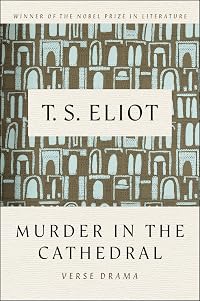
I'm afraid for me Eliot's greatest works are Murder in the Cathedral and Old Possum's Book of Practical Cats. The Wasteland leaves me cold; I respect Four Quartets
Members
- Recently Added By
Lists

20th Century Literature
1,161 works; 55 members

American Lit for Eng 11 Research Project
368 works; 6 members
Harold Bloom - The Western Canon: D. The Chaotic Age
833 works; 24 members

Modernism
140 works; 8 members

Tom's Bookstore
346 works; 2 members
Author Information

504+ Works 47,925 Members
T. S. Eliot is considered by many to be a literary genius and one of the most influential men of letters during the half-century after World War I. He was born on September 26, 1888, in St. Louis, Missouri. Eliot attended Harvard University, with time abroad pursuing graduate studies at the Sorbonne, Marburg, and Oxford. The outbreak of World War show more I prevented his return to the United States, and, persuaded by Ezra Pound to remain in England, he decided to settle there permanently. He published his influential early criticism, much of it written as occasional pieces for literary periodicals. He developed such doctrines as the "dissociation of sensibility" and the "objective correlative" and elaborated his views on wit and on the relation of tradition to the individual talent. Eliot by this time had left his early, derivative verse far behind and had begun to publish avant-garde poetry (including "The Love Song of J. Alfred Prufrock" (1915), which exploited fresh rhythms, abrupt juxtapositions, contemporary subject matter, and witty allusion. This period of creativity also resulted in another collection of verse (including "Gerontian") and culminated in The Waste Land, a masterpiece published in 1922 and produced partly during a period of psychological breakdown while married to his wife, Vivienne Haigh-Wood Eliot. In 1922, Eliot became a director of the Faber & Faber publishing house, and in 1927 he became a British citizen and joined the Church of England. Thereafter, his career underwent a change. With the publication of Ash Wednesday in 1930, his poetry became more overtly Christian. As editor of the influential literary magazine The Criterion, he turned his hand to social as well as literary criticism, with an increasingly conservative orientation. His religious poetry culminated in Four Quartets, published individually from 1936 onward and collectively in 1943. This work is often considered to be his greatest poetic achievement. Eliot also wrote poetry in a much lighter vein, such as Old Possum's Book of Practical Cats (1939), a collection that was used during the early 1980s as the basis for the musical, Cats. In addition to his contributions in poetry and criticism, Eliot is the pivotal verse dramatist of this century. He followed the lead of William Butler Yeats in attempting to revive metrical language in the theater. But, unlike Yeats, Eliot wanted a dramatic verse that would be self-effacing, capable of expressing the most prosaic passages in a play, and an insistent, undetected presence capable of elevating itself at a moment's notice. His progression from the pageant The Rock (1934) and Murder in the Cathedral (1935), written for the Canterbury Festival, through The Family Reunion (1939) and The Cocktail Party (1949), a West End hit, was thus a matter of neutralizing obvious poetic effects and bringing prose passages into the flow of verse. Recent critics have seen Eliot as a divided figure, covertly attracted to the very elements (romanticism, personality, heresy) he overtly condemned. His early attacks on romantic poets, for example, often reveal him as a romantic against the grain. The same divisions carry over into his verse, where violence struggles against restraint, emotion against order, and imagination against ironic detachment. This Eliot is more human and more attractive to contemporary taste. During his lifetime, Eliot received many honors and awards, including the Nobel Prize for literature in 1948. (Bowker Author Biography) show less
Common Knowledge
- Disambiguation notice
- Contains no works later than 1950. Please do not combine with editions containing later material.
Classifications
Statistics
- Members
- 1,908
- Popularity
- 11,205
- Reviews
- 13
- Rating
- (4.37)
- Languages
- English
- Media
- Paper, Ebook
- ISBNs
- 4
- ASINs
- 24