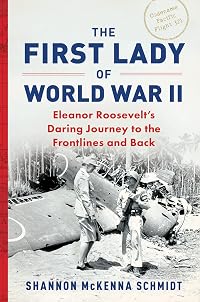
The First Lady of World War II: Eleanor Roosevelt's Daring Journey to the Frontlines and Back
by Shannon McKenna Schmidt
On This Page
Description
"On August 27, 1943, news broke in the United States that First Lady Eleanor Roosevelt was on the other side of the world. A closely guarded secret, she had left San Francisco aboard a military transport plane headed for the South Pacific to support and report the troops on WW2's front lines. Meanwhile, for those ten days, Americans had believed she was secluded at home. As Allied forces battled the Japanese for control of the region, Eleanor was THERE, spending five weeks traveling to show more islands in the area, as well as Hawaii, New Zealand, and Australia, on a mission as First Lady of the United States to experience what our servicemen were experiencing... and report back home"-- show lessTags
Recommendations
















Member Reviews
WW2, historical-figures, historical-places-events, historical-research, historical-setting, history, history-and-culture, famous-persons, Pacific-theater-of-operations, 1943*****
When I was a teenager I wanted to learn how to knit sox because the woman who embodied the United Nations to me and others was often pictured knitting sox while waiting for whatever came next.
This book does justice to that woman and how she faced down the malignant racism and misogyny in the militaries of more than just the USA as well as the foolish back home. But not those who cared about the men in their command, like Adm. Halsey and others. Or the men she spoke with under rigorous conditions of war in the tropics.
The author has taken a massive amount of show more research materials and formed all that into a very readable accounting of Eleanor's time in the Pacific in 1943 as she herself reported it to the general public via radio and newspapers as well as the reports that she sent back to the President.
I was disappointed that the e-book did not have the photos that were credited at the end.
I requested and received an EARC from Sourcebooks via NetGalley. Thank you! show less
When I was a teenager I wanted to learn how to knit sox because the woman who embodied the United Nations to me and others was often pictured knitting sox while waiting for whatever came next.
This book does justice to that woman and how she faced down the malignant racism and misogyny in the militaries of more than just the USA as well as the foolish back home. But not those who cared about the men in their command, like Adm. Halsey and others. Or the men she spoke with under rigorous conditions of war in the tropics.
The author has taken a massive amount of show more research materials and formed all that into a very readable accounting of Eleanor's time in the Pacific in 1943 as she herself reported it to the general public via radio and newspapers as well as the reports that she sent back to the President.
I was disappointed that the e-book did not have the photos that were credited at the end.
I requested and received an EARC from Sourcebooks via NetGalley. Thank you! show less
This new book about Eleanor Roosevelt's personal involvement WWII reads like the most entertaining historical fiction but is a nonfiction biography. Author Shannon McKenna Schmidt did her research. The book comes to life through the primary sources she dug up and weaves throughout the text. The First Lady of World War II is an engaging and inspiring book about a little-known piece of American history.
Shannon McKenna Smith, in her extraordinary work of non-fiction, "The First Lady of World War II," reveals that in 1943, Eleanor Roosevelt—who at the time was America's First Lady—traveled approximately twenty-five thousand miles to Hawaii, Australia, New Zealand, and various islands in the South Pacific. She did so with little fanfare, and when word of her activities reached the public, she was praised by some but derided by others who disapproved of her mission. Many wondered why she refused to stay in the White House instead of flying to remote battlefields.
In this meticulously researched book, the author points out that Eleanor had been a social activist for years. She wrote a popular syndicated newspaper column and had show more crisscrossed the country, advocating for the rights of women, people of color, and the underprivileged. Mrs. Roosevelt firmly believed that young men sent to remote locations to preserve democracy deserved more than lip service. During her travels, she asked for no special accommodations. When she arrived at her destination, she often ate in the mess hall with the enlisted men, conversed with the soldiers about their concerns, and visited the sick and wounded. Wherever she went, she impressed her audiences with her inspiring and eloquent comments; after much practice, she had become an accomplished public speaker. When she finally finished her odyssey, Eleanor returned to the United States deeply saddened by the high toll that this brutal war was taking on GIs and their families.
Ms. Smith writes in detail, not just about Eleanor's efforts to boost morale abroad, but also about America's valiant struggle to stop the Japanese onslaught. We learn about the horrendous carnage at Pearl Harbor and Guadalcanal, as well as other tropical islands where our soldiers fought fiercely while facing bouts of malaria, enduring stifling heat and humidity, and navigating dense jungles. This is an impressive account of the courage, tenacity, and compassion that Eleanor Roosevelt displayed during her remarkable and perilous trip to the Pacific theater during the Second World War. show less
In this meticulously researched book, the author points out that Eleanor had been a social activist for years. She wrote a popular syndicated newspaper column and had show more crisscrossed the country, advocating for the rights of women, people of color, and the underprivileged. Mrs. Roosevelt firmly believed that young men sent to remote locations to preserve democracy deserved more than lip service. During her travels, she asked for no special accommodations. When she arrived at her destination, she often ate in the mess hall with the enlisted men, conversed with the soldiers about their concerns, and visited the sick and wounded. Wherever she went, she impressed her audiences with her inspiring and eloquent comments; after much practice, she had become an accomplished public speaker. When she finally finished her odyssey, Eleanor returned to the United States deeply saddened by the high toll that this brutal war was taking on GIs and their families.
Ms. Smith writes in detail, not just about Eleanor's efforts to boost morale abroad, but also about America's valiant struggle to stop the Japanese onslaught. We learn about the horrendous carnage at Pearl Harbor and Guadalcanal, as well as other tropical islands where our soldiers fought fiercely while facing bouts of malaria, enduring stifling heat and humidity, and navigating dense jungles. This is an impressive account of the courage, tenacity, and compassion that Eleanor Roosevelt displayed during her remarkable and perilous trip to the Pacific theater during the Second World War. show less
Ratings
Members
- Recently Added By
Lists

History: War & Terrorism
64 works; 1 member
Author Information
2 Works 67 Members
Classifications
- Genres
- History, Nonfiction, Biography & Memoir, General Nonfiction
- DDC/MDS
- 973.917 — History & geography History of North America United States 1901- World Wars and Depression Era (1901-1953) Franklin Delano Roosevelt (1933-1937) New Deal, Social Security Act
- LCC
- E807.1 .R48 .S36 — History of the United States United States Twentieth century Franklin Delano Roosevelt's administrations,
- BISAC
Statistics
- Members
- 63
- Popularity
- 492,816
- Reviews
- 3
- Rating
- (4.50)
- Languages
- English
- Media
- Paper, Audiobook, Ebook
- ISBNs
- 8
- ASINs
- 1