
On This Page
Description
From the building of Camelot to the tempering of Arthur's allies Gawaine, King Ban, and Lancelot, this tale of love, loyalty, and war reveals a fascinating world where battles are won by faith as well as force, and peace is as elusive as the mist of time itself. First in a planned trilogy. A lively extension of Arthurian lore. . . .--Publishers Weekly.Tags
Recommendations














Member Reviews
I LOVED this read and flew through it. It started in the introduction as Jones was talking about how much research he did, changing some of the facts from the original story to be more historically correct. Even going so far as to making up the 5th century romano-celtic calligraphy font the book is written in for a more authentic feel. It may not pass the muster of some, but to me it spike of how much Jones loved his story and his subject. The introduction I thought did a good job of explaining the tribes, but maybe that is because I took so many history classes in college about this era.
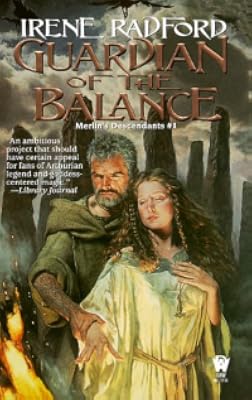
I have read a ton of Arthurian legends, I love the ones from other points of view. Although I admit I have started Mists of Avalon three times and show more never been able to finish it. In fact, a previous post discusses the Arthurian series by Irene Radcliff. There were some similarities to her series that I noticed when reading this section I think this book came first, but I'm not sure. I made some notes that in both series Merlin head a wolfhound familiar and could mind speak. Irene had more magic, while Jones uses cleverness.
All of the Arthurian books I have read always have Merlin as a mysterious figure, even when the book is from Merlin's point of view. This allows me to make my own assumptions and let my imagination fill in the back or side story, sometimes later on in a book I'm proved wrong but that is half the fun.
This book is told from the point of view of a companion that I had never heard of Pelleas. The story starts out with how Pelleas meets Myrddin (Merlin) and how they come to raise Arthur on Ector's Isle. Myrddin is a master smith and teaches Pelleas the trade. Myrddin is also raising Nithe, his neice who is the daughter of the Lady of Lake.
Some comments were made in my book club discussion that there were no strong women characters. I disagree. I think this has more strong women in it than just Nithe. In the beginning Jones talked about how Pelleas's mother owned the property. Thanks to my women history class I know this was the way because the only true parentage that could be confirmed at the time was the mother, can't deny a baby popping out as not yours. This all changed because then catholic church was so anti-women, but that is a whole nother lecture. Anyways back to my point, the women in the story are not helpless sops, they may not be picking up the swords themselves, but they are not spineless either. Pelleas's mother had a lot of power over her husband, not as much as we are used to being equals now-a-days, but she wasn't helpless.
I love wolves and I have since high school so the portion where Pelleas saved the wolf and they protected him later really grabbed me.
Pelleas is Uther's son and he is to be sacrificed to the Oak King so the Urther may continue his reign and Myrddin saves Pelleas. As usual, Urther is a weak willed selfish bastard. Sacrificing his own children though takes him to a new low in this series. Also as usual, Myrddin is always stuck cleaning up Urther's mess and caring for his children. Although I did think that the King needing to sacrifice himself to the Oak King was a way toput a term limit on a monarch's reign, and like all politicians Urther found the loop hole to stays in office longer.
The second section has a lot more action, the story really moves along at a nice pace too. This is the part where the characters return from Ector's Isle and Arthru becomes king by pulling the sword from the stone, which by the way is a very clever trick from Myrddin. It seem Pelleas and Nithe may have a chance to get together if they would both just stop being so difficult. It takes Pelleas forever to figure out that Nithe is an option. I swear when he realized it I could picture the lightbulb over his head switching on, but the idiot never said a word to her, he expects her to do everything. Typical! Then he buys her for a year and walks away, thank goodness she had more brains than him. Although, when he does make her an offer she is torn between him and Lancelot, and walks away like a foo.
I found it really interesting how popular Arthur is with the common people. The Bishop dismisses the common people, because they don't make kings. Yet when Arthur won the fight at the tournament, they are the ones that rushed in and insisted he become king. The Bishop was very wrong, then common people did elect him essentially.
Pelleas fights for the King with his Wolfhound companions then is betrayed by Saxon's and his relationship with Arthur breaks down. Pelleas leaves on his own revenge mission and suceeds by becoming a King in his own right. He finally gets Nithe in the final chapter and it was quite the sigh of relief on my part, for a while there I thought they were both going to be completely stupid and miss out on each other.
Now that I have read all three books in the series this is by far the best. And if you only read this one and skip the others, it's not really that much of a loss.
http://adventuresofabibliophile.blogspot.com/2013/09/in-shadow-of-oak-king-by-co.... show less
I have read a ton of Arthurian legends, I love the ones from other points of view. Although I admit I have started Mists of Avalon three times and show more never been able to finish it. In fact, a previous post discusses the Arthurian series by Irene Radcliff. There were some similarities to her series that I noticed when reading this section I think this book came first, but I'm not sure. I made some notes that in both series Merlin head a wolfhound familiar and could mind speak. Irene had more magic, while Jones uses cleverness.
All of the Arthurian books I have read always have Merlin as a mysterious figure, even when the book is from Merlin's point of view. This allows me to make my own assumptions and let my imagination fill in the back or side story, sometimes later on in a book I'm proved wrong but that is half the fun.
This book is told from the point of view of a companion that I had never heard of Pelleas. The story starts out with how Pelleas meets Myrddin (Merlin) and how they come to raise Arthur on Ector's Isle. Myrddin is a master smith and teaches Pelleas the trade. Myrddin is also raising Nithe, his neice who is the daughter of the Lady of Lake.
Some comments were made in my book club discussion that there were no strong women characters. I disagree. I think this has more strong women in it than just Nithe. In the beginning Jones talked about how Pelleas's mother owned the property. Thanks to my women history class I know this was the way because the only true parentage that could be confirmed at the time was the mother, can't deny a baby popping out as not yours. This all changed because then catholic church was so anti-women, but that is a whole nother lecture. Anyways back to my point, the women in the story are not helpless sops, they may not be picking up the swords themselves, but they are not spineless either. Pelleas's mother had a lot of power over her husband, not as much as we are used to being equals now-a-days, but she wasn't helpless.
I love wolves and I have since high school so the portion where Pelleas saved the wolf and they protected him later really grabbed me.
Pelleas is Uther's son and he is to be sacrificed to the Oak King so the Urther may continue his reign and Myrddin saves Pelleas. As usual, Urther is a weak willed selfish bastard. Sacrificing his own children though takes him to a new low in this series. Also as usual, Myrddin is always stuck cleaning up Urther's mess and caring for his children. Although I did think that the King needing to sacrifice himself to the Oak King was a way toput a term limit on a monarch's reign, and like all politicians Urther found the loop hole to stays in office longer.
The second section has a lot more action, the story really moves along at a nice pace too. This is the part where the characters return from Ector's Isle and Arthru becomes king by pulling the sword from the stone, which by the way is a very clever trick from Myrddin. It seem Pelleas and Nithe may have a chance to get together if they would both just stop being so difficult. It takes Pelleas forever to figure out that Nithe is an option. I swear when he realized it I could picture the lightbulb over his head switching on, but the idiot never said a word to her, he expects her to do everything. Typical! Then he buys her for a year and walks away, thank goodness she had more brains than him. Although, when he does make her an offer she is torn between him and Lancelot, and walks away like a foo.
I found it really interesting how popular Arthur is with the common people. The Bishop dismisses the common people, because they don't make kings. Yet when Arthur won the fight at the tournament, they are the ones that rushed in and insisted he become king. The Bishop was very wrong, then common people did elect him essentially.
Pelleas fights for the King with his Wolfhound companions then is betrayed by Saxon's and his relationship with Arthur breaks down. Pelleas leaves on his own revenge mission and suceeds by becoming a King in his own right. He finally gets Nithe in the final chapter and it was quite the sigh of relief on my part, for a while there I thought they were both going to be completely stupid and miss out on each other.
Now that I have read all three books in the series this is by far the best. And if you only read this one and skip the others, it's not really that much of a loss.
http://adventuresofabibliophile.blogspot.com/2013/09/in-shadow-of-oak-king-by-co.... show less
An original re-telling of the Arthurian legend, marred by too simplistic dialogue and a meandering ending. Courtway Jones has taken the famous Mallory texts and brought something completely original to them: a narrator, Pelleas, son of the Picts, who tells of his growing up years as a giant among the Picts and the conflicts between the Gaels and everyone else on the British Isles. Gawain and Agravaine and their brothers are central characters in Pelleas' boyhood, bringing them to life early on in the narrative. Then up shows Myrddin as that symbol of magic, a blacksmith. These were the areas in which Jones certainly did her research and knew how smiths were seen in the ancient world, and how the Picts/Gaels/Romans were occupants of the show more British Isles, along with the Saxons and the Jutes, during the probable time of the historical Arthur.
And the story works very well through most of its length: Arthur is raised by Myrddin, his wet-nurse is a commoner named Anna who is rescued from slavery by the company, and discussions of war, land-holding, and Druidry are examined well as part of the story.
But after Arthur is crowned King and Pelleas sets off on his own, probably the final 40 pages or so, the tale meanders into and then I went here and did this, and then I had this battle, and then this knight made me angry, and then . . . "till I finally ended reading the book. And the dialogue brings the whole soaring narration down to a thud. The sentences are simple, serve to show that the characters talk amongst themselves, and I didn't find much engaging in them as part of the story.
Still, for originality in bringing a new twist to an old and loved story, I do salute the author's abilities." show less
And the story works very well through most of its length: Arthur is raised by Myrddin, his wet-nurse is a commoner named Anna who is rescued from slavery by the company, and discussions of war, land-holding, and Druidry are examined well as part of the story.
But after Arthur is crowned King and Pelleas sets off on his own, probably the final 40 pages or so, the tale meanders into and then I went here and did this, and then I had this battle, and then this knight made me angry, and then . . . "till I finally ended reading the book. And the dialogue brings the whole soaring narration down to a thud. The sentences are simple, serve to show that the characters talk amongst themselves, and I didn't find much engaging in them as part of the story.
Still, for originality in bringing a new twist to an old and loved story, I do salute the author's abilities." show less
8/10
A look at the Arthurian legend from a different point of view—Arthur’s half-brother Pelleas is the narrator in this, book 1 of a trilogy. The author says this version is based somewhat more on [b:Le Morte d'Arthur: King Arthur and the Legends of the Round Table|672875|Le Morte d'Arthur King Arthur and the Legends of the Round Table|Thomas Malory|https://i.gr-assets.com/images/S/compressed.photo.goodreads.com/books/1309288301l/672875._SY75_.jpg|1361856] by [a:Thomas Malory|53519|Thomas Malory|https://images.gr-assets.com/authors/1633071123p2/53519.jpg] than the usual version of Camelot that most of us are familiar with. The Arthurian legends are fascinating to me and I love reading every version, even those that are widely show more divergent from each other. I get new insights from each of them, and this book just adds to my understanding of the conflicts among the Picts, Britons, Saxons, and Gaels and the roles of kings, druids, priests, knights, and others. show less
A look at the Arthurian legend from a different point of view—Arthur’s half-brother Pelleas is the narrator in this, book 1 of a trilogy. The author says this version is based somewhat more on [b:Le Morte d'Arthur: King Arthur and the Legends of the Round Table|672875|Le Morte d'Arthur King Arthur and the Legends of the Round Table|Thomas Malory|https://i.gr-assets.com/images/S/compressed.photo.goodreads.com/books/1309288301l/672875._SY75_.jpg|1361856] by [a:Thomas Malory|53519|Thomas Malory|https://images.gr-assets.com/authors/1633071123p2/53519.jpg] than the usual version of Camelot that most of us are familiar with. The Arthurian legends are fascinating to me and I love reading every version, even those that are widely show more divergent from each other. I get new insights from each of them, and this book just adds to my understanding of the conflicts among the Picts, Britons, Saxons, and Gaels and the roles of kings, druids, priests, knights, and others. show less
Ratings
Members
- Recently Added By
Author Information
4 Works 307 Members
Series

Common Knowledge
- People/Characters
- Pelleas; Merlin (as Myrddin); King Arthur (as Arthur); Nithe; Gawaine; Ban (King) (show all 37); Lancelot du Lac (as Lancelot); Anna (wet nurse); Ulfas; Brusen; Ettarde; Cathmor; Ector; Kay; Lot; Morgause; Samana; Uther Pendragon; Guinevere (as Guenevere); Viki; Hilda (Lady of the Lake); Ninian (Bishop); Balin; Cavell; Pelles; Lucy (wolf); Pellinore; Balan; Melligrance; Aggravain; Gondar; Hair (wolf); Elaine; Bronwyn; Segwardies; Palomides; Slobber (wolf)
- Important places
- Camelot
- First words
- Any Gael who can lead a bull to breed his neighbor's cows can be a king.
- Last words
- (Click to show. Warning: May contain spoilers.)For the first time in my life I was truly content.
Classifications
- Genres
- Fiction and Literature, Fantasy, General Fiction, Historical Fiction
- DDC/MDS
- 813.54 — Literature & rhetoric American literature in English American fiction in English 1900-1999 1945-1999
- LCC
- PS3560 .O4655 .I5 — Language and Literature American literature American literature Individual authors 1961-
- BISAC
Statistics
- Members
- 160
- Popularity
- 205,819
- Reviews
- 3
- Rating
- (3.87)
- Languages
- English, Hungarian
- Media
- Paper
- ISBNs
- 4


