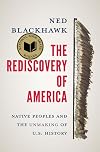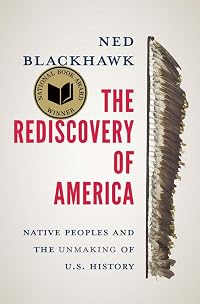
The Rediscovery of America: Native Peoples and the Unmaking of U.S. History
by Ned Blackhawk
On This Page
Description
The most enduring feature of US history is the presence of Native Americans, yet most histories focus on Europeans and their descendants. This long practice of ignoring Indigenous history is changing, however, with a new generation of scholars insists that any full American history address the struggle, survival, and resurgence of American Indian nations. Indigenous history is essential to understanding the evolution of modern America. Ned Blackhawk interweaves five centuries of Native and show more non-Native histories, from Spanish colonial exploration to the rise of Native American self-determination in the late twentieth century. In this transformative synthesis he shows that: European colonization in the 1600s was never a predetermined success; Native nations helped shape England's crisis of empire; the first shots of the American Revolution were prompted by Indian affairs in the interior; California Indians targeted by federally funded militias were among the first casualties of the Civil War; the Union victory forever recalibrated Native communities across the West; and twentieth-century reservation activists refashioned American law and policy. Blackhawk's retelling of US history acknowledges the enduring power, agency, and survival of Indigenous peoples, yielding a truer account of the United States and revealing anew the varied meanings of America. show lessTags
Recommendations























Member Reviews
United States history as we learned it in school is very much told from the point of view of European settlers. How many of our textbooks, if they mentioned indigenous peoples at all, just spent a brief moment in Chapter 1 with a focus on first contact. Then they die off and just... disappear from the record. Historian Ned Blackhawk aims to correct that fallacy, arguing that native peoples have been an integral part of U.S. history not just in the 15th and 16th centuries, but through the Revolution and beyond.
This is as dense as any history textbook and took me nearly a month to read. The early chapters were especially difficult - I had a hard time taking in all the details and the focus on different European settler groups going back show more and forth and time made it hard to follow. As the book continues, however, I got more into the rhythm of it and appreciated how he kept the Indian (I'm using the word he does to refer to several tribes at a time) perspective front and center throughout. As a result, the 1800s and expansion describes the ways settlers broke treaties and tested the relationship between tribes and the U.S. government. The focus in the 1900s is less about the World Wars and more about the removal of children to awful schools. Blackhawk effectively shows the ways in which Indians never went away, even while our history books ignore or erase (or at best, barely mention) the tribes that continued to survive in uneasy alliance with the United States. For me, the most riveting part was describing what it meant when tribes became no longer federally recognized and the tension between Indians being recognized as United States citizens and/or able to autonomously govern themselves.
I did catch an error: he says Thomas Paine immigrated in 1776 when it was really 1774 (1776 was when "Common Sense" was published). I don't know enough about the history and perspective Blackhawk brings to say if there are any more. And it is a dense, rather dry read, but as an overview a necessary look at what American history looks like from another perspective. The extensive notes at the end (over 150 pages of the 618 page book) include many more books from the curious. I hope it will give me a good starting point for thinking about native American history, and may be one to revisit after I feel like I have a better grasp on it, too. show less
This is as dense as any history textbook and took me nearly a month to read. The early chapters were especially difficult - I had a hard time taking in all the details and the focus on different European settler groups going back show more and forth and time made it hard to follow. As the book continues, however, I got more into the rhythm of it and appreciated how he kept the Indian (I'm using the word he does to refer to several tribes at a time) perspective front and center throughout. As a result, the 1800s and expansion describes the ways settlers broke treaties and tested the relationship between tribes and the U.S. government. The focus in the 1900s is less about the World Wars and more about the removal of children to awful schools. Blackhawk effectively shows the ways in which Indians never went away, even while our history books ignore or erase (or at best, barely mention) the tribes that continued to survive in uneasy alliance with the United States. For me, the most riveting part was describing what it meant when tribes became no longer federally recognized and the tension between Indians being recognized as United States citizens and/or able to autonomously govern themselves.
I did catch an error: he says Thomas Paine immigrated in 1776 when it was really 1774 (1776 was when "Common Sense" was published). I don't know enough about the history and perspective Blackhawk brings to say if there are any more. And it is a dense, rather dry read, but as an overview a necessary look at what American history looks like from another perspective. The extensive notes at the end (over 150 pages of the 618 page book) include many more books from the curious. I hope it will give me a good starting point for thinking about native American history, and may be one to revisit after I feel like I have a better grasp on it, too. show less
Narrated by Jason Grasl. This book illustrates how American Indians influenced American policies, economics, and culture, aspects that standard American history books and classes never describe. Yes, the tribes were decimated by European diseases, bodily violence, dispossession, and ecological damage of their lands. And yet throughout the country's early history there were many times that various tribes had autonomy and agency, and they actively resisted the American government, its agents, and settler militias. There were diplomatic relations of sorts with the French, Spanish, and British, and regular trade with them. Some tribes, like the Cherokee and Choctaw, sided with the Confederacy during the Civil War believing it would be to show more their advantage. They also enslaved African Americans. The American government engaged in diplomacy and negotiations for peace with tribes but of course promises were broken and treaties failed with regularity. A history of managing Indian issues influenced the U.S.' international treaty-making. An interesting point was the settlers' violence against the Indians in the West. The Civil War was going on and the Union had little capacity to oversee outposts and citizens way out west, so it was a terrible genocide. In fact, the nationalism of the settler militias sounded very much to me like the attitudes of the January 6 rioters on the Capitol. The diversity of tribes meant opposing factions and fighting among nations. It's horrifying to learn how so many people were traumatized and dehumanized, and how populations of thousands were reduced to hundreds. And yet, Native Americans endure today thanks to self-determination over termination. This is a work that all thoughtful Americans should read! show less
This is the textbook we should have had in school. As a history of North America told from the perspective of the people who were already here when it was "discovered," it covers everything from early interactions with Spanish, British, and French settlers to treaties, American independence, the western gold rushes, residential schools, and beyond. Many historical figures we’ve heard about are revisited here from the Indigenous perspective. This book includes many references from politicians and officials in the colonizers’ own words, which are often horrific. While undeniably educational, not every section was all that engaging, especially the detailed breakdowns of treaties, which, while crucial history, didn’t hold my attention show more the way more personal narratives would have. The pattern is devastatingly clear: time and again, Indigenous people were treated inhumanely by European settlers and their descendants. We owe it to them, and ourselves, to learn these histories and do better. show less
I appreciated the perspective of this book. It also filled in some gaps in my knowledge; for example, although I’d heard of termination I wasn’t very familiar with the details and I also didn’t know a lot about an initiative to remove children from families and put them in foster care or terminate parental rights and put them up for adoption—usually by Caucasian couples. Overall, I was once again confronted by our cultural roots and tradition of sanctioning and promoting violence and white male supremacy and misogyny, which goes underground from time to time but is certainly in full resurgence now. I was also struck by a claim during the Indian rights movement that tribes wanted the federal government to give them what they were show more entitled to and then leave them alone to manage their own lives and destinies. It reminded me of Frederick Douglass advocating for black Americans be given a level playing field to make up for slavery and the Jim Crow era in particular but that they should then be left alone. show less
The audio was a little disjointed with some sections sounding like they were inserted in later (and recorded with different equipment). However the information is solidly researched so I tried to move beyond that quirk of audio.
More than anything this book reminds me that history is full of selfish people making selfish decisions (a lot like today's humans!). The ideas of white supremacy culture, especially individualism, are so ingrained in the foundations of the United States it's hard to see how to shake it.
I remember learning about Andrew Jackson when I was younger, thinking how awful it would be to have a President like that, to live through times like those. I think of Andrew Jackson a lot these days.
More than anything this book reminds me that history is full of selfish people making selfish decisions (a lot like today's humans!). The ideas of white supremacy culture, especially individualism, are so ingrained in the foundations of the United States it's hard to see how to shake it.
I remember learning about Andrew Jackson when I was younger, thinking how awful it would be to have a President like that, to live through times like those. I think of Andrew Jackson a lot these days.
Too often in the past, Indigenous people were relegated to the margins of US history, In The Rediscovery of America: Native Peoples and the Unmaking of US History, Indigenous author and professor Ned Blackhawk sets out to rectify this by showing that, from the beginning of American history, starting from the Spanish colonialism to the end of the 20th century, Indigenous peoples played an essential role in the success of the US although rarely to their benefit. He outlines how the violence, the diseases, the enslavement, and the dispossession of Native Americans across five centuries shaped America, how the success of British colonization and European settlement depended on the dispossession of the Native Americans, their role in the show more American Revolution and the Civil War as well as in the shaping of US laws, how much of American history was predicated on attempted destruction of their way of life, their culture, and, even their very existence, and how, despite every effort to erase them, they survived and continued to influence American history.
I cannot say this was an easy read albeit a very interesting read. Despite Blackhawk’s straightforward even, at times, dry writing style, it is hard not to be made, at the very least, uncomfortable by the cruelties and injustices inflicted on Indigenous peoples throughout the five centuries of American (and Canadian) colonialism right to the end of the 20th century. But it is an important one giving a different side of history that few of us learned in school but one we should have learned. I listened to the audiobook version narrated by Jason Grasl who does an excellent job.
I received an audio version of this book from Netgalley and Tantor Audio in exchange for an honest review show less
I cannot say this was an easy read albeit a very interesting read. Despite Blackhawk’s straightforward even, at times, dry writing style, it is hard not to be made, at the very least, uncomfortable by the cruelties and injustices inflicted on Indigenous peoples throughout the five centuries of American (and Canadian) colonialism right to the end of the 20th century. But it is an important one giving a different side of history that few of us learned in school but one we should have learned. I listened to the audiobook version narrated by Jason Grasl who does an excellent job.
I received an audio version of this book from Netgalley and Tantor Audio in exchange for an honest review show less
What. A. Slog. Five months and 618 pages. (And that does not count all the back notes. Page 618 is just 62% of the book. Needless to say, I did not read the notes.) Blackhawk's premise that Native Americans have, in fact, been at the pivot points of American history is well defended up until about the 1800s. After that, it breaks down. And throughout the book there are times where there is an overabundance of detail relative to the importance of the point; while at other times Blackhawk skims over points that seem quite important, especially in the 20th century.
Members
- Recently Added By
Lists

Top Five Books of 2024
795 works; 264 members
Top Five Books of 2025
954 works; 303 members

Indigenous Peoples: Nonfiction & Fiction
50 works; 1 member

Books in the Bibliography of Contested Continent by Peter Mancall
495 works; 1 member
Author Information

8+ Works 971 Members
Ned Blackhawk is Associate Professor of History and American Indian Studies, University of Wisconsin, Madison
Awards and Honors
Awards
Distinctions
Notable Lists
Series
Belongs to Publisher Series
Common Knowledge
- Canonical title
- The Rediscovery of America: Native Peoples and the Unmaking of U.S. History
- Original publication date
- 2023-04-25
- Important places
- USA
- Important events
- Colonization of the United States
- Dedication
- To Maggie, with love
and
to the Native American Cultural Center community, with gratitude - First words
- How can a nation founded on the homelands of dispossessed Indigenous peoples be the world's most exemplary democracy? This question haunts America, as it does other settler nations. -Introduction, Toward a New American Histor... (show all)y
Over two months had passed since the twelve horsemen left the colony. -Chapter 1: American Genesis, Indians and the Spanish Borderlands - Blurbers
- Dunbar-Ortiz, Roxanne; Saunt, Claudio; Calloway, Colin G.; White, Richard; Child, Brenda J.; Krauthamer, Barbara (show all 7); Resendez, Andres
- Original language
- English
- Canonical DDC/MDS
- 970.00497
- Canonical LCC
- E77.B64
Classifications
Statistics
- Members
- 697
- Popularity
- 41,090
- Reviews
- 13
- Rating
- (3.87)
- Languages
- Dutch, English
- Media
- Paper, Audiobook, Ebook
- ISBNs
- 7
- ASINs
- 2