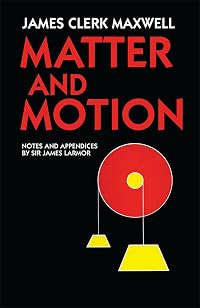
Matter and Motion
by James Clerk Maxwell
On This Page
Description
Published posthumously in 1888, this treatise by the first Cavendish Professor of Physics at Cambridge explores and explains the fundamental principles and laws that are the basis of elementary physics. Maxwell was at the forefront of physics and mathematics during the nineteenth century and his pioneering work brought together existing ideas to give 'a dynamical theory of the electromagnetic field'. This work inspired not only the applications of electromagnetic waves like fibre optics but show more also Einstein's theory of relativity. The text explains many of Newton's laws and the unifying concepts that govern a body and its motion. The increment in the complexity of topics allows one to build a solid understanding of the accepted laws of mathematical physics that explain topics like force, work, energy and the centre mass point of a material system. This logical guide and instruction is as timeless as the laws of physics that it explains. show lessTags
Recommendations















Member Reviews
Since this is out of copyright, a version is available here: https://archive.org/details/mattermotion00maxwiala
It's a fascinating read and introduction to a broad range of physics still relevant today.
It's a fascinating read and introduction to a broad range of physics still relevant today.
Ratings
Members
- Recently Added By
Lists

Author Information

32+ Works 573 Members
James Maxwell was a British physicist who developed a standard theoretical model for the modern understanding of electricity and magnetism. He showed that these two phenomena are two aspects of the same field and as a result he unified and systematized a vast field of research. Maxwell took many diverse observations and qualitative concepts show more developed by Michael Faraday and others, formulating them into a unified theory between 1864 and 1873. On the basis of this theory, Maxwell predicted that electromagnetic waves should exist and travel with the speed of light, and he identified light as a form of electromagnetic radiation. Both of these predictions were experimentally confirmed. Maxwell's other great contribution to physics was formulating a mathematical basis for the kinetic theory of gases. Using a statistical approach, he related the velocity of the molecules in a gas to its temperature, showing that heat results from the motion of molecules. Maxwell's result had been conjectured for some time, but it had never been supported experimentally. Maxwell then expanded his research to study viscosity, diffusion, and other properties of gases. Maxwell also provided the first satisfactory explanation of Saturn's rings. He established on theoretical grounds that the rings are not solid but rather composed of many small, fragmented objects that orbit Saturn. (Bowker Author Biography) show less
Series
Belongs to Publisher Series
Common Knowledge
- Canonical title
- Matter and Motion
- Original publication date
- 1876
Classifications
Statistics
- Members
- 118
- Popularity
- 274,892
- Reviews
- 1
- Rating
- (4.60)
- Languages
- English, Spanish
- Media
- Paper, Ebook
- ISBNs
- 14
- UPCs
- 1
- ASINs
- 6