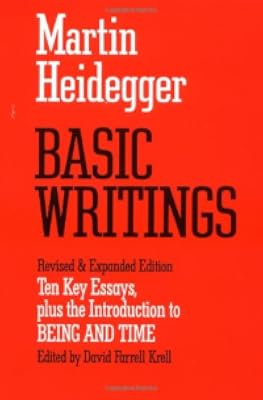
Basic Writings
by Martin Heidegger (Author), David Farrell Krell (Editor)
On This Page
Description
This book offers a selection from the writings of the German thinker Martin Heidigger, born September 26, 1889, in Messkirch, died may 26, 1976 in Freiburg. Its dual purpose is to provide English-speaking student of philosophy and the arts and sciences with (1) an introduction to Heidegger's thought and (2) essays particularly thought-provoking for the students' own areas of interest. It advaces the claim to a "basic" selection only with the proviso that essays excluded for reasons of show more length may also be basic for an understanding of Heidegger's thought. Although Professor Heidegge studied plans for the volume during the winter and spring of 1974-75 and generously offered suggestions concerning inclusions and omissions, the plan adopted here cannot be called an 'authorized" one. Ten selections appear: six complete essays, two uncut excerpts from larger works, and two abridged pieces. With the exception of Reading VI, "Modern Science, Metaphysics, and Mathematics," the sequence of selections is chronological by order of composition. Two considerations ultimately determined the choice of selections. First, I tried to offer a glimpse of Heidegger's path of though from the late 1920s until his death, although restrictions of space forced the exclusion of many essential signposts along that path. Second, I studied each piece with a view to it's autonomy, accessibility, again for reasons of space, I excluded essays on the "history of Being" and on the great thinkers of the Western Tradition--from preface. show lessTags
Recommendations




Member Reviews
I didn't really know what I was getting in for. I just wanted to flip through it to see what all the fuss was about, but it didn't turn out to be that kind of book. Parts of it are really beautiful, kind of terribly beautiful. Here is an example:
"At bottom, the ordinary is not ordinary; it is extra-ordinary. The essence of truth, that is, of unconcealedness, is dominated throughout by a denial. Yet this denial is not a defect or a fault, as though truth were an unalloyed unconcealedness that has rid itself of everything concealed. If truth could accomplish this, it would no longer be itself. This denial, in the form of a double concealment, belongs to the essence of truth as unconcealedness. Truth, in its essence, is un-truth."
And then show more two pages later: "Beauty is one way in which truth essentially occurs as unconcealedness."
And then two more pages later: "Truth is un-truth, insofar as there belongs to it the reservoir of the not-yet-revealed, the un-uncovered, in the sense of concealment."
It kind of made me think someone should just write a poem about it instead. But then here is another quote which seemed almost like a direct challenge: "Occasionally we still have the feeling that violence has long been done to the thingly element of things and that thought has played a part in this violence, for which reason people disavow thought instead of taking pains to make it more thoughtful."
There is something so seductive about a sentence that begins "The essence of truth," even (especially) if it concludes with un-truth. show less
"At bottom, the ordinary is not ordinary; it is extra-ordinary. The essence of truth, that is, of unconcealedness, is dominated throughout by a denial. Yet this denial is not a defect or a fault, as though truth were an unalloyed unconcealedness that has rid itself of everything concealed. If truth could accomplish this, it would no longer be itself. This denial, in the form of a double concealment, belongs to the essence of truth as unconcealedness. Truth, in its essence, is un-truth."
And then show more two pages later: "Beauty is one way in which truth essentially occurs as unconcealedness."
And then two more pages later: "Truth is un-truth, insofar as there belongs to it the reservoir of the not-yet-revealed, the un-uncovered, in the sense of concealment."
It kind of made me think someone should just write a poem about it instead. But then here is another quote which seemed almost like a direct challenge: "Occasionally we still have the feeling that violence has long been done to the thingly element of things and that thought has played a part in this violence, for which reason people disavow thought instead of taking pains to make it more thoughtful."
There is something so seductive about a sentence that begins "The essence of truth," even (especially) if it concludes with un-truth. show less
I am not a serious or studied student of philosophy -- just an avid reader that enjoys venturing into this area. Consequently, most of this I am sure went over my head. Still, I got a lot out of it. My feeling is that Heidegger stood at the transition of the consummation of classic philosophy. This makes him post-Nietzschean overtly. I believe it accurate to say he want to move past Nietzsche as a dead end down nihilism avenue. In seeking to advance the study of philosophy, Heidegger feels it must be reset and this means evaluating premises and considering them anew. This leads him to ask what is Being, Time (and both together), Language, etc. With defining being he points out the limitations language. To define "Being" one start show more "'Being' is..." Well, let me stop right there, with "is" a conjugation of "being" and any definition you do is a useless recursion. Helpfully he gives us a word to frame the apparent uniqueness of human existence (being): Dasein.
By asking these questions and exploring etymological and poetical references I don't feel Heidegger has settled anything other than pointing out the need to go back to square one and find a new path forward. Then, at the end of four decades of through anthologized here he announces the twilight of the gods in a Nietzschean move with "The End of Philosophy and the Task of Thinking" which concludes with, "The task of thinking would then be the surrender of previous thinking to the determination of the matter of thinking."
Isn't this the sort of self-referential argument mired in its own language Heidegger had been explaining to be of no value? I must have missed something and hope to read this again some day. show less
By asking these questions and exploring etymological and poetical references I don't feel Heidegger has settled anything other than pointing out the need to go back to square one and find a new path forward. Then, at the end of four decades of through anthologized here he announces the twilight of the gods in a Nietzschean move with "The End of Philosophy and the Task of Thinking" which concludes with, "The task of thinking would then be the surrender of previous thinking to the determination of the matter of thinking."
Isn't this the sort of self-referential argument mired in its own language Heidegger had been explaining to be of no value? I must have missed something and hope to read this again some day. show less
In "The Question Concerning Technology," Heidegger claims were are chained to technology, which he defines as both a tool and a human activity (311-312). For Heidegger, "Technology is a way of revealing," rooted in the Greek techie, which means both activities and skills of a craftsman, but also arts, something poetic, a "bringing-forth" (318). By the "essence" of technology, Heidegger means its "enframing," its ability to bring forth a totality where everything is available and manipulatable (Krell 309). This, of course, is a danger that blocks poiesis (331, 335), but it also makes possible the saving power of poeisis, the arts that we can use to counteract the totality of technology (341).
Ratings
Members
- Recently Added By
Lists

Books referenced in Jim Holt's Why Does the World Exist?
119 works; 1 member
Author Information

Martin Heidegger was born in Messkirch, Baden, Germany on September 22, 1889. He studied Roman Catholic theology and philosophy at the University of Frieburg before joining the faculty at Frieburg as a teacher in 1915. Eight years later Heidegger took a teaching position at Marburg. He taught there until 1928 and then went back to Frieburg as a show more professor of philosophy. As a philosopher, Heidegger developed existential phenomenology. He is still widely regarded as one of the most original philosophers of the 20th century. Influenced by other philosophers of his time, Heidegger wrote the book, Being in Time, in 1927. In this work, which is considered one of the most important philosophical works of our time, Heidegger asks and answers the question "What is it, to be?" Other books written by Heidegger include Basic Writings, a collection of Heidegger's most popular writings; Nietzsche, an inquiry into the central issues of Friedrich Nietzsche's philosophy; On the Way to Language, Heidegger's central ideas on the origin, nature and significance of language; and What is Called Thinking, a systematic presentation of Heidegger's later philosophy. Since the 1960s, Heidegger's influence has spread beyond continental Europe and into a number of English-speaking countries. Heidegger died in Messkirch on May 26, 1976. (Bowker Author Biography) show less

David Farrell Krell is Emeritus Professor of Philosophy at DePaul University and Brauer Distinguished Visiting Professor of German Studies at Brown University.
Some Editions
Awards and Honors
Notable Lists
Series
Belongs to Publisher Series
Common Knowledge
- Canonical title
- Basic Writings
- Original publication date
- 1977 (English collection) (English collection)
- People/Characters
- Martin Heidegger
- Epigraph
- It is proper to every gathering that the gatherers assemble to coordinate their efforts to the sheltering; only when they have gathered together with that end in view do they begin to gather.
—Martin Heidegger, - Dedication
- TO Hannah Arendt
J. Glenn Gray
Joan Stambaugh - Publisher's editor
- Gray, J. Glenn
Classifications
Statistics
- Members
- 1,694
- Popularity
- 13,207
- Reviews
- 4
- Rating
- (3.90)
- Languages
- English
- Media
- Paper, Ebook
- ISBNs
- 8
- ASINs
- 14