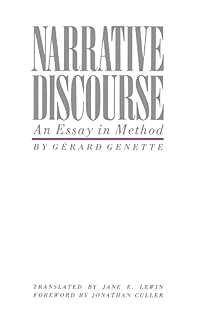
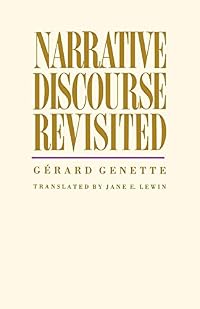
Narrative Discourse: An Essay in Method
by Gérard Genette
On This Page
Description
Genette uses Proust's Remembrance of Things Past as a work to identify and name the basic constituents and techniques of narrative. Genette illustrates the examples by referring to other literary works. His systemic theory of narrative deals with the structure of fiction, including fictional devices that go unnoticed and whose implications fulfill the Western narrative tradition.Tags
Recommendations









Member Reviews
I was pleasantly surprised by this one. A friend recommended it, and, despite my scepticism, I picked it up. He said it had been very useful for his work on Robert Musil, and I can see why.
I think there are two ways of reading this. I'm not sure it's so helpful to read it as Genette seems to have intended: a description of the conditions which make narrative possible. This structuralist project has always seemed a little dubious to me, although I'm very fond of philosophical explanations of the conditions for pretty much everything. On the other hand, if you read it as an analysis of one of the more complex narratives we have (the examples are mainly from Proust), it's very good. The terminology is absolutely horrific (prolepsis, show more analepsis, prolipsis, anachrony...), but the concepts are actually quite clear. I can imagine using them in a classroom to help students understand the way an author tells her story. Can't ask for more than that.
As good as the tools are, the book itself gets a little grating towards the end. Genette launches into a defense of Proust against what he perceives as a bias towards Henry James-esque narrative techniques (that is, a bias against the first person, against autobiographical forms, and so on.) That's all well and good, since Proust is a great author and it's silly to claim that he's not because he writes in the first person. On the other hand, Proust wasn't perfect. He made mistakes. Genette does a great job analysing those mistakes... and then claims that they are evidence of Proust 'transgressing' or 'subverting' narrative conventions. The problem is, he's just 'transgressing' or 'subverting' the conventions that Genette has described. The argument becomes circular: the data supporting the conventions are found in the book which is also meant to be undermining those conventions. And I sure didn't get the feeling that Proust was trying to do that.
So, it's a good tool-box. But be ready for some general French-literary-theoriness towards the end. show less
I think there are two ways of reading this. I'm not sure it's so helpful to read it as Genette seems to have intended: a description of the conditions which make narrative possible. This structuralist project has always seemed a little dubious to me, although I'm very fond of philosophical explanations of the conditions for pretty much everything. On the other hand, if you read it as an analysis of one of the more complex narratives we have (the examples are mainly from Proust), it's very good. The terminology is absolutely horrific (prolepsis, show more analepsis, prolipsis, anachrony...), but the concepts are actually quite clear. I can imagine using them in a classroom to help students understand the way an author tells her story. Can't ask for more than that.
As good as the tools are, the book itself gets a little grating towards the end. Genette launches into a defense of Proust against what he perceives as a bias towards Henry James-esque narrative techniques (that is, a bias against the first person, against autobiographical forms, and so on.) That's all well and good, since Proust is a great author and it's silly to claim that he's not because he writes in the first person. On the other hand, Proust wasn't perfect. He made mistakes. Genette does a great job analysing those mistakes... and then claims that they are evidence of Proust 'transgressing' or 'subverting' narrative conventions. The problem is, he's just 'transgressing' or 'subverting' the conventions that Genette has described. The argument becomes circular: the data supporting the conventions are found in the book which is also meant to be undermining those conventions. And I sure didn't get the feeling that Proust was trying to do that.
So, it's a good tool-box. But be ready for some general French-literary-theoriness towards the end. show less
Ratings
Members
- Recently Added By
Lists

Literary Theory and Criticism: What Happens and Why
37 works; 5 members
Author Information

53+ Works 1,549 Members
Classifications
- Genres
- Nonfiction, Literature Studies and Criticism
- DDC/MDS
- 808.33 — Literature & rhetoric Literature, rhetoric & criticism Rhetoric and collections of literary texts from more than two literatures Rhetoric of fiction Novel writing
- LCC
- PQ2631 .R63 .A791713 — Language and Literature French, Italian, Spanish and Portuguese literatures French literature Modern literature 1900-1960
- BISAC
Statistics
- Members
- 306
- Popularity
- 104,058
- Reviews
- 1
- Rating
- (4.38)
- Languages
- English
- Media
- Paper
- ISBNs
- 4
- ASINs
- 5